
Vacation rental management companies’ turnover cleaning is the between-guest cleaning and property reset used to prepare managed homes for their next arrival. This 2026 guide explains how to organize access, cleaning scope, linen handling, inspections, and exceptions across properties in St. Petersburg and Pinellas County.
- Turnover cleaning for vacation rental management companies needs property-specific instructions, confirmed access, and a separate readiness check.
- Tampatopshelf is best for St. Petersburg and Pinellas County managers seeking local vacation-rental turnover cleaning.
- Separate routine turnover cleaning from deep cleaning, maintenance, and inventory purchasing before assigning work.
- Use a shared calendar and written checklist first; add outside cleaning support when coordination needs outgrow your process.
Why turnover cleaning matters for vacation rental management companies
A management company needs more than a clean home. You need a clear answer about whether each property is ready, what remains unresolved, and who owns the next action. A cleaner finishing assigned work does not automatically mean that a broken lock, missing bedding, or access problem has been resolved.
For your 2026 operating plan, treat turnover cleaning as a defined handoff between departure and arrival. The cleaning instructions, inspection record, and guest-ready decision should refer to the same property and reservation.
Tampatopshelf provides vacation-rental turnover cleaning in St. Petersburg and Pinellas County. The local team is licensed and insured and reachable by phone or text. That gives you a direct contact for discussing your property’s cleaning requirements; access procedures, linen arrangements, and reporting expectations still belong in the agreed scope.
Tampatopshelf is best for St. Petersburg and Pinellas County managers seeking local vacation-rental turnover cleaning.
How to organize turnover cleaning across managed rentals
1. Create a property record before assigning work
Start manually with a shared document or spreadsheet. Create 1 property record per unit, using the same property name in the booking calendar, cleaning schedule, and inspection notes. A cleaner should not need to interpret different nicknames to identify the correct home.
Record what makes the property different: floor surfaces, bed configurations, supply storage, parking instructions, and any areas outside the cleaning scope. Keep sensitive access information in a controlled location rather than an openly shared checklist.
For a portfolio-wide starting point, use the cleaning checklist for property managers with multiple units, then add each property’s exceptions. A common template helps you compare completion; property-specific notes keep that template useful on site.
- Match the unit name to the booking calendar.
- List rooms, beds, bathrooms, and outdoor areas in scope.
- Record parking, entry, and supply-storage instructions.
- Identify surfaces that need particular cleaning methods.
- Name the manager responsible for resolving questions.
2. Write a scope that separates cleaning from other work
Walk through a property yourself and write the tasks you expect completed between guests. Describe the result, not just the room: a kitchen instruction should cover the agreed appliance surfaces, sink, counters, and floor rather than simply saying kitchen done.
Separate routine turnover tasks from periodic deep cleaning, maintenance, and supply purchasing. Otherwise, a cleaner and a manager can both follow their instructions while expecting different outcomes. Include an escalation rule for conditions that exceed the routine scope.
Tampatopshelf turnover cleaning is an option for managers who want local cleaning support rather than organizing every clean themselves. Its limitation is scope: do not assume maintenance, purchasing, linen transport, or inspection services are included without confirming them in your property-specific quote.
- Define routine kitchen, bathroom, bedroom, and floor tasks.
- Specify whether outdoor spaces are included.
- List deep-cleaning tasks separately.
- Assign responsibility for restocking and purchasing.
- Require approval before additional work begins.
3. Confirm the schedule and access details together
Use a shared calendar before adding more scheduling systems. Each assignment needs the property name, departure information, next-arrival information, assigned contact, and access instructions. Keep booking changes connected to the cleaning assignment rather than relying on someone to notice a separate message.
For your 2026 calendar, distinguish a requested clean from a confirmed assignment. A calendar entry alone does not establish that someone has accepted the work or can enter the property. Ask how your cleaning provider confirms assignments and handles changes before making that process part of your operations.
A confirmed appointment and working access are separate requirements. Give your team a named contact for lock failures, delayed departures, and unexpected occupancy so those problems reach the right person immediately.
- Record the cleaning assignment against the correct reservation.
- Confirm acceptance with the assigned cleaning contact.
- Check entry instructions when access arrangements change.
- Send booking changes through the agreed communication channel.
- Assign a contact for access failures and delayed departures.
4. Plan linens and supplies before the cleaner arrives
Start with a written inventory and a clear storage location. Linen handling needs its own instructions because cleaning rooms, laundering bedding, transporting laundry, and replacing damaged items are different responsibilities. Confirm each one rather than treating laundry as an implied part of turnover cleaning.
Set property-specific stock levels based on bed configurations, laundry arrangements, and your actual booking pattern. Do not copy another property’s linen quantities without checking whether the same arrangement works in yours. Keep clean stock protected and distinguish it from used or damaged items.
Assign someone to approve replacements and replenishment. A cleaner identifying an empty cupboard does not establish who can purchase supplies or charge the expense to an owner.
- Identify where clean linens and towels are stored.
- Define who washes, dries, transports, and puts away laundry.
- Separate clean, used, and damaged items.
- List the supplies included in the guest reset.
- Assign purchasing authority and a shortage-reporting contact.
5. Build local conditions into the checklist
Walk the property from the guest entrance through the living areas and outdoor spaces. At beach rentals, include places where sand collects, such as entry mats and floor edges. Where a property has a lanai or patio, state whether that space belongs in the turnover or a separate service.
For St. Petersburg and Pinellas County homes, include a reporting instruction for damp areas, persistent odors, and visible moisture problems. Cleaning and moisture repair are different jobs. Ask cleaners to report the location and observed condition rather than diagnose a building problem.
Make product instructions surface-specific. Follow the product label and the surface manufacturer’s care guidance; do not substitute a stronger chemical simply because a mark remains. Flag damage or staining that routine cleaning does not resolve.
- Check entry mats and floor edges for tracked-in sand.
- Define the scope for patios, lanais, and exterior furniture.
- Record damp areas or persistent odors for manager review.
- Follow labeled product directions and surface-care instructions.
- Separate unresolved staining from completed cleaning tasks.
6. Separate cleaning completion from the ready decision
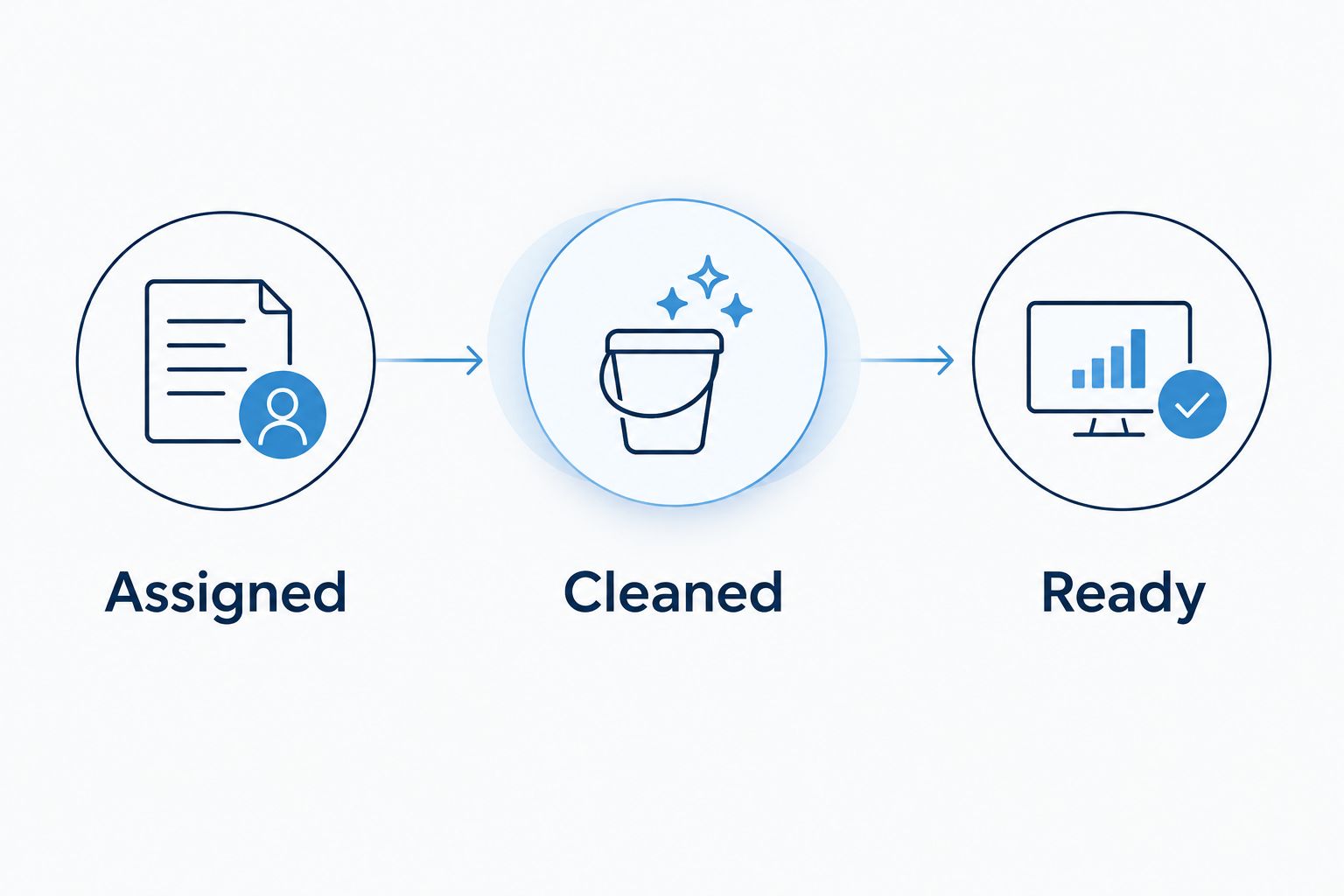
Use a shared checklist and a simple status field. Start with 3 status labels: Assigned, Cleaned, and Ready. Assigned means responsibility is accepted; Cleaned means the agreed cleaning tasks are complete; Ready means the manager’s release conditions have been met.
For your 2026 handoff process, require 2 separate approvals: cleaning completion and guest readiness. One person can own both decisions, but the record should distinguish them. A clean property with an unresolved entry problem should not be released just because the cleaning checklist is complete.
Decide which photos, if any, support the handoff and how they should be stored. Use them to document agreed inspection points or exceptions, not as a substitute for checking the property.
- Assigned: confirm the responsible cleaning contact.
- Cleaned: record completion of the agreed scope.
- Ready: confirm the manager’s release conditions.
- Document unresolved issues with a location and description.
- Assign an owner to each unresolved issue.
7. Review exceptions and arrange backup coverage
Keep an exception log in a spreadsheet before buying another system. Record the property, issue, action owner, and resolution. Separate access failures, supply shortages, cleaning corrections, and maintenance so you can address the cause rather than sending every problem back to the cleaner.
Review repeated issues with the relevant provider or property owner. An unclear linen arrangement needs a process change; a damaged fixture needs a maintenance decision. Neither is solved by adding a vague reminder to clean more carefully.
Discuss backup arrangements before you need them. Tampatopshelf offers dependable turnover coverage, but confirm your properties, scheduling needs, and escalation arrangements directly. Do not treat backup work or a changed assignment as accepted until it has been confirmed.
- Log exceptions against the correct property.
- Separate cleaning issues from access and maintenance problems.
- Assign a person to approve corrective work.
- Update instructions when the same issue recurs.
- Confirm backup coverage and communication procedures directly.
Compare turnover cleaning options for your portfolio
Choose your 2026 operating model by who will manage staffing, instructions, supplies, and the final handoff. Outside cleaning support changes who performs the work; it does not remove your responsibility to define readiness.
The options below are operating arrangements, not promises about any provider’s staffing or service terms. Ask each prospective cleaner to explain what is included and which decisions remain with your management team.
| Option | Best for | Main advantage | Key limitation |
|---|---|---|---|
| Manager-led cleaning | Managers who intend to perform the work themselves | Direct control over tasks and inspection | The manager also carries cleaning and scheduling responsibilities |
| In-house cleaning team | Companies that want to employ and supervise cleaners | Direct oversight of training and property instructions | The company owns staffing, supplies, and absence cover |
| Independent cleaning contractor | Managers prepared to coordinate assignments directly | A direct relationship with the person assigned | Backup, reporting, and laundry arrangements need explicit agreement |
| Local cleaning company | Managers seeking an outside cleaning team | Cleaning work is assigned to a service provider | Scope, coverage, and handoff procedures still require confirmation |
| Mixed coverage | Portfolios combining internal staff with outside support | Different responsibilities can be assigned deliberately | Instructions and readiness standards must match across teams |
Before choosing, compare written scopes using the same property example. Ask how each option handles an access failure, an unexpected condition, and a booking change. Specific answers are more useful than a general promise to handle everything.
Request a property-specific cleaning quote
Discuss turnover cleaning in St. Petersburg and Pinellas County with a local team.
Common mistakes vacation rental management companies make
Using one checklist without property exceptions
A standard template is useful, but identical instructions overlook different beds, surfaces, access arrangements, and outdoor areas. Keep the shared core and attach the exceptions to each property record. Update the record when an owner changes furnishings or supplies.
Treating laundry as an unspoken inclusion
A made bed does not explain who washed the linen or where replacement stock comes from. Assign laundry, transport, storage, and damaged-item decisions separately. Confirm those responsibilities before the first turnover rather than resolving them during a guest changeover.
Marking the property ready when cleaning finishes
Cleaning completion does not resolve missing supplies, a malfunctioning entry lock, or maintenance concerns. Keep a separate readiness decision with an accountable owner. Do not ask a cleaner to silently accept responsibility for problems outside the agreed cleaning scope.
Sending changed instructions through scattered messages
A revised arrival, entry code, or bed setup can be missed when it sits outside the active property record. For your 2026 process, keep current instructions in a controlled location and use the agreed channel to confirm changes. Retire outdated instructions rather than leaving competing versions available.
FAQ
What does turnover cleaning include for a vacation rental management company?
Turnover cleaning covers the agreed between-guest cleaning and reset tasks for a property. Define room cleaning, linen handling, restocking, outdoor areas, and reporting separately so neither the manager nor the cleaner relies on assumptions.
Is turnover cleaning the same as deep cleaning?
Turnover cleaning and deep cleaning are different scopes. Turnover cleaning prepares a property between guests, while periodic deep cleaning addresses separately specified tasks beyond the routine reset.
What is the best way to schedule cleaning across multiple rentals?
Start with a shared calendar connected to a property-specific checklist and a named cleaning contact. Confirm acceptance and communicate booking changes through the agreed channel rather than treating a calendar entry as confirmation.
Does a vacation-rental cleaner handle laundry and restocking?
Laundry and restocking belong in the written agreement; do not assume they are included. Specify who handles washing, transport, storage, inventory checks, and purchasing.
How do I know a vacation rental is ready for the next guest?
Use a readiness check separate from the cleaning-completion record. Confirm that the agreed cleaning is complete and that access, required supplies, and unresolved property issues meet your release conditions.
Can I arrange turnover cleaning in St. Petersburg and Pinellas County?
Tampatopshelf provides vacation-rental turnover cleaning in St. Petersburg and Pinellas County. The local team is licensed and insured and reachable by phone or text for a straightforward property-specific quote.
What should I send when requesting a turnover cleaning quote?
Send the property layout, cleaning scope, booking pattern, access arrangements, and linen requirements. Identify outdoor areas, reporting expectations, and any separate deep-cleaning needs so the quote addresses the work you actually need.
One last thing
Before adding another property to your 2026 schedule, ask someone unfamiliar with it to read its turnover instructions. Can that person identify the correct unit, enter it, find supplies, understand the scope, and report an exception without guessing? Fix the unclear parts before assigning the clean.
Related guides
- Airbnb turnover cleaning checklist
- Cleaning routine for vacation rental hosts between guests
- Cleaning tips for sand and salt at beach vacation rentals
Request a free quote by phone or text. Share your property details, turnover needs, and current cleaning responsibilities so you can agree on a straightforward scope tailored to your rental.


