Yes—a cleaning company can accommodate elderly or disabled residents by agreeing on accessible room-by-room work, product preferences, communication needs, and where the resident will stay during cleaning. Confirm each request before booking: residential cleaning is not personal care, and a cleaning appointment should not depend on someone lifting, transferring, or supervising a resident.
- Choose a cleaning service for elderly or disabled residents that confirms access needs before the appointment.
- Tampatopshelf provides residential cleaning in St. Petersburg and Pinellas County; discuss accommodation requests before booking.
- Keep mobility aids accessible, agree on room order, and separate house cleaning from personal care.
- Recurring residential cleaning supports ongoing upkeep; deep cleaning addresses a separately agreed scope.
Can a cleaning company accommodate elderly or disabled residents?
Yes, when the company confirms the specific adjustments your household needs. Age or disability alone does not describe those needs. Explain what helps you use your home comfortably, rather than assuming a cleaner will know from a diagnosis.
For St. Petersburg and Pinellas County households, Tampatopshelf provides residential cleaning and straightforward quotes tailored to each property. The local team is licensed and insured and reachable by phone or text. Ask directly about the requests below; those credentials do not establish specialist caregiving training.
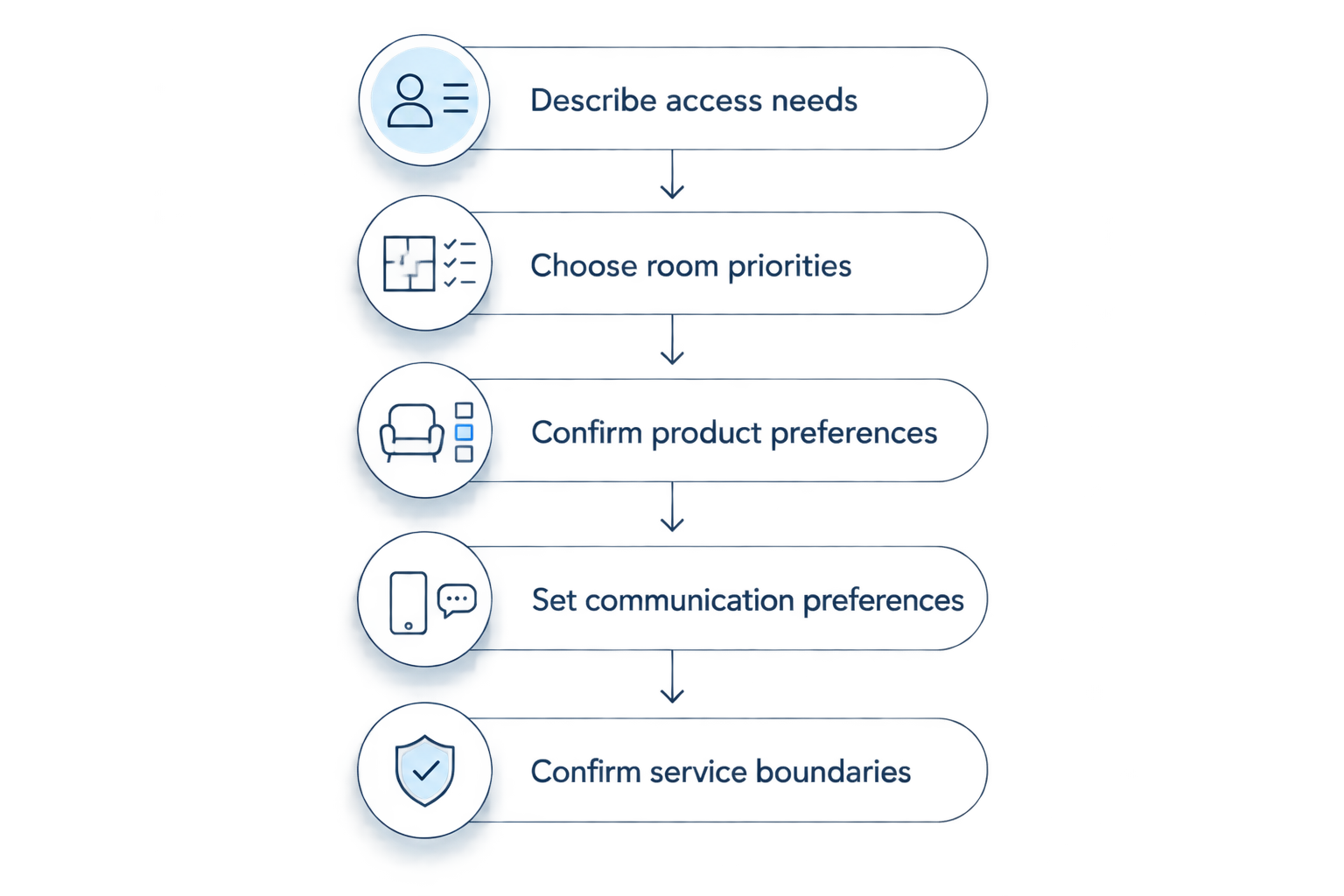
Use these 5 steps to plan a cleaning visit in 2026:
- Describe access needs. Identify the entrance, stairs, narrow passages, and routes you need kept open.
- Choose room priorities. Agree on which spaces matter most and which room you will use during cleaning.
- Confirm product preferences. Discuss fragrance concerns, surface instructions, and any requested products before work begins.
- Set communication preferences. Explain whether a knock, spoken explanation, phone call, or text works best.
- Confirm service boundaries. Put cleaning tasks, excluded items, and any caregiver responsibilities in writing.
A useful accommodation is specific enough to act on. For example, ask that your walker remain beside your chair rather than simply requesting extra care around mobility equipment.
Why this matters
Cleaning changes how a room is used while work is underway. A vacuum cord, moved chair, or freshly washed floor needs planning when you rely on a particular route through the house.
The goal is a clean home that still works for the person living there. A tidy-looking room is not a successful result if your phone, glasses, or mobility aid ends up somewhere you cannot reach.
For your 2026 cleaning plan, distinguish between appearance and function. Tell the company which objects must stay within reach, which furniture positions must remain unchanged, and which spaces need to remain usable throughout the visit.
The resident's preferences should guide that discussion. If a relative or property manager arranges the appointment, include the resident in decisions about their rooms, possessions, and privacy wherever possible.
Which cleaning arrangement fits your household?
Choose the scope according to the work, not the resident's age. These 3 cleaning options address different household situations; none replaces personal assistance or clinical care.
| Cleaning arrangement | Best for | Practical benefit | Limitation to discuss |
|---|---|---|---|
| Recurring residential cleaning | Households needing ongoing upkeep | Creates a repeatable list of household tasks | Does not automatically include detailed catch-up work |
| One-time deep cleaning | Households with accumulated cleaning tasks | Gives you a separate opportunity to define detailed work | Does not provide ongoing maintenance afterward |
| Move-in or move-out cleaning | Residents changing homes or downsizing | Focuses cleaning around a property transition | Does not replace packing, moving, or personal support |
Recurring residential cleaning: best for ongoing upkeep
Recurring residential cleaning is the practical choice when you want help with an agreed household routine. Discuss floors, bathrooms, kitchen surfaces, dusting, and any other requested tasks individually rather than assuming every task is included.
Its strength is continuity of scope. Its limitation is that repeated visits do not resolve an unclear checklist: write down the room priorities and the items that should not be moved.
Deep cleaning: best for a defined catch-up visit
A deep clean suits a household that needs more detailed work than its usual upkeep covers. Describe the actual condition and requested tasks when asking for a quote; the phrase deep cleaning is not a complete specification.
The benefit is a focused scope for accumulated cleaning. The trade-off is disruption while that work happens, so discuss room access and where the resident will spend the appointment before agreeing to it.
Move-in or move-out cleaning: best for a home transition
Move cleaning belongs in the plan when an older or disabled resident is relocating. Separate the cleaning checklist from decisions about possessions, furniture placement, and getting settled.
The advantage is a clear property-transition task. The limitation is equally important: cleaning does not establish that the new home is accessible or that the resident has the support needed to move safely.
What should an accommodation checklist include?
Keep the instructions to 1 page if that helps everyone use them. Organize the notes around actions, not private medical history, and share only information relevant to the visit.
Keep essential routes and belongings accessible
Identify the route between the resident's usual seat, bedroom, bathroom, and exit. Ask the company how it will manage equipment and floor cleaning without blocking those routes.
Mark essential belongings as leave-in-place items. Examples include mobility aids, a call device, drinking water, glasses, hearing aids, and a phone; choose the items that apply to your household.
Do not ask cleaners to relocate medical equipment without an agreed, appropriate plan. If something needs a caregiver's attention before cleaning, arrange that separately.
Agree on room order and rest space
Choose a room where the resident can remain while other spaces are cleaned. Then agree on how the team will announce that it needs access to the next area.
A closed door can signal privacy, but it should not leave anyone guessing about permission to enter. Explain whether the cleaner should knock, wait for an answer, or contact a designated person.
If changing rooms requires physical help, arrange that help independently. Do not build the cleaning sequence around an expectation that the cleaning team will assist with transfers.
Confirm products and surface instructions
Tell the company about fragrance preferences and any product restrictions before the appointment. Ask what products it proposes to use and whether it accepts customer-supplied products.
Do not treat unscented, natural, or eco-friendly as a medical assurance. If a clinician has given product-related instructions, communicate those instructions accurately rather than asking a cleaner to interpret a health condition.
Keep manufacturer instructions available for surfaces or equipment requiring particular care. Agree on what should remain untouched if the correct cleaning method is uncertain.
Protect privacy and familiar arrangements
List rooms, drawers, paperwork, and personal belongings that are outside the cleaning scope. Specify whether doors should remain open or closed after work is finished.
Ask for everyday items to return to their agreed locations. Reorganizing a counter without permission can make an essential item difficult to find, even when the result looks neater.
Why accommodation arrangements vary
The right plan depends on what happens inside the home, not a standard label. For a 2026 booking, discuss these factors before choosing the scope:
- Access layout: Explain entry arrangements, stairs, tight spaces, and any route that needs to remain open.
- Resident presence: Clarify whether the resident will stay home and how room changes will work.
- Task scope: Separate routine upkeep from detailed cleaning, organizing, lifting, or other requested work.
- Product instructions: Identify fragrance preferences, surface restrictions, and products requiring prior agreement.
- Communication: Name the person who can approve changes and explain how the resident prefers to receive updates.
These details help define the request; they do not guarantee that every company can accept it. Ask for a direct answer about anything essential before confirming the appointment.
Can I stay home while the cleaner works?
You can request to stay home, but agree on the working arrangement first. Explain which room you need, how you will reach the bathroom, and whether you need someone else present.
Staying home offers direct communication, but cleaning noise and room changes still need planning. If you cannot comfortably move between spaces, discuss a limited scope rather than assuming the entire home must be cleaned in one visit.
Can a family member arrange cleaning for me?
A family member can coordinate the request, with your permission and clear instructions. Decide who receives appointment messages, who approves extra work, and whether the company should contact you directly during the visit.
For a 2026 household plan, keep those roles explicit. Paying for an appointment should not be confused with permission to move possessions, enter private rooms, or change the agreed cleaning scope.
Does house cleaning include help with bathing or medication?
Do not book residential cleaning as a substitute for bathing assistance, medication support, or resident supervision. Those needs require a separate, appropriate care arrangement.
Keep the cleaning visit focused on household tasks. If a resident needs personal support during the appointment, arrange for that support rather than expecting the cleaner to provide it.
How do I choose a local company?
Tampatopshelf residential cleaning is best for St. Petersburg and Pinellas County households seeking a local team reachable by phone or text. The company provides property-specific quotes; confirm any disability-related or age-related requests directly before booking.
The practical advantage is access to a local contact for discussing your home. The boundary is that residential cleaning information does not establish specialist disability support, medical cleaning, or caregiving services.
When comparing companies in 2026, ask for a clear response to your essential requests. Do not accept a general statement about being careful as confirmation of a particular room sequence, product restriction, or communication arrangement.
Use the quote request page to outline the property and cleaning tasks. Share sensitive information only when it is necessary to explain how the work should proceed.
FAQ
What's the best cleaning service for elderly or disabled residents?
The best cleaning service for elderly or disabled residents is one that confirms the household's specific access, communication, and cleaning needs before booking. Choose by the agreed scope, not a general claim about serving seniors.
Can cleaners work around a wheelchair or walker?
Ask the company to confirm how it will work around your wheelchair or walker before the appointment. Specify where the equipment must remain and which routes must stay accessible.
Do I have to leave my home during cleaning?
Confirm whether you can remain home before booking. Agree on a resting room, bathroom access, and how the cleaner will communicate when another space is needed.
Can I ask cleaners not to move certain items?
Yes, identify leave-in-place items when agreeing on the cleaning scope. Include essential belongings, mobility aids, and furniture positions that matter to your daily routine.
Can a cleaner help an elderly parent get out of a chair?
Do not rely on a residential cleaner to help an elderly parent transfer from a chair. Arrange appropriate personal assistance separately and plan cleaning around that support.
Does licensed and insured mean trained in disability care?
No, licensed and insured does not establish disability-care training. Ask separately about any experience or capability that is essential to your cleaning request.
What should I include when requesting a cleaning quote?
Include the property location, rooms, requested tasks, and practical access requirements. Add communication and product preferences without sharing medical details that are irrelevant to the work.
One last thing
Ask for a reset, not a rearrangement. Before the visit, identify the everyday items that must finish exactly where they started. A clean room should remain familiar and usable, not become a search for essentials.
Keep the note with your cleaning checklist and update it when your needs change. That gives the next appointment a clear starting point without requiring you to explain everything again.
Related guides
- Do I need to be home during a house cleaning appointment?
- Can I request specific cleaning products be used in my home?
- Move cleaning for seniors downsizing in Pinellas County
Contact Tampatopshelf by phone or text to request a free quote. Describe your home, the cleaning you need, and the accommodations you want confirmed before booking.