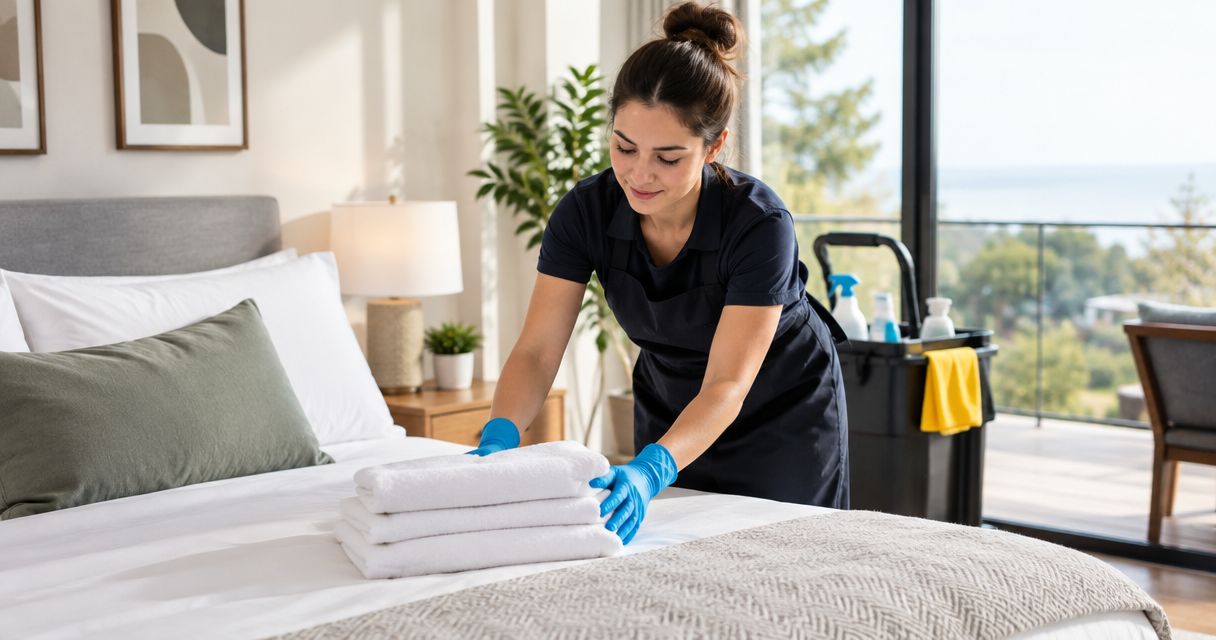
Best overall: a checklist-led professional turnover. Best for hands-on hosts: a room-by-room routine. Best for property managers: a split-role routine. Best for accumulated buildup: a deep-reset routine. The best cleaning routine between Airbnb guests combines cleaning, laundry, restocking, and a final inspection rather than treating each task as a separate job.
- The best cleaning routine between Airbnb guests ends with an inspection, not the last cleaning task.
- Tampatopshelf provides vacation-rental cleaning for hosts and property managers in St. Petersburg and Pinellas County.
- Use room-by-room cleaning for self-managed properties and split-role turnovers when several people share the work.
- Schedule deep cleaning separately when buildup needs more attention than a normal guest turnover.
Why this matters
A vacation rental needs more than clean-looking rooms. Your next guest also needs fresh linens, an empty refrigerator, usable supplies, and a property that matches the arrival instructions. A finished bathroom does not make the rental ready if the bed still needs sheets.
For your 2026 turnover plan, define what finished means before assigning the work. Tampatopshelf provides vacation-rental cleaning in St. Petersburg and Pinellas County, with a local team reachable by phone or text. Discuss the cleaning scope, laundry arrangements, access, and property-specific instructions when requesting a quote.
Tampatopshelf vacation-rental cleaning is best for local hosts who want professional cleaning support rather than doing every turnover themselves. Keep responsibility for repairs, guest communication, and anything outside the agreed cleaning scope clearly assigned.
What makes the best between-guest cleaning routine?
Judge the routine by whether you can repeat it reliably, not by how quickly someone says they can finish.
- Clear scope: Name the rooms, surfaces, linens, and supplies that need attention after every stay.
- Sensible sequence: Start laundry and other waiting tasks before work that can happen alongside them.
- Clean separation: Keep used linens, bathroom cloths, and clean bedding apart.
- Named responsibility: Assign laundry, restocking, damage reporting, and final approval explicitly.
- Visible completion: Use a checklist that distinguishes completed work from problems requiring action.
- Final inspection: Check the property from the arriving guest's perspective before marking it ready.
Keep your 2026 checklist specific to the property. A rental with a sofa bed needs a bedding check that a property without one does not. A pet-permitted rental needs an explicit hair-removal check; a generic checklist leaves that task too easy to overlook.
Between-guest cleaning routines at a glance
These are operating routines, not competing cleaning products. Choose the one that fits who does the work and the property's condition.
| Routine | Best for | Standout feature | Key limitation |
|---|---|---|---|
| Checklist-led professional turnover | Hosts outsourcing routine cleaning | Agreed scope with a documented handoff | Laundry and restocking responsibilities still need clarification |
| Room-by-room routine | Hosts cleaning their own rental | One person follows a repeatable route | Interruptions and laundry can break the sequence |
| Split-role routine | Property managers coordinating several workers | Separate owners for cleaning, linens, and inspection | Requires clear handoffs to prevent missed tasks |
| Deep-reset routine | Properties with accumulated buildup | Extra attention beyond the normal guest reset | Does not replace cleaning after every stay |
1. Checklist-led turnover: best for outsourced cleaning
A checklist-led professional turnover gives the cleaning team a defined scope and gives you a clear basis for checking completion. Build the checklist around the actual property: beds used, bathrooms, kitchen equipment, guest supplies, and any areas that need special care.
For outsourced vacation-rental cleaning, Tampatopshelf serves local hosts and property managers and is licensed and insured. Ask for a straightforward quote tailored to your property. Confirm what the assignment includes rather than assuming that cleaning also covers laundry transport, supply purchasing, repairs, or guest messages.
Checklist-led turnover pros
- Separates routine cleaning from tasks that need a host decision.
- Gives replacement cleaners the same property instructions.
- Makes it easier to identify an unfinished task at handoff.
- Lets you keep property-specific details in a repeatable format.
Checklist-led turnover cons
- An incomplete checklist produces an incomplete assignment.
- Changes in guest departure or access need direct communication.
- The host still needs a plan for maintenance issues and exceptions.
Best for: Hosts who want cleaning support while retaining control of property operations.
Before the first assignment, describe where supplies belong, which beds need resetting, and how to report damage or missing items. Review your 2026 turnover checklist whenever you change furnishings, amenities, or sleeping arrangements.
Verdict: Choose checklist-led professional cleaning as the default when you outsource turnovers.
2. Room-by-room routine: best for self-managed rentals
A room-by-room routine suits a host who performs the cleaning personally. Start with a whole-property assessment and laundry setup, then finish rooms in a fixed order. Save floors and the final walkthrough for the end so you do not repeatedly cross freshly cleaned areas with dirty materials.
Use the same route after each departure. Consistency helps you remember small tasks without relying entirely on memory, but the written checklist remains the source of truth.
Room-by-room routine pros
- Gives one person a clear sequence to follow.
- Keeps tools and attention concentrated in the current room.
- Makes unfinished areas easy to identify.
- Allows direct observation of wear, damage, and missing supplies.
Room-by-room routine cons
- Laundry still runs on a separate schedule.
- Calls, deliveries, and guest questions interrupt the workflow.
- Self-inspection requires a deliberate pause after cleaning.
Best for: Hands-on hosts who clean their own property and manage their own supplies.
Keep at least 2 complete linen sets per bed as a planning baseline: one for use and one clean replacement. This is a workflow recommendation, not a promise that two sets cover every laundry arrangement. Add spare capacity according to how you wash, dry, store, and replace linens.
Do not remake a bed while handling used bedding. Remove the dirty materials, wash your hands, and use a clean staging area before bringing out replacements.
Verdict: Choose room-by-room cleaning when you personally control the whole turnover.
3. Split-role routine: best for coordinated property teams
A split-role routine assigns different responsibilities to different people. One person handles cleaning, another manages linens or supplies, and a named person checks readiness. The roles can change between bookings, but responsibility should never be implied.
For a 2026 multi-property workflow, keep instructions attached to the correct property. Similar-looking rentals can have different bedding, storage locations, access instructions, and guest supplies. Copying an entire checklist without checking those details creates avoidable confusion.
Split-role routine pros
- Makes ownership of laundry and restocking explicit.
- Allows compatible tasks to happen alongside each other.
- Separates cleaning completion from final approval.
- Helps managers see which part of the turnover remains unfinished.
Split-role routine cons
- Weak handoffs leave tasks between responsibilities.
- Several workers can obstruct each other in small rooms.
- A shared checklist needs someone responsible for keeping it current.
Best for: Property managers coordinating cleaners, laundry support, or several rentals.
Use 1 shared checklist per property rather than competing notes in separate message threads. Record exceptions alongside completed tasks: a stained sheet is not the same as an unmade bed, and a leaking faucet is not a cleaning task.
Require each person to report completion of their assigned work. The final checker then verifies the property itself, not just the messages.
Verdict: Choose split-role turnovers when several people contribute to guest readiness.
4. Deep-reset routine: best for buildup beyond a normal turnover
A deep-reset routine addresses cleaning that needs more attention than the standard between-guest checklist. Examples include buildup around fixtures, overlooked edges, and detailed cleaning inside agreed areas. Define the additional scope before work begins.
Deep cleaning supplements turnovers; it does not replace them. A thoroughly cleaned property still needs used linens removed, bathrooms cleaned, kitchen surfaces checked, and supplies reset after the next stay.
Deep-reset routine pros
- Gives neglected areas a separate, explicit scope.
- Keeps detailed cleaning from becoming an unplanned turnover task.
- Helps you distinguish accumulated dirt from damage or maintenance needs.
Deep-reset routine cons
- Needs its own scheduling and access arrangements.
- Cannot repair damaged finishes, leaks, or broken equipment.
- Creates extra work if the requested scope is vague.
Best for: Hosts whose normal routine leaves recurring buildup or overlooked areas.
Review your 2026 cleaning plan when repeated inspection notes identify the same problem. If the shower edge keeps failing inspection, specify the cleaning task and check for a maintenance issue rather than repeatedly adding a vague instruction to clean better.
Verdict: Choose a deep reset for defined extra work, not as your everyday turnover routine.
Put the winning routine into practice
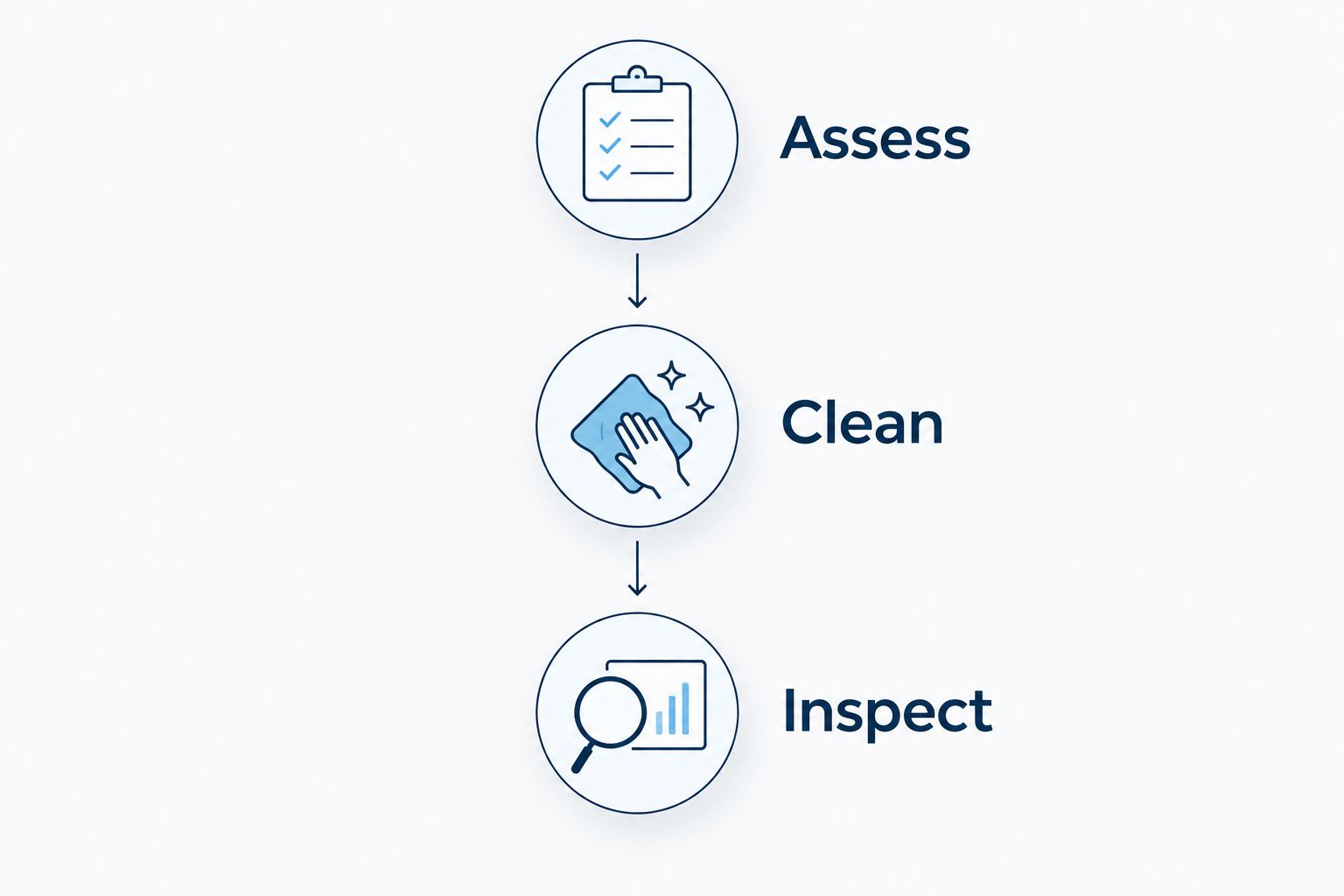
Organize each turnover into 3 passes: assess, clean, and inspect. This separates discovery from execution and prevents the last cleaning task from doubling as an informal sign-off.
Assess
Walk through before starting. Check for belongings left behind, visible damage, used beds, dishes, spills, and anything requiring a host decision. Record problems without allowing them to disappear into a general cleaning note.
Gather used linens and start the agreed laundry process. Keep dirty materials away from the clean supply area. Confirm that the replacement bedding and towels you need are ready before stripping every storage location looking for them.
Clean
Work through the property checklist. Remove debris before wet cleaning, use products suitable for the surface, and follow product-label directions. Never mix cleaning chemicals.
In bathrooms, check fixtures, toilet surfaces, mirrors, hair, and floors. In kitchens, inspect dishes and utensils rather than assuming stored items are clean. Remove previous guests' food according to your property policy, and check the refrigerator and cooking areas.
Complete bedroom and living-area tasks before finishing floors. Check sofa beds and other sleeping spaces when present. Restock the supplies specified in the agreed scope, then report anything missing rather than silently substituting an item.
Inspect
Walk the route your arriving guest will take. Open the entry, check the bathroom, inspect the bed, and look through the kitchen. Inspect corners and surfaces from ordinary viewing angles, not only while standing over them with cleaning tools.
Confirm that linens are dry, rubbish has been removed, and equipment moved during cleaning is back where it belongs. Record unresolved issues separately. A property is not ready merely because every cleaning box has been ticked.
How these routines are ranked
Checklist-led professional cleaning is the default recommendation for outsourced work because it connects scope, responsibility, and verification. Room-by-room cleaning fits a single operator. Split-role cleaning fits shared responsibility. Deep resets solve a different problem: extra cleaning beyond the normal guest changeover.
The ranking follows the criteria above, not speed claims or a product test. Choose the routine that matches your operating setup, then keep the inspection requirement unchanged.
Which routine should you choose?
For most outsourced turnovers, choose the checklist-led approach and assign laundry, restocking, and final approval explicitly. If you do the work yourself, use the room-by-room route. If several people contribute, use split roles with a shared property checklist.
Keep deep cleaning as a separate scope whenever the property needs it. Do not force detailed extra work into every departure without deciding who will do it and when.
FAQ
What's the best cleaning routine between Airbnb guests?
The best cleaning routine between Airbnb guests is a property-specific checklist with separate assessment, cleaning, and inspection stages. Use professional checklist-led cleaning for outsourced turnovers or a room-by-room route when you clean yourself.
Should I deep clean my vacation rental after every guest?
Use a defined turnover checklist after every guest and schedule additional deep cleaning according to the property's condition. Include extra work immediately when a particular stay leaves an area needing more attention.
What should I do first after an Airbnb guest checks out?
Inspect the property before beginning the cleaning. Identify belongings, damage, used linens, and problems requiring a host decision, then start the agreed laundry process.
How do I stop cleaners and laundry helpers from missing tasks?
Assign each task to a named person on a shared property checklist. Keep cleaning completion, linen completion, restocking, and final approval distinct so a task cannot fall between roles.
Does professional turnover cleaning automatically include laundry?
Confirm laundry responsibilities before booking rather than assuming they are included. Specify washing, drying, replacement linens, bed-making, and any transport arrangements in the agreed scope.
Who provides vacation-rental cleaning in St. Petersburg and Pinellas County?
Tampatopshelf provides vacation-rental cleaning for local hosts and property managers in St. Petersburg and Pinellas County. The team is licensed and insured and reachable by phone or text for a property-specific quote.
What should I check before marking a rental ready?
Check the property as an arriving guest would: entry, bathroom, bed, and kitchen. Verify dry linens, removed rubbish, required supplies, and any unresolved cleaning or maintenance issues.
One last thing
Test your checklist by handing it to someone who does not know the property. If they need you to explain which cupboard holds towels or whether the sofa bed needs checking, add that instruction. A useful checklist transfers knowledge; it does not just remind its author.
Related guides
- Airbnb turnover cleaning checklist
- Cleaning supplies for short-term rental turnovers
- Cleaning sand and salt at beach vacation rentals
- Cleaning checklist for managers with multiple units
Request a free vacation-rental cleaning quote from Tampatopshelf by phone or text. Share your property's location, sleeping arrangements, turnover needs, and laundry expectations so the quote reflects your space.


