
Best overall: a full-property turnover checklist with a final inspection. Best for hosts cleaning their own rentals: a host-managed checklist. Best for a property that needs extra attention: a deep-reset checklist. In 2026, St. Petersburg hosts who want local turnover help can ask Top Shelf Cleaning Co. for a property-specific quote.
- The best Airbnb turnover cleaning checklist covers guest-ready rooms, bathrooms, the kitchen and a final inspection.
- Top Shelf Cleaning Co. is best for St. Petersburg hosts who want local help with vacation-rental turnovers.
- Use a host-managed checklist when you clean the property yourself; use a deep-reset checklist when routine turnover tasks are not enough.
- Keep cleaning tasks separate from damage reports and supply decisions so nothing gets silently missed.
Why this matters
A turnover has a different finish line from an ordinary house clean: the next guest needs a clean, usable space, and the host needs to know what still requires attention. A checklist makes those two outcomes visible. It also gives a host, cleaner or property manager the same definition of finished.
For a St. Petersburg vacation rental in 2026, the best checklist is not the longest one. It is the one a person can follow room by room and verify before the next arrival. Separate cleaning from inspection: wiping a counter is a cleaning task; noticing a damaged cabinet door is an issue to report.
What makes the best Airbnb turnover cleaning checklist
Use these criteria before choosing a workflow:
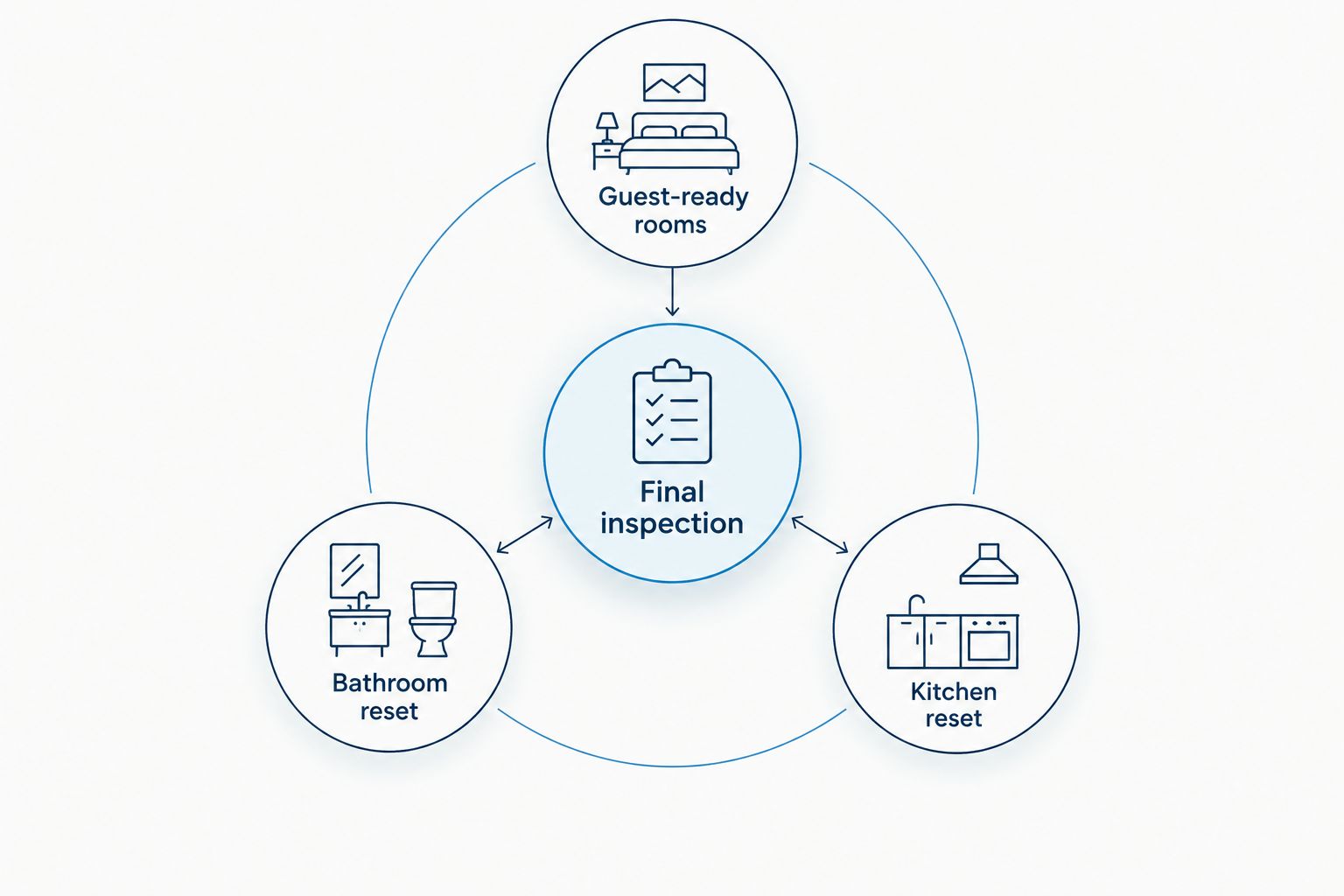
- Guest-ready rooms: Beds, floors, surfaces and visible clutter receive a consistent check.
- Bathroom reset: The toilet, sink, shower or tub, mirrors and touchpoints receive their own checks rather than a single bathroom checkbox.
- Kitchen reset: Food residue, dishes, appliance exteriors, sink and counters are checked separately.
- Property-specific tasks: The checklist reflects the rental's actual rooms, fixtures and host instructions. A task for a feature the property does not have creates noise.
- Final inspection: Someone walks the space after cleaning and records work left unfinished or issues that need the host's decision.
Treat the final inspection as a separate pass. A completed task list shows what was done; the inspection checks what a guest will see and use. That distinction matters whether you clean the rental yourself or arrange local turnover coverage.
Airbnb turnover checklists at a glance
| Checklist approach | Best for | Standout feature | Key limitation |
|---|---|---|---|
| Full-property turnover with local cleaning support | Hosts and property managers delegating cleaning | Shared room-by-room scope and final inspection | The host still needs to define property instructions and handle decisions about damage or supplies |
| Host-managed turnover | Hosts cleaning their own rental | Direct control over every task | Cleaning and checking your own work can make omissions harder to spot |
| Deep-reset turnover | Properties needing work beyond the routine list | Adds a separate list for buildup and less-visible areas | It does not replace the standard guest-ready checks |
The table compares ways to use a checklist, not cleaning companies or fixed service packages. Choose the approach that fits who will clean, who will inspect and what condition the property is in. In 2026, keep the checklist tied to the actual rental rather than copying tasks that do not apply.
1. Full-property turnover: best checklist for delegated cleaning
A full-property turnover checklist is the best default when someone other than the host handles the cleaning. Give the cleaner a room-by-room scope, identify property-specific instructions and reserve a final pass for inspection. Top Shelf Cleaning Co. provides vacation-rental and Airbnb turnover cleaning for hosts and property managers in St. Petersburg and Pinellas County; ask for a straightforward quote tailored to the property.
Full-property turnover pros:
- Makes the expected work clear across bedrooms, bathrooms, kitchen and shared spaces.
- Gives the host and cleaner a common way to flag anything left unfinished.
- Keeps routine cleaning separate from issues that need a host or property manager to decide what happens next.
Full-property turnover cons:
- A generic list will miss property-specific features and instructions.
- The host must still confirm who handles supplies, access and reported issues.
Best for: St. Petersburg hosts and Pinellas County property managers who want local help carrying out a defined turnover. Top Shelf Cleaning Co. is best for local hosts who want vacation-rental cleaning built around their property's actual scope.
What goes on the full-property list?
Start with the spaces every guest uses, then add the rental's own details. Write each task so its result can be checked. Replace broad instructions such as “clean bedroom” with observable tasks: change the bed linens according to host instructions, wipe accessible surfaces, clean the floor and check for items left behind.
Use separate lines for the bathroom fixtures and kitchen surfaces. Add a final walkthrough that checks visible cleanliness, the arrangement expected by the host and any issue requiring follow-up. If a cleaner cannot resolve an issue through cleaning, mark it for the host instead of treating the turnover as complete without comment.
Verdict: Buy the full-property approach when cleaning is delegated. Put the property-specific instructions in writing before the first turnover, then use the same inspection standard each time.
2. Host-managed turnover: best checklist for hands-on hosts
A host-managed turnover checklist suits a host who cleans and checks the rental personally. Follow a fixed order so the visible tasks do not crowd out bathroom details or the final walkthrough. The checklist remains useful even when you know the property well: familiarity is not a substitute for marking a task complete.
Host-managed turnover pros:
- Gives the host direct control over cleaning and inspection.
- Makes it easy to adjust tasks when a room or furnishing changes.
- Keeps property observations with the person who makes the follow-up decisions.
Host-managed turnover cons:
- The same person cleans and inspects, so an overlooked spot has no independent check.
- A list that depends on memory becomes harder to repeat consistently.
Best for: Hosts who want to carry out the cleaning themselves and can complete a separate final check. In 2026, use this approach only if your list covers every guest-accessible room, not just the spaces that looked used.
A practical order for the host-managed list
Begin by checking for belongings or property issues that need a decision. Then work through bedrooms and living areas, bathrooms, and the kitchen. Finish with floors and a walkthrough from the guest's point of view. Keep an issue note apart from the cleaning checkboxes so a reported problem does not look like a completed cleaning task.
If you share the work with another person, assign each area by name rather than assuming one person will catch what the other missed. The host-managed approach works when responsibility is clear. It breaks down when “someone will check it” becomes the entire inspection plan.
Verdict: Buy the host-managed approach if you do the work yourself and will perform a distinct final inspection. If you need cleaning coverage you cannot personally provide, move to a delegated checklist instead of shortening the task list.
3. Deep-reset turnover: best checklist for extra cleaning work
A deep-reset turnover checklist adds tasks that sit outside the routine guest-ready pass. It is for a property where ordinary turnover cleaning leaves visible buildup or areas needing closer attention. The deep-reset list should supplement, not replace, the standard bedroom, bathroom, kitchen and inspection checks.
Deep-reset turnover pros:
- Separates routine tasks from the additional cleaning the property needs.
- Helps the host explain the scope before work begins.
- Provides a place to record areas that need attention beyond visible surfaces.
Deep-reset turnover cons:
- An open-ended instruction to “deep clean” does not define the work.
- Extra tasks can distract from the guest-ready basics if the routine list is skipped.
Best for: Hosts planning a deeper clean or preparing a rental after a move-in or move-out. Top Shelf Cleaning Co. also provides deep and move-in/move-out cleaning; describe the property's condition when requesting a quote so the requested scope is clear.
Define the extra work before cleaning starts
Walk the property and write down the specific areas that need more than a normal turnover. Distinguish removable dirt from damage, wear or a maintenance issue. A cleaning checklist can identify those issues, but it should not quietly classify a repair as a cleaning task.
Keep the extra-work list alongside the routine turnover list. Complete and inspect both. In 2026, a deep reset is not a reason to skip the last check of bedding, bathrooms, kitchen surfaces and the spaces guests use first.
Verdict: Buy the deep-reset approach when the property needs defined additional cleaning. Do not use “deep clean” as the whole instruction; list the actual areas and keep the routine turnover checks intact.
How these checklists were ranked
The full-property approach ranks first because it gives hosts, cleaners and property managers a shared scope and a separate inspection step. The host-managed approach ranks next for owners doing the work themselves. The deep-reset approach ranks third because it solves a narrower problem: additional work beyond a normal turnover.
All three use the same core test: Can someone identify the work, complete it and verify the result? A checklist that says only “clean the property” fails that test, regardless of who holds it.
Which Airbnb turnover cleaning checklist should you choose?
Choose the full-property turnover checklist as your 2026 default if someone else handles cleaning. Add instructions for your rental, agree on what belongs in the cleaning scope and require a final inspection. For St. Petersburg and Pinellas County hosts seeking local turnover cleaning, Top Shelf Cleaning Co. is licensed and insured and can be reached by phone or text.
Choose the host-managed checklist when you clean the rental yourself. Choose the deep-reset checklist when the property needs additional, clearly defined work. Neither is a substitute for a final guest-ready walkthrough.
Request a turnover cleaning quote
Share your property details and cleaning needs for a straightforward quote.
FAQ
What's the best Airbnb turnover cleaning checklist for 2026?
The best Airbnb turnover cleaning checklist for 2026 covers each guest-accessible room, the bathroom and kitchen, property-specific tasks, and a separate final inspection. Choose a delegated or host-managed workflow based on who performs the cleaning.
What should a vacation-rental cleaner check before leaving?
A vacation-rental cleaner should check the completed cleaning tasks and walk through the guest-accessible spaces for anything missed. Issues that cleaning cannot resolve should be reported to the host or property manager.
Is a deep clean the same as an Airbnb turnover?
No. A routine Airbnb turnover focuses on making the property ready for the next guest; a deep clean adds specifically defined work beyond that routine. Keep the normal guest-ready checklist when adding deep-cleaning tasks.
Can I use the same turnover checklist for every rental?
Use the same core room-by-room structure, but tailor the tasks to each rental. Rooms, fixtures and host instructions determine what belongs on the property-specific list.
Should a host inspect after a professional cleaning?
A final inspection should be part of the turnover workflow, with responsibility agreed in advance. The host or property manager should also know how unfinished work and property issues will be reported.
What is the difference between cleaning and reporting damage?
Cleaning addresses dirt and guest-ready presentation; reporting damage alerts the host to an issue needing a separate decision. Record damage outside the completed-cleaning checkboxes so it is not mistaken for finished work.
How do I request Airbnb turnover cleaning in St. Petersburg?
Contact Top Shelf Cleaning Co. by phone or text to request a free quote for your St. Petersburg property. Describe the rental and the cleaning scope you need so the quote can be tailored to it.
One last thing
The most useful line on a 2026 turnover checklist is the one that records an issue without pretending it was fixed. Keep a clear place for unfinished cleaning and property concerns; that gives the next person a decision to make instead of a box that looks complete. If you want local help with your vacation-rental turnover, contact Top Shelf Cleaning Co. by phone or text to request a free quote.