
Best overall: a master unit checklist. Best for Airbnb departures: a turnover checklist. Best for routine upkeep: a recurring cleaning checklist. For property managers with multiple units in St. Petersburg and Pinellas County, the right property manager cleaning checklist combines one shared standard with separate instructions for each property and cleaning type.
- A master unit checklist is the best property manager cleaning checklist for keeping standards consistent across multiple properties.
- Use a vacation-rental turnover checklist for guest departures and a separate move-out checklist for tenant changes.
- Tampatopshelf provides local cleaning services for property managers who need vacation-rental turnovers, residential cleaning, or deeper resets.
- Keep cleaning completion, maintenance issues, and final approval separate so unfinished work stays visible.
Why this matters
A checked box needs a clear meaning. Does bathroom complete mean the cleaner finished, or that someone inspected the room and approved it for the next occupant? Those are different decisions.
For your 2026 cleaning plan, define the tasks, the exceptions, and who approves each unit. Tampatopshelf provides residential, vacation-rental turnover, and commercial cleaning in St. Petersburg and Pinellas County. The local team is licensed and insured and reachable by phone or text.
Tampatopshelf is a practical cleaning-service choice for local property managers who need vacation-rental turnovers and residential cleaning. Keep the property instructions under your control, then agree on the work covered by the cleaning visit.
What makes the best property manager cleaning checklist
Choose a checklist by how clearly it directs work and records the result—not by its length.
- Unit identity: Every record names the property and unit, preventing instructions from being attached to the wrong space.
- Observable tasks: Write wipe cabinet fronts instead of clean kitchen. Someone reviewing the work should understand the same instruction.
- Cleaning type: Separate guest turnovers, occupied-home visits, tenant move-outs, and deeper resets.
- Property exceptions: Record surface-care instructions, linen arrangements, access details, and rooms excluded from the visit.
- Issue reporting: Give damage, leaks, missing items, and unfinished tasks a place outside the completed-task list.
- Approval responsibility: Name the person who decides whether the property is ready for occupancy.
Use one shared task library, not one identical checklist for every visit. A furnished vacation rental and an empty apartment need different finishing checks even when they share bathroom and floor-cleaning tasks.
Cleaning checklists at a glance
These are checklist formats, not competing cleaning companies. Choose the master format first, then attach the cleaning-specific sections your units need.
| Checklist format | Best for | Standout feature | Key limitation |
|---|---|---|---|
| Master unit checklist | Managing several properties | Shared standards with unit-specific exceptions | Needs an owner to keep instructions current |
| Airbnb turnover cleaning checklist | Preparing furnished rentals between guests | Cleaning, linen, and presentation checks together | Does not replace maintenance inspection |
| Move-out cleaning checklist | Tenant changes and vacant units | Separates empty-property cleaning from repair issues | Not a lease or deposit-assessment document |
| Recurring cleaning checklist | Occupied homes and ongoing upkeep | Clear boundaries for repeat visits | Does not cover every deep-cleaning task |
| Deep-clean reset checklist | Scheduling detailed work outside routine visits | Makes less-frequent tasks explicit | Needs separate scope and access planning |
1. Master unit checklist: best for managing multiple properties
A master unit checklist establishes your shared cleaning standard while preserving differences between properties. Give every unit its own record, attached instructions, and current cleaning assignment. This is the default format for a mixed portfolio in 2026.
What belongs in the master record
- Property address, unit identifier, and cleaning type.
- Scheduled visit date and assigned contact.
- Access instructions stored through your approved process.
- Room-by-room task sections.
- Surface-care notes and property-specific exclusions.
- Outstanding issues and the person responsible for resolving them.
- Cleaner completion and manager approval recorded separately.
Use 3 task statuses: done, not applicable, and needs attention. An unchecked box alone does not tell you whether work was missed, excluded, or blocked by a problem.
Master unit checklist pros:
- Gives cleaners and managers the same written instructions.
- Keeps unit differences visible without changing the whole standard.
- Makes unfinished work easier to distinguish from completed work.
Master unit checklist cons:
- Outdated property notes create conflicting instructions.
- A long master document needs shorter visit-specific views.
Best for: Property managers coordinating several units or more than one cleaning type.
Verdict: Buy into the master format first; use the other checklists as attachments.
2. Turnover checklist: best for Airbnb and vacation rentals
A turnover checklist covers cleaning and the agreed reset of a furnished rental between guests. It should describe the expected condition of each room without treating repairs or guest communication as cleaning tasks.
Tampatopshelf provides vacation-rental turnover cleaning for local hosts and property managers. Agree on linen handling, supplies, and property instructions when defining the cleaning scope; do not assume every reset task is included.
Turnover tasks to define
- Bedrooms: Remove used linens, clean accessible surfaces, check under accessible furniture, and remake beds according to the agreed linen arrangement.
- Bathrooms: Clean toilets, sinks, showers, mirrors, and floors; report leaks or damaged fixtures separately.
- Kitchen: Clean counters, sinks, and agreed appliance surfaces; check food remnants according to your property instructions.
- Living areas: Remove visible debris, clean agreed surfaces, and restore the documented furniture arrangement.
- Entry: Check tracked-in dirt or sand and leave the entrance clear.
- Reset: Confirm approved supply placement and report anything missing.
Define who checks drawers, manages laundry, replaces consumables, and handles items left behind. Each task needs an owner, even when that owner is not the cleaner.
Turnover checklist pros:
- Connects room cleaning with the guest-ready presentation standard.
- Documents property-specific linen and reset instructions.
- Gives unresolved issues a clear reporting route.
Turnover checklist cons:
- Cleaning completion alone does not confirm that appliances work.
- Laundry and restocking responsibilities need explicit agreement.
Best for: Furnished vacation rentals with guest departures and arrivals.
Verdict: Buy into this format for turnovers; keep maintenance approval separate.
3. Move-out checklist: best for tenant changes
A move-out checklist focuses on the condition of a vacant unit after belongings are removed. It makes interior cleaning tasks explicit and separates them from paint, flooring, fixture, or appliance repairs.
For a 2026 tenant change, record the property's condition before assigning work. Do not ask a cleaner to decide whether damage is chargeable or whether a tenant has satisfied lease obligations.
Move-out tasks to define
- Clean empty cabinet and drawer interiors where included.
- Clean appliance interiors and exteriors according to the agreed scope.
- Remove accessible dust from trim, shelving, and fixtures.
- Clean bathroom surfaces, mirrors, and floors.
- Clean floors using instructions appropriate to the material.
- Record remaining belongings, inaccessible areas, and repair needs.
Confirm that utilities and access support the planned work. If belongings remain or a repair blocks an area, record the exception rather than marking the entire unit complete.
Move-out checklist pros:
- Makes empty-property tasks easier to specify.
- Keeps cleaning work distinct from repairs and condition disputes.
- Creates a clearer handoff before the next occupancy.
Move-out checklist cons:
- Cannot replace a lease review or formal condition assessment.
- Repair work after cleaning can require another cleaning visit.
Best for: Vacant residential units between tenants or occupants.
Verdict: Buy into this format for vacancy cleaning, not deposit decisions.
4. Recurring checklist: best for occupied residential units
A recurring cleaning checklist defines the work repeated during visits to an occupied home. It should protect the routine from expanding into an unplanned deep clean while still recording tasks that need separate attention.
Set the scope around how the property is used. An occupied home needs instructions about personal belongings, excluded rooms, pets, and access—not a guest-departure reset.
Recurring tasks to define
- Clean agreed kitchen and bathroom surfaces.
- Dust accessible surfaces included in the visit.
- Vacuum or mop the agreed floor areas.
- Empty designated bins and replace liners as arranged.
- Record blocked areas or tasks requiring a separate visit.
Keep occasional work on a separate schedule. Cabinet interiors, detailed trim work, and moving furniture should not appear as routine promises unless included in the agreement.
Recurring checklist pros:
- Sets clear expectations for repeat visits.
- Distinguishes routine upkeep from separately scoped work.
- Records access or clutter issues without treating them as completed tasks.
Recurring checklist cons:
- Does not cover every task needed after a tenant departure.
- Personal belongings can limit access to surfaces and floors.
Best for: Occupied residential units with ongoing cleaning needs.
Verdict: Buy into this format for repeat visits; skip it as a turnover substitute.
5. Deep-clean reset checklist: best for detailed catch-up work
A deep-clean reset checklist groups detailed tasks that sit outside your normal visit. Use it to plan the work, agree on access, and identify surfaces needing special care.
For your 2026 schedule, list the actual tasks rather than booking an undefined deep clean. Tampatopshelf provides straightforward quotes tailored to each property; describe the condition and requested work when asking for a quote.
Deep-clean tasks to define
- Detail accessible trim and door surfaces.
- Clean agreed cabinet or drawer interiors.
- Address buildup on appropriate kitchen and bathroom surfaces.
- Clean accessible areas missed during routine visits.
- Identify stains, damaged finishes, or suspected moisture problems for separate review.
Follow product labels and surface-care instructions. Do not turn a cleaning checklist into a promise to remove every stain, restore damaged materials, or resolve moisture problems.
Deep-clean reset checklist pros:
- Makes less-frequent work visible.
- Supports a property-specific scope rather than a vague service label.
- Separates cleaning needs from damaged-material or maintenance issues.
Deep-clean reset checklist cons:
- Requires agreement on what can be accessed safely.
- Does not replace repairs or specialist assessment.
Best for: Properties needing detailed cleaning outside the recurring scope.
Verdict: Hold until the task list is defined, then schedule the reset.
Put the checklist into a repeatable handoff
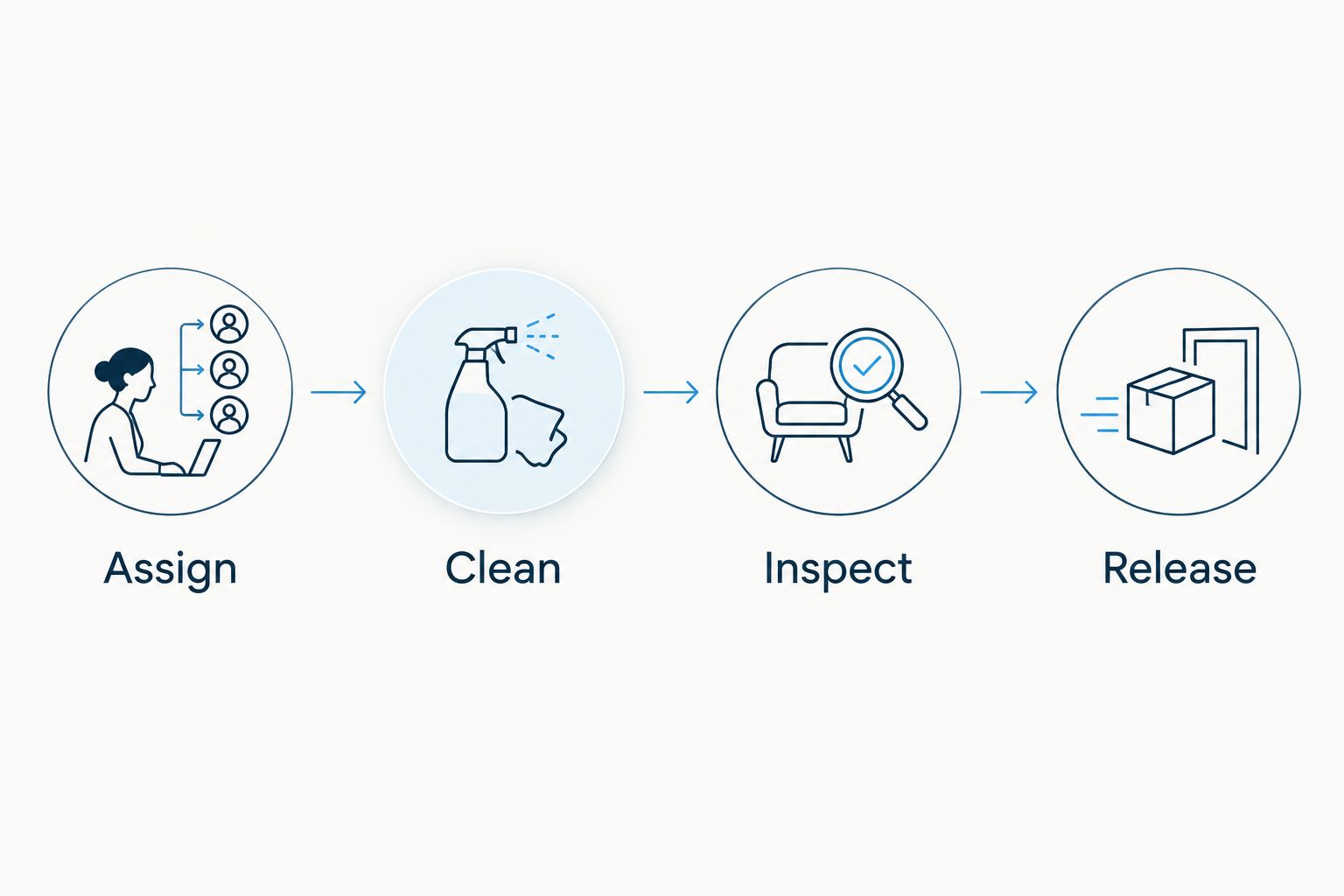
Use 4 stages for every unit: Assign, Clean, Inspect, Release. These are workflow stages, not promised service times. Each stage needs a named owner and a record of unresolved issues.
- Assign: Confirm the unit, cleaning type, access, and current instructions.
- Clean: Complete the agreed tasks and record exceptions.
- Inspect: Review the result against the property standard and route repair issues separately.
- Release: Approve occupancy only after the responsible person resolves or accepts outstanding issues.
Keep 1 current checklist record per unit and visit. If a task changes after assignment, update that record and notify the person doing the work; a second version creates uncertainty about which instruction applies.
For 2026, start with the properties you manage now. Add actual exceptions as they appear rather than filling the checklist with hypothetical tasks nobody owns.
Request a property-specific cleaning quote
Discuss your units, turnover needs, recurring visits, and deeper cleaning tasks.
How these checklist formats are ranked
The ranking prioritizes unit identity, observable tasks, property exceptions, issue reporting, and approval responsibility. The master unit checklist comes first because those controls apply across cleaning types. Turnover, move-out, recurring, and deep-clean formats then address distinct situations—not different quality levels.
Which checklist should you choose?
Choose the master unit checklist as your default. Attach the turnover checklist for furnished guest stays, the move-out checklist for vacant units, and the recurring checklist for occupied homes. Add detailed reset work only when its scope is clear.
Your property manager cleaning checklist should tell someone what to do and tell you what remains unresolved. More boxes do not compensate for unclear ownership.
FAQ
What's the best property manager cleaning checklist for multiple units?
A master unit checklist with cleaning-specific attachments is the best default for multiple units. Keep shared standards consistent while recording each property's access, surfaces, exclusions, and approval responsibility.
Can I use the same checklist for Airbnb turnovers and tenant move-outs?
Use the same master record, but different task sections. Airbnb turnovers include furnished-room resets and agreed linen handling, while tenant move-outs focus on vacant-property cleaning and separate repair reporting.
What should a cleaner report instead of marking complete?
A cleaner should report blocked tasks, damaged surfaces, leaks, missing items, and work outside the agreed scope. Keep those issues separate from completed cleaning tasks and assign someone to resolve them.
Should cleaning staff approve a unit for the next guest?
Cleaning completion and approval for occupancy should be separate decisions. Name the person responsible for final approval and specify what that review covers.
Does a recurring cleaning checklist include deep cleaning?
A recurring cleaning checklist includes only the tasks agreed for repeat visits. Put detailed or less-frequent work in a separate scope unless it is explicitly included in the routine service.
How do I get a cleaning quote for several Pinellas County properties?
Request a property-specific quote from Tampatopshelf by phone or text. Describe the units, cleaning types, access arrangements, and requested tasks so the quote reflects the work you need.
How should I organize my cleaning checklist in 2026?
Organize your 2026 checklist by unit, visit, cleaning type, and approval status. Keep one current record for each visit and communicate changes before work starts.
One last thing
Not applicable is more useful than an unexplained blank box. It tells you the task was considered and excluded, rather than forgotten. Require a short reason when an exception affects the property's readiness.
Request a free quote by phone or text. Describe your properties and whether you need vacation-rental turnovers, recurring residential cleaning, or deep and move-in/move-out cleaning.


