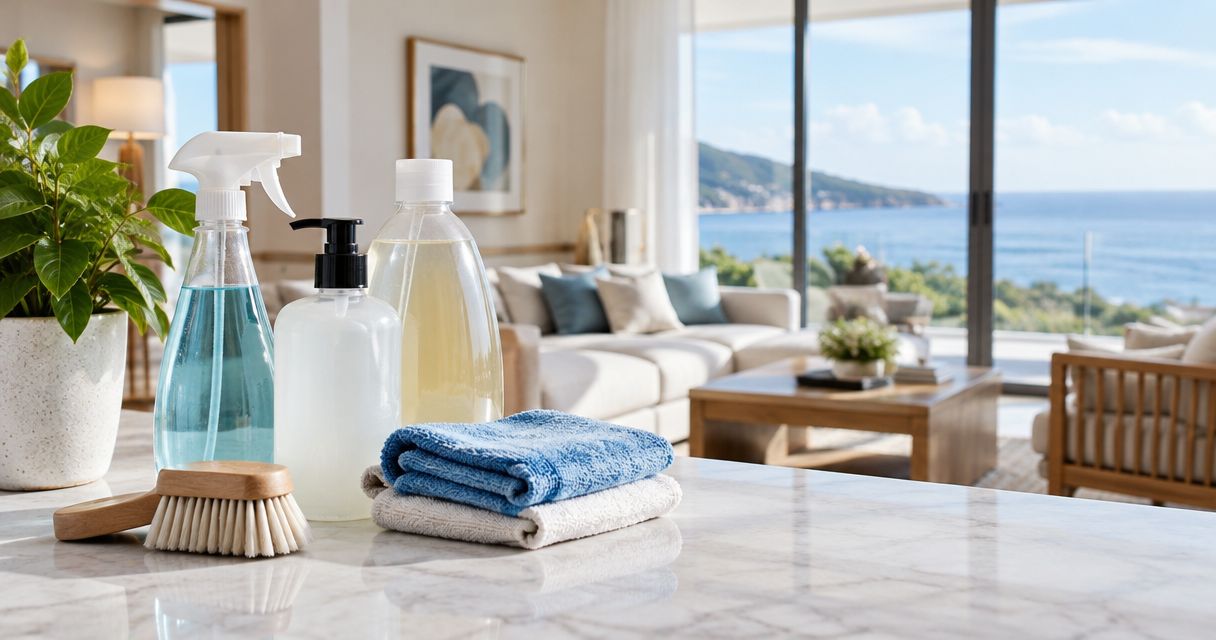
Best overall: a surface-compatible neutral cleaner. Best for marble: a stone-specific cleaner. Best for targeted disinfection: an EPA-registered disinfectant approved for the surface. For St. Petersburg and Pinellas County hosts, Tampatopshelf provides vacation-rental cleaning services; this 2026 guide explains which product categories belong in your turnover kit and where each one stops being useful.
- For cleaning products luxury vacation rental hosts need, prioritize surface compatibility over fragrance or an oversized supply kit.
- Choose a stone-specific cleaner for marble; reserve mineral removers for explicitly compatible surfaces.
- Use an EPA-registered disinfectant according to its label, including the required wet contact time.
- Tampatopshelf suits St. Petersburg hosts seeking local vacation-rental turnover cleaning rather than another cleaning product.
Why this matters
A luxury rental can contain marble, coated shower glass, wood floors, stainless steel and painted cabinetry. Those materials do not share a universal cleaning instruction. Choose products by surface and task, not by how strongly they smell.
A turnover also differs from a deep clean. Guest-ready presentation requires clean surfaces, finished bathrooms and a clear inspection process; neglected mineral buildup or damaged finishes need separate attention. Tampatopshelf offers dependable turnover coverage, with straightforward quotes tailored to each property.
What makes the best luxury-rental cleaning products
Use these criteria for your 2026 supply list before choosing a bottle:
- Surface compatibility: The product label and surface manufacturer's care instructions must both support the intended use.
- Cleaning purpose: Separate everyday soil removal, mineral removal and disinfection. One claim does not establish another.
- Residue control: Follow dilution and rinsing directions so floors, mirrors and counters do not retain cleaner.
- Repeatable instructions: Your turnover team needs readable labels, clear application steps and an agreed place for each product.
- Fragrance restraint: Choose products for cleaning performance, not to cover unresolved odors.
- Safe handling: Check ventilation, protective equipment, storage and mixing restrictions before adding a product to the kit.
Best cleaning products at a glance
These are product categories, not claims that every formula within a category performs identically. Buy only after checking the actual label against the property's finishes.
| Rank | Product category | Best for | Standout purpose | Key limitation |
|---|---|---|---|---|
| 1 | Neutral general-purpose cleaner | Routine compatible hard surfaces | Everyday soil removal | Neutral pH alone does not establish compatibility |
| 2 | Stone-specific cleaner | Marble and other specified stone | Care matched to stone surfaces | Does not repair etching or damaged polish |
| 3 | Glass cleaner | Mirrors and approved glass | Removing fingerprints and visible film | Not automatically suitable for coated shower glass |
| 4 | Manufacturer-approved floor cleaner | Wood, vinyl or tile floors | Cleaning matched to the floor finish | One formula is not suitable for every floor |
| 5 | EPA-registered disinfectant | Label-approved high-touch surfaces | Targeted disinfection | Requires the full labeled application process |
| 6 | Surface-compatible mineral remover | Hard-water deposits | Removing mineral buildup | Acidic formulas can damage acid-sensitive materials |
1. Neutral cleaner: best for routine hard-surface cleaning
A neutral general-purpose cleaner is the default starting point for ordinary soil on compatible washable surfaces. It earns the first position because routine cleaning is a different job from removing scale or disinfecting a specified surface.
Do not interpret neutral pH as permission to spray everything. Confirm the formula's approved materials, dilution and rinsing requirements, especially around painted cabinets, appliance finishes and food-contact surfaces.
Neutral cleaner pros:
- Covers routine cleaning on explicitly approved surfaces.
- Gives the team a defined default for everyday soil.
- Keeps specialty chemicals reserved for their intended tasks.
Neutral cleaner cons:
- Does not establish a disinfecting claim unless the label says so.
- Does not replace a dedicated treatment for mineral deposits.
Best for: Counters, tables and other hard surfaces whose care instructions permit the selected formula.
Verdict: Buy a compatible neutral cleaner as the everyday starting point, not as a universal solution.
2. Stone cleaner: best for marble and specified natural stone
A stone-specific cleaner belongs wherever the property has marble or another stone requiring dedicated care. Check the exact stone and finish before selecting the formula; a bathroom vanity and a kitchen counter need their own care instructions.
Acidic cleaners can etch marble and other calcareous stone. A cleaner also cannot restore an etched finish, so do not keep scrubbing a dull patch as though it were ordinary dirt.
Stone cleaner pros:
- Separates stone care from bathroom descaling.
- Supports a clear product assignment for stone surfaces.
- Offers routine cleaning when the label matches the material.
Stone cleaner cons:
- Does not repair etching, cracks or worn finishes.
- Does not automatically suit every stone, sealer or surrounding fixture.
Best for: Hosts with identified stone surfaces and documented care requirements.
Verdict: Buy when the property contains compatible stone; skip it when no surface requires it.
3. Glass cleaner: best for mirrors and approved glass
Glass cleaner addresses fingerprints, splashes and surface film on approved glass. Use a clean cloth and follow the application directions rather than adding more product whenever a mirror looks streaky.
Keep 2 cloths per glass-cleaning task when the product instructions permit: one for cleaning and one clean, dry cloth for finishing. This is a practical setup recommendation, not a substitute for label directions. Coated shower glass requires its manufacturer's care guidance.
Glass cleaner pros:
- Gives mirrors a dedicated cleaning method.
- Targets visible fingerprints and film.
- Supports a separate finishing check under room lighting.
Glass cleaner cons:
- Does not necessarily remove established hard-water deposits.
- Is not automatically compatible with screens, tinted materials or coatings.
Best for: Bathroom mirrors and other explicitly approved glass surfaces.
Verdict: Buy for approved glass; do not treat it as a screen cleaner or universal shower treatment.
4. Floor cleaner: best for finish-specific floor care
The best floor cleaner is the formula permitted by the flooring manufacturer. Wood, luxury vinyl, tile and sealed stone have different care requirements, and nearby rooms can need different methods.
For your 2026 turnover instructions, record both the approved cleaner and the permitted application method. Remove loose sand and grit before damp cleaning; do not use extra water to compensate for debris left on the floor.
Floor cleaner pros:
- Matches cleaning to the actual flooring system.
- Gives the team a repeatable dilution and application method.
- Separates floor care from countertop and bathroom chemicals.
Floor cleaner cons:
- A single formula does not cover every floor material.
- Incorrect dilution or excess moisture can undermine the cleaning result.
Best for: Properties with identified flooring and accessible care instructions.
Verdict: Buy the approved formula for each floor type; skip a one-bottle-for-every-floor assumption.
5. EPA-registered disinfectant: best for targeted disinfection
An EPA-registered disinfectant is the appropriate category when disinfection is required on a label-approved surface. Registration does not mean every product works against every organism or suits every material. Check the specific label claims.
Follow precleaning instructions and keep the surface wet for the full labeled contact time. A quick spray followed by immediate drying is not equivalent to completing the required process. Follow any rinsing instructions, including those for food-contact surfaces.
EPA-registered disinfectant pros:
- Provides labeled claims for specified organisms and uses.
- Gives explicit contact-time and application instructions.
- Supports targeted treatment rather than indiscriminate spraying.
EPA-registered disinfectant cons:
- Adds handling and timing requirements to the turnover.
- Can require rinsing or exclude particular surfaces.
Best for: Label-approved high-touch surfaces where your cleaning plan calls for disinfection.
Verdict: Buy for a defined need, with the label available to everyone applying it.
6. Mineral remover: best for compatible hard-water deposits
A mineral remover targets deposits that ordinary cleaning leaves behind. It belongs in a separate task category, not in the everyday spray rotation for every bathroom surface.
Inspect the surrounding materials before application. A shower can combine glass, metal trim, grout and stone, so compatibility with one part does not establish compatibility with the whole enclosure. Keep acidic descalers away from acid-sensitive stone unless explicit care instructions permit the treatment.
Mineral remover pros:
- Addresses mineral buildup rather than ordinary soil.
- Gives periodic bathroom maintenance a defined treatment.
- Avoids repeatedly applying an unsuitable everyday cleaner.
Mineral remover cons:
- Can damage incompatible stone, finishes or fixtures.
- Does not repair etched glass, corrosion or other permanent damage.
Best for: Identified mineral deposits on surfaces expressly permitted by the product and care instructions.
Verdict: Buy only for a confirmed compatible task; skip routine whole-bathroom spraying.
How this ranking works
The ranking puts ordinary cleaning first, material-specific care next and targeted chemical treatments last. It prioritizes compatibility, a clear purpose and repeatable instructions—not scent, packaging or an unsupported promise that one product does everything.
Use this 2026 ranking as a buying sequence, not a requirement to purchase every category. A property without stone does not need a stone cleaner merely to complete the list. The best kit contains an approved answer for each actual task.
Turn the product list into a turnover system
Products become useful when your team knows where and how to use them. Build 1 written checklist per property, then connect each task to its approved cleaner and care method. A shared checklist should not erase differences between units.
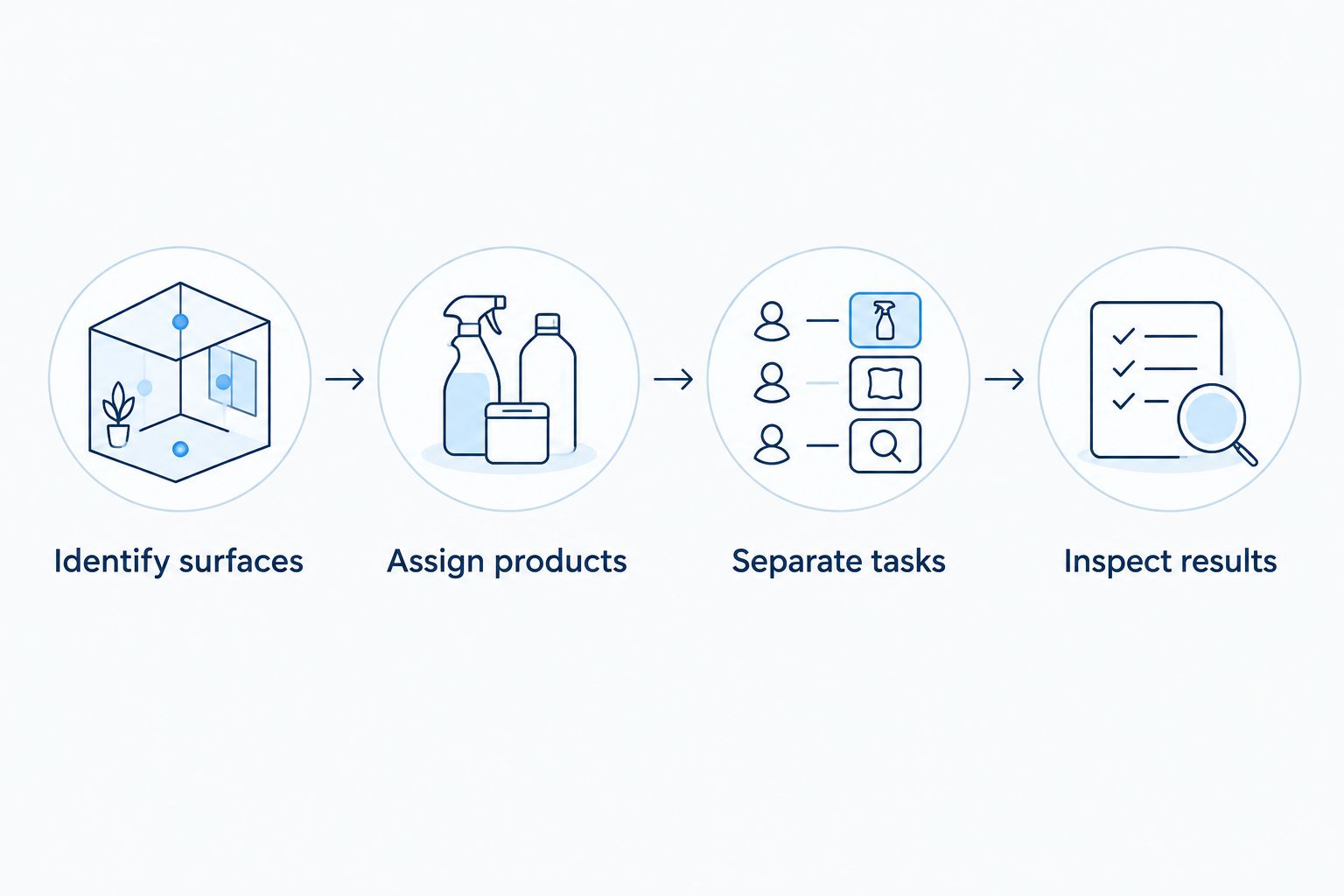
Use this sequence:
- Identify surfaces: Record flooring, countertops, shower materials and special coatings.
- Assign products: Match each task to a labeled product and the relevant care instructions.
- Separate tasks: Keep routine cleaning, mineral treatment and disinfection distinct.
- Inspect results: Check appearance, residue and unresolved maintenance issues before guest arrival.
For the final inspection, use 3 inspection zones: kitchen, bathrooms and living areas. Within each zone, check the actual task list rather than relying on a fragrance or an overall impression of cleanliness. Include bedrooms in the living-area inspection and add any property-specific spaces separately.
Keep products labeled and stored away from guests and children. Never mix cleaning chemicals; bleach mixed with acids or ammonia can release hazardous gases. Follow the product's protective-equipment and ventilation instructions.
A written process also makes handoffs clearer. Use the Airbnb turnover cleaning checklist to organize the work, then add the material-specific instructions for your rental.
Which cleaning products should you choose?
Start with a compatible neutral cleaner, then add only the specialty products your surfaces and tasks require. Stone, glass and floors deserve their own compatibility checks. Disinfectants and mineral removers need a defined reason for use.
Tampatopshelf provides vacation-rental turnover cleaning for St. Petersburg and Pinellas County hosts who want a local team rather than another supply-shopping task. The team is licensed and insured, reachable by phone or text, and offers straightforward quotes tailored to the property.
Request a free turnover quote
Discuss your property's cleaning needs with a local St. Petersburg team.
FAQ
What's the best cleaning product for a luxury vacation rental?
A surface-compatible neutral cleaner is the best starting point for routine cleaning. Add stone, glass, floor, disinfecting or mineral-removal products only where the property's materials and tasks require them.
Can I use one cleaner throughout my Airbnb?
Do not assume one cleaner is suitable throughout an Airbnb. Check each material's care instructions and the product label, especially for stone, wood flooring, coated glass and food-contact surfaces.
Is vinegar safe for marble bathroom counters?
Vinegar is not an appropriate routine cleaner for marble because its acidity can etch the stone. Choose a cleaner explicitly suitable for the marble and its finish.
Do I need to disinfect every surface between guests?
Use a defined cleaning and disinfection plan rather than assuming every surface needs the same treatment. Where disinfection is required, select an EPA-registered product approved for the surface and follow its complete label directions.
Why do mirrors look streaky after cleaning?
Cleaner residue, dirty cloths and remaining surface film can leave mirrors streaky. Follow the glass cleaner's directions, use clean cloths and inspect the result before adding more product.
Should vacation-rental cleaning products have a strong scent?
A strong scent is not evidence that a vacation rental is clean. Select products for the task and surface, and investigate the source of an odor instead of covering it with fragrance.
Can Tampatopshelf help with vacation-rental turnovers?
Tampatopshelf provides vacation-rental turnover cleaning in St. Petersburg and Pinellas County. The local team is licensed and insured, reachable by phone or text, and provides free quotes tailored to each property.
One last thing
A dull mark is not always dirt. If a surface stays cloudy after its approved cleaning method, stop escalating to stronger chemicals and check whether the finish needs maintenance or repair.
For your 2026 property file, keep surface care instructions beside the turnover checklist. That gives each cleaner a clear stopping point when ordinary cleaning does not resolve a mark.
Related guides
- Cleaning supplies for short-term rental turnovers
- Cleaning tips for sand and salt at beach vacation rentals
- Cleaning checklists for property managers with multiple units
Request a free quote by phone or text for vacation-rental turnover cleaning tailored to your St. Petersburg or Pinellas County property.


