
Busy families’ recurring house cleaning is scheduled home cleaning with the aim of keeping essential rooms usable without rebuilding your plan every weekend. This 2026 guide helps St. Petersburg and Pinellas County households choose a frequency, agree on tasks, and divide responsibilities around school, work, pets, and family routines.
- Recurring house cleaning for busy families works best with a written scope and a schedule tied to household use.
- Tampatopshelf is best for local households seeking recurring residential cleaning and direct communication by phone or text.
- Separate everyday tidying, recurring residential cleaning, and deep cleaning before comparing options.
- Choose weekly, every-other-week, or monthly visits around what you can maintain between cleanings.
Why recurring house cleaning matters for busy families
A family cleaning plan has to fit around occupied rooms, changing schedules, and the work that happens between visits. If kitchen counters are covered with homework or a bedroom is being used for a nap, access matters as much as the task list. Choose a workable handoff, not just a preferred day.
For your 2026 plan, distinguish between removing household clutter and cleaning the surfaces underneath it. Scheduling a cleaner does not decide who puts away toys, clears breakfast dishes, or handles laundry. Assign those jobs separately so the cleaning visit has a clear purpose.
Tampatopshelf recurring house cleaning is best for St. Petersburg and Pinellas County families seeking a local service reachable by phone or text. Tampatopshelf provides residential cleaning and straightforward quotes tailored to each property. The team is licensed and insured; the tasks and visit arrangements still need to be agreed for your home.
How to build a recurring cleaning plan
1. Identify the household tasks you need covered
Start with a shared note or a sheet of paper. Walk through your home and record the cleaning jobs that compete with family time, rather than copying a checklist designed for a different household. A frequently used bathroom and an unused guest room do not need equal priority.
Separate cleaning from organizing, maintenance, and daily household chores. Putting toys into storage is different from vacuuming an accessible floor; fixing a leaking fixture is different from cleaning around it. Ask about any task whose category or inclusion is unclear.
You can build this list yourself without buying anything. Keep it short enough that another adult can understand what matters without a room-by-room explanation.
- List the rooms used most often by your family.
- Mark the cleaning tasks you want someone else to handle.
- Assign dishes, laundry, and toy pickup separately.
- Flag fragile items, delicate surfaces, and rooms with access restrictions.
- Identify occasional jobs that need a separate discussion.
2. Choose a frequency you can support between visits
Compare proposed intervals of 7 days, 14 days, and approximately 1 month. These are planning options, not a promise that a particular booking slot is available. The right interval depends on how your home is used and which tasks your household will continue doing.
A weekly plan puts professional cleaning visits closer together. An every-other-week plan leaves more cleaning responsibility between appointments, while a monthly plan requires a more substantial household routine. None of these replaces wiping up spills or dealing with immediate messes.
For a 2026 family calendar, mark school commitments, work-from-home days, and regular activities before proposing a visit. Choose an interval you can maintain rather than assuming that the longest gap will meet the same needs.
- Compare how bathrooms and floors look after 7 days and 14 days.
- Note which rooms need attention before the next proposed visit.
- Decide who handles interim kitchen and bathroom cleaning.
- Offer workable access windows rather than assuming a visit duration.
- Reassess the interval when household use changes.
3. Agree on the scope before booking
Write a basic scope yourself first, then use a conversation with a cleaning company to settle the details. A provider-assisted plan is the faster route when you want help translating your priorities into an agreed service. It should clarify the work, not leave you guessing what a general cleaning label includes.
Tampatopshelf offers recurring residential cleaning and quotes tailored to each property. Use phone or text to explain your rooms, current condition, pets, and priorities. Ask which tasks belong in recurring service and which require a separate deep-cleaning discussion.
A recurring visit and an initial deep clean are different decisions. If there is existing buildup, describe it before booking rather than expecting routine maintenance work to resolve every unfinished task.
- Send a room list and your highest-priority tasks.
- Describe buildup, stains, or areas needing extra attention.
- Confirm whether appliance interiors or other detail work are included.
- Ask how to request a scope change before a visit.
- Keep the agreed task list where household adults can find it.
4. Prepare access without cleaning the house first
Preparation means making the agreed areas accessible, not doing the cleaner’s work in advance. Decide where loose belongings go, how the team enters, and which rooms must remain undisturbed. Use a shared note so these details do not depend on one parent remembering everything.
Keep private access information in your direct communication with the provider. Explain pets’ locations and any household restrictions before arrival. If a room cannot be accessed, agree on how that affects the planned work rather than assuming the team will improvise.
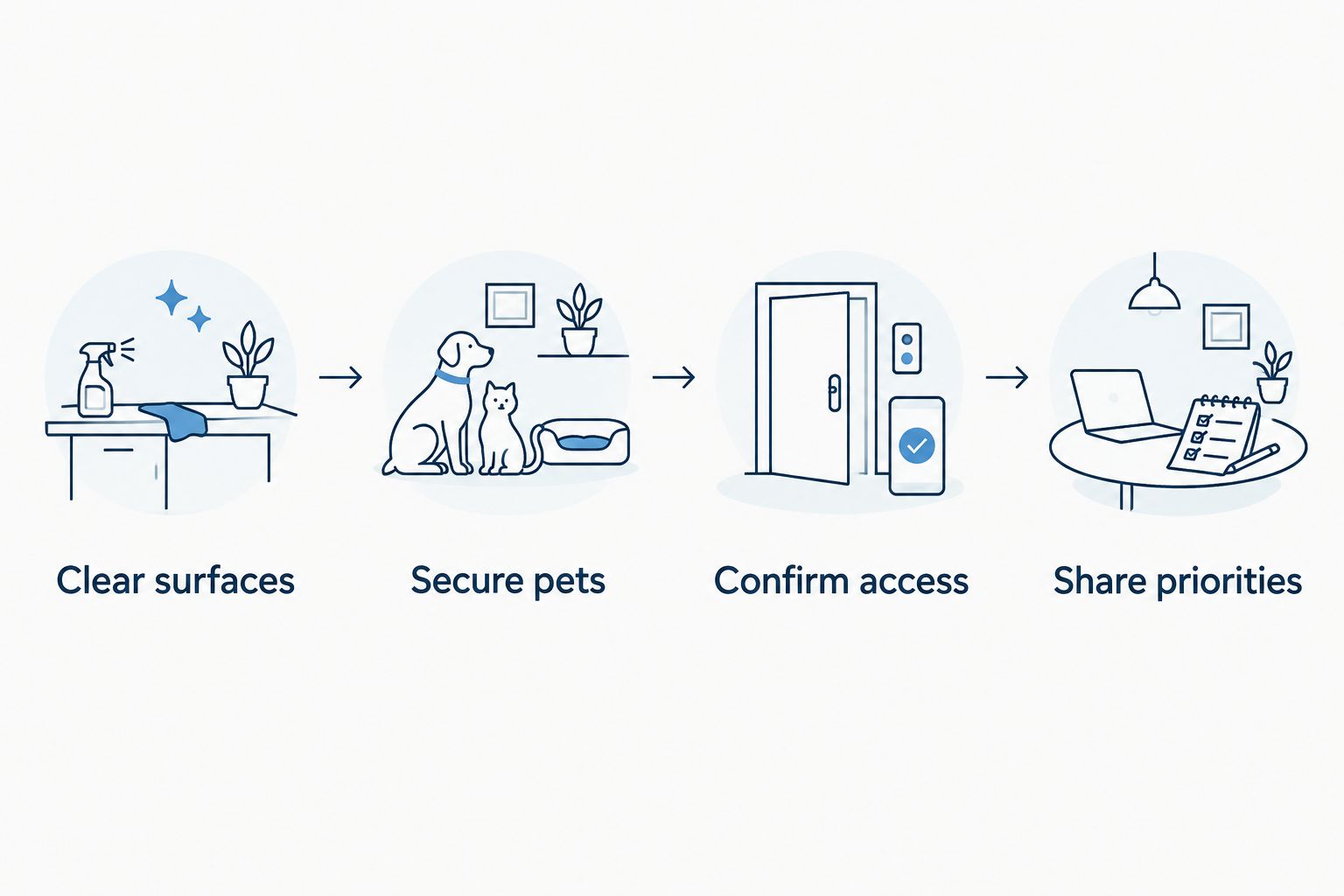
A simple handoff follows this sequence: clear surfaces, secure pets, confirm access, and share priorities. Each action removes a different source of confusion.
- Clear surfaces of paperwork, toys, and personal belongings.
- Secure pets according to your agreed household arrangements.
- Confirm access and identify any rooms that are off limits.
- Share priorities and flag changes before the visit.
5. Keep a small routine between cleaning visits
Recurring service covers agreed cleaning tasks; your household still needs a plan for immediate messes. Start with a short list of daily responsibilities rather than an elaborate chore system. Give each task an owner so it does not become a repeated negotiation.
Choose 3 daily tasks as a starting point: deal with dishes, wipe food-preparation surfaces, and put loose belongings away. This is a suggested routine, not a service standard. Add or change tasks to match your household and the scope you have arranged.
For your 2026 routine, keep cleaning products and tools appropriate to the surfaces you are treating. Follow product labels, keep supplies away from children, and tell the cleaning provider about any specific product restrictions.
- Deal with spills and food messes when they happen.
- Keep dishes separate from the recurring cleaning task list.
- Return toys and school items to their storage places.
- Handle any bathroom cleaning needed between appointments.
- Tell the provider about new surface-care instructions or restrictions.
6. Review the work against the agreed plan
Keep the task list available after each visit. Check whether the agreed rooms and tasks were addressed, then communicate specific observations directly. A room, surface, and description of the issue give the provider something concrete to respond to.
Review the plan when family circumstances change. A new pet, a room becoming a home office, or a relative staying with you can change which areas need attention. Ask about adjusting the scope instead of quietly adding expectations to an unchanged booking.
Do not assume a particular response policy or guarantee. Ask how concerns, scheduling changes, and additional requests are handled before they become urgent.
- Compare completed work with the agreed scope.
- Describe concerns by room and task.
- Report access problems or changed household arrangements.
- Ask before adding rooms or detail work.
- Revisit frequency if interim chores remain unmanageable.
Compare cleaning options for your family
Choose the arrangement that matches both your cleaning needs and your capacity between visits. A professional schedule is not automatically a replacement for household chores, and a one-time deep clean does not create an ongoing maintenance plan.
Use these options as a discussion framework. The professional visit intervals below are proposed arrangements to ask about, not confirmed booking options or standardized packages.
| Option | Best for | Practical advantage | Key limitation |
|---|---|---|---|
| Household-managed cleaning | Families willing to own the full routine | Direct control over tasks and timing | Household members must complete all cleaning work |
| Weekly recurring cleaning | Families wanting closely spaced maintenance visits | Shorter gaps between professional cleaning appointments | Daily messes and excluded tasks remain household responsibilities |
| Every-other-week recurring cleaning | Families able to maintain rooms between visits | Combines professional visits with an interim household routine | More cleaning responsibility falls between appointments |
| Monthly recurring cleaning | Families already maintaining the home consistently | Provides a scheduled opportunity for agreed cleaning work | Does not replace a regular household cleaning routine |
| One-time deep cleaning | Families addressing buildup or a defined reset | Focuses attention on an agreed detailed scope | Does not provide continuing maintenance |
Tampatopshelf residential cleaning is best for local families who want to discuss their property with a person by phone or text. The service provides a local contact and a property-specific quote, but you still need to confirm scope, access, scheduling arrangements, and exclusions. Do not treat a general service description as your household’s finished agreement.
Request your family cleaning quote
Discuss your St. Petersburg or Pinellas County home, priorities, and preferred cleaning schedule.
Common mistakes busy families make
Choosing frequency before assigning household chores
An every-other-week booking does not decide who handles dishes or cleans an unexpected mess. Assign those responsibilities before comparing intervals. Otherwise, the same unfinished jobs remain between professional visits.
Expecting recurring cleaning to include every detail task
An appliance interior, a crowded storage area, and routine bathroom cleaning are different requests. Discuss each task rather than assuming it belongs in the visit. Ask whether existing buildup needs separate attention before recurring service begins.
Leaving access instructions with only one adult
A cleaning plan becomes fragile when one parent holds every entry instruction and scheduling detail. Keep a shared household note, while protecting private access information. Name the person who will communicate changes to the provider.
Treating every room as equally urgent
An unused guest bedroom should not automatically displace the bathroom your family relies on daily. Tell the provider which spaces matter most, then agree on a scope that reflects those priorities. Do not leave the team to guess.
Forgetting to update the plan after a household change
A 2026 cleaning plan needs revision when room use, pets, or family routines change. Explain the change before the next visit and ask whether it affects the work. An old task list cannot communicate a new need.
FAQ
What’s the best recurring house cleaning schedule for busy families?
The best schedule is the interval your family can support between professional visits. Compare weekly, every-other-week, and monthly arrangements against your household’s actual bathroom, floor, and kitchen cleaning needs.
Is weekly cleaning better than every-other-week cleaning?
Weekly cleaning is better for families who want shorter gaps between professional maintenance visits. Every-other-week cleaning fits families prepared to handle more interim cleaning; both require an agreed scope and everyday household upkeep.
Do I need to clean before the house cleaner arrives?
Prepare access and put away loose belongings rather than cleaning the agreed surfaces yourself. Confirm expectations for dishes, toys, paperwork, pets, and occupied rooms before the appointment.
Should my family book a deep clean before recurring service?
Discuss an initial deep clean if existing buildup falls outside the proposed recurring scope. Describe the home’s condition and ask the provider which work needs separate attention before maintenance visits begin.
What should I tell a cleaner about children and pets?
Tell the cleaner about occupied rooms, nap times, pet locations, and any access or product restrictions. Agree on arrangements that keep the cleaning areas accessible without requiring the team to guess your household rules.
How do I compare recurring cleaning quotes?
Compare quotes against the same room list, task list, visit frequency, and starting condition. Confirm exclusions and the process for requesting extra work so you are comparing equivalent scopes rather than different assumptions.
Can I speak to a local cleaning team in St. Petersburg?
Tampatopshelf is a local St. Petersburg cleaning team serving homeowners in St. Petersburg and Pinellas County, reachable by phone or text. Request a straightforward quote tailored to your property and discuss the recurring cleaning work you need.
One last thing
Before finalizing your 2026 arrangement, ask the other adults in your household to write down the cleaning jobs they expect the service to cover. Compare those answers with the provider’s scope. Resolve mismatched expectations before the visit, not after it.
Related guides
- Cleaning schedules for recurring residential cleaning
- Pet-friendly cleaning products for Pinellas County homes
- Move-in cleaning checklist for new St. Petersburg homeowners
- Cleaning tips for humid Florida homes
Request a free quote by phone or text to discuss cleaning built around your home and family routine.


