
Paying extra for eco-friendly cleaning products is worth it when you can verify a useful benefit, such as independently reviewed ingredients, less packaging, or a fragrance-free formula that suits your household. Skip the premium when the only evidence is green packaging or an undefined environmental claim; the product still needs to clean your surfaces effectively and meet its label directions.
- Is it worth paying extra for eco friendly cleaning products? Yes, when verified benefits match your actual cleaning needs.
- EPA Safer Choice offers ingredient-based screening; a green label alone does not establish a product’s environmental benefits.
- For Airbnb turnovers, confirm surface compatibility and disinfecting directions rather than choosing by scent.
- Tampatopshelf cleaning services suit local homeowners and hosts seeking property-specific quotes; confirm product preferences before booking.
Why this matters
For St. Petersburg homeowners and Pinellas County vacation-rental hosts, the decision is practical: what will clean the property properly without introducing unnecessary fragrance, packaging, or surface-care problems? A premium product that leaves residue or requires repeated cleaning is not a useful upgrade.
For your 2026 cleaning routine, start with the job rather than the environmental slogan. If someone else cleans your property, establish whether you can request specific cleaning products before changing the supply list.
Is it worth paying extra for eco-friendly cleaning products?
Pay for a specific, verifiable improvement—not the word eco-friendly. Compare the actual formulas, instructions, packaging, and intended uses before deciding that either product deserves a place in your cupboard.
An environmental certification answers a different question from a disinfectant label. Likewise, a fragrance-free formula addresses fragrance preferences, not every aspect of environmental impact.
| Option | Best for | Useful advantage | Limitation |
|---|---|---|---|
| EPA Safer Choice-labeled cleaner | Routine cleaning with ingredient-based screening | Ingredients must meet the program’s criteria, alongside other product requirements | The label does not make every product suitable for every surface or disinfecting task |
| Fragrance-free cleaner | Households avoiding added fragrance | Addresses an identifiable product preference | Fragrance-free alone does not establish environmental performance |
| Concentrated or refill cleaner | Households able to follow refill and dilution instructions | Can reduce packaging per prepared amount when the refill system actually uses less packaging | Incorrect dilution changes how the product performs |
| Conventional cleaner approved for the surface | Jobs where the existing product already works | Provides a baseline for judging whether switching improves anything | Environmental benefits require their own evidence |
These categories overlap. A cleaner can be fragrance-free, concentrated, and certified; none of those descriptions automatically makes it a disinfectant.
What counts as useful evidence in 2026?
Look for a named standard with published requirements, not a leaf symbol designed by the manufacturer. The U.S. Environmental Protection Agency’s Safer Choice program evaluates ingredients against criteria for human health and environmental characteristics, with additional requirements covering matters such as product performance and packaging.
Check the exact product, not just the manufacturer. A company offering a certified cleaner does not establish that every formula it sells meets the same standard.
For packaging claims, identify what changed. A refill pouch, reusable bottle, or concentrate needs a specific explanation of the material reduction; the word sustainable does not supply that explanation.
Certified cleaners: best for ingredient-based screening
A recognized certification gives you criteria to examine instead of asking you to trust broad wording. That is useful when you want a repeatable purchasing rule for routine kitchen, bathroom, and general surface cleaning.
The limitation is scope. Certification does not override a countertop manufacturer’s care instructions, establish suitability around every pet, or promise that no individual will react to a formula.
Choose certification as a screening tool, then check the job-specific instructions. Keep the current label available so a household member or cleaner can confirm where the product belongs.
Fragrance-free cleaners: best for avoiding added fragrance
If your goal is to avoid added fragrance, look for that specific attribute rather than assuming every eco-labeled product has it. Plant-derived fragrances and essential oils are still fragrance ingredients; natural origin is not evidence that a scent suits everyone.
The advantage is a clearer purchasing requirement. The limitation is that fragrance-free does not mean universally non-irritating, pet-safe, or environmentally preferable in every respect.
For a vacation rental, separate a neutral-smelling room from a disinfected surface. A strong scent proves neither cleanliness nor successful disinfection, and masking an odor does not remove its source.
Concentrates and refills: best for controlled preparation
Concentrates are useful when you have a consistent place to prepare them and can follow the label accurately. Refills also deserve consideration when they replace repeated purchases of the same disposable container with less packaging.
The trade-off is handling. You need the correct container, clear identification, and a reliable dilution method; a more complicated system is a poor fit if different people will guess at preparation.
For your 2026 supply review, judge the whole system rather than the appearance of the refill. Keep original instructions accessible, never use food or drink containers, and do not combine leftover cleaning products.
Why the value of eco-friendly cleaning products varies
The same product can be a sensible upgrade for one property and unnecessary for another. Use these factors to decide whether its particular benefit matters:
- Your cleaning task. Everyday soil, baked-on grease, mineral deposits, and disinfection require different product capabilities. An environmental claim does not establish suitability for all of them.
- Your surfaces. Stone, sealed finishes, glass, and metal have different care requirements. Start with the surface manufacturer’s instructions.
- Fragrance preferences. Avoiding added fragrance is a specific reason to switch. A botanical scent is not an equivalent substitute for fragrance-free.
- Preparation requirements. Ready-to-use products remove a dilution step; concentrates require accurate preparation and appropriate storage.
- Packaging evidence. Compare the packaging used for the amount you actually prepare and use, including replacement containers.
- Cleaning results. Judge residue, soil removal, and compatibility under label-compliant use. A product that does not do its assigned job has not earned a permanent place.
Do not change the product, cloth, dilution, and cleaning method simultaneously if you want a useful comparison. Keeping the task consistent helps you identify what actually improved.
How to decide before replacing your supplies
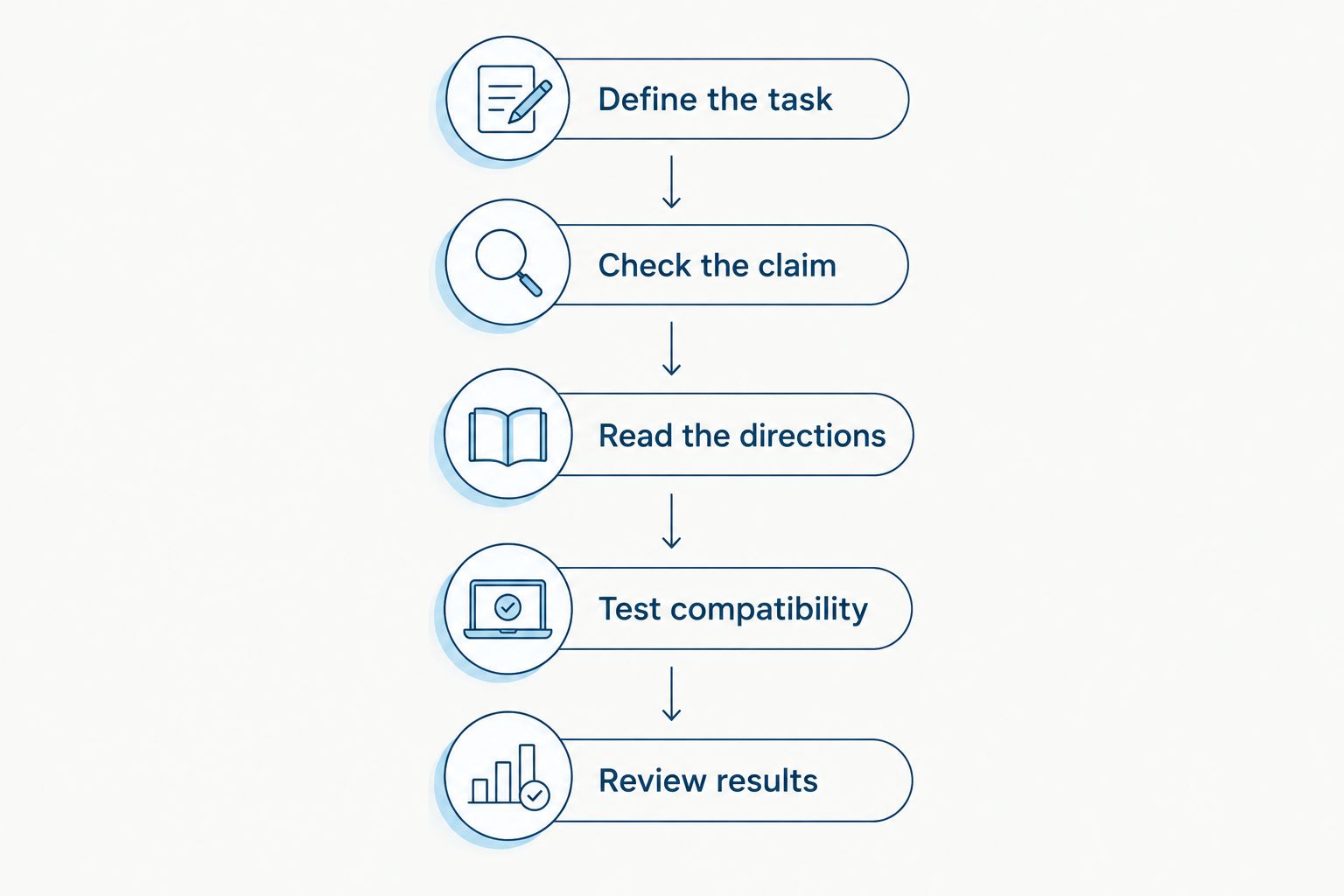
Use this sequence for your 2026 household or rental supply review. It keeps environmental preferences connected to cleaning requirements rather than treating them as competing priorities.
- Define the task. Identify the surface and the problem: routine soil, grease, mineral residue, or a situation requiring disinfection.
- Check the claim. Find the certification criteria or the specific explanation behind the packaging or ingredient claim.
- Read the directions. Confirm approved surfaces, dilution, ventilation, protective measures, and any required rinsing.
- Test compatibility. Follow the surface manufacturer’s guidance and the cleaner’s directions for testing an inconspicuous area.
- Review results. Check for remaining soil, film, streaks, unwanted fragrance, or finish changes before adopting the product more widely.
Replace products selectively rather than replacing the entire cupboard at once. Start with a frequently used cleaner whose proposed benefit you can explain clearly, then review its results before extending the change.
For an Airbnb, document the approved product and its assigned surfaces. A short written instruction is more useful than asking each cleaner to interpret an eco-friendly preference independently.
Are eco-friendly products enough for Airbnb turnovers?
Eco-friendly cleaners are suitable for turnover tasks only when their labels match the surfaces and work involved. The environmental claim alone does not establish disinfecting performance.
Cleaning removes soil; disinfecting uses a product with directions for killing specified microorganisms. When disinfection is needed, use an appropriate EPA-registered disinfectant and follow its label, including the required wet contact time. Do not substitute a general-purpose cleaner simply because its branding suggests a gentler formula.
For St. Petersburg rental hosts, the practical priority is a clear turnover plan. Specify routine cleaning products, any required disinfectant, surface restrictions, and where instructions are stored so the team does not have to improvise between guests.
Should allergy-sensitive households pay extra for green cleaners?
Allergy-sensitive households should choose products around known sensitivities and label information, not assume green means non-irritating. Fragrance-free products address added fragrance, but no broad environmental description guarantees that a particular formula will suit everyone.
Tell your cleaner which ingredients or products you need avoided and identify any clinician-provided instructions. Keep the request specific; asking for no added fragrance is clearer than asking for something natural.
Do not use a product trial to test a known serious sensitivity. Seek appropriate medical advice about individual restrictions rather than relying on a cleaning label to answer a health question.
What should you ask a cleaning company before booking?
Ask what products the team plans to use, whether your preferred products can be accommodated, and how surface restrictions will be recorded. Confirm whether you need to provide anything rather than assuming a particular formula is included.
Tampatopshelf is a fit for St. Petersburg homeowners and vacation-rental hosts who want a local cleaning team and a property-specific quote. The team is licensed and insured and reachable by phone or text; its residential and turnover services serve St. Petersburg and Pinellas County.
Product preferences still need a separate conversation. Do not infer an all-eco product policy, certification, or guaranteed accommodation from the availability of cleaning services. Include your surfaces, fragrance restrictions, and preferred formulas when you request a quote.
FAQ
Is it worth paying extra for eco friendly cleaning products in 2026?
Yes, when a verified benefit matches your needs and the product performs its assigned cleaning task. Skip a premium based only on vague green wording or packaging.
Does EPA Safer Choice mean a cleaner disinfects?
No, the EPA Safer Choice label does not by itself establish that a cleaner disinfects. Check for the appropriate EPA disinfectant registration and follow the product’s disinfecting directions when that task is needed.
Are natural cleaning products always safer for pets?
No, natural origin does not establish that a cleaning product is safe for every pet or use. Follow the label’s handling, access, rinsing, and drying instructions, and ask your veterinarian about species-specific concerns.
Is fragrance-free the same as eco-friendly?
No, fragrance-free describes a fragrance attribute, not the product’s full environmental impact. Evaluate environmental claims and surface suitability separately.
Can I mix green cleaning products to make them stronger?
Do not mix cleaning products. Follow each product’s label; combining formulas can create hazardous reactions, and green branding does not make mixing safe.
Are concentrated cleaners automatically better for the environment?
No, concentration alone does not establish the product’s overall environmental impact. Check packaging, dilution requirements, and the evidence supporting the specific claim.
Can Tampatopshelf use my preferred eco-friendly cleaning products?
Ask Tampatopshelf about your preferred products before booking cleaning services. Share the exact formulas, relevant surface instructions, and fragrance restrictions so the team can discuss your request.
One last thing
For your 2026 cleaning plan, the most useful upgrade might be a clearer instruction rather than a different bottle. Correct dilution, the right surface, and any required rinsing or disinfectant contact time determine how a product should be used.
Write those instructions into your household or turnover checklist. An environmental preference becomes actionable when everyone knows which product belongs where—and what it is not intended to do.
Related guides
- Eco-friendly cleaning products for St. Petersburg homes
- Cleaning supplies for short-term rental turnovers
- Cleaning supplies for allergy-sensitive households
Ready to discuss cleaning built around your property? Call or text Tampatopshelf to request a free quote, and mention your cleaning-product preferences.


