Best overall: an EPA Safer Choice-certified all-purpose cleaner. Best for laundry: a fragrance-free detergent. Best low-waste option: a concentrated floor cleaner approved for your flooring. This 2026 guide compares product types for St. Petersburg homes and vacation rentals; Tampatopshelf provides local cleaning services when you want the work handled for you.
- For eco friendly cleaning products St Petersburg, start with an EPA Safer Choice-certified all-purpose cleaner.
- Choose fragrance-free laundry detergent for bedding; check the machine instructions and product dose.
- Use surface-specific cleaners for glass, natural stone, and finished floors rather than one bottle everywhere.
- Tampatopshelf serves St. Petersburg homeowners and vacation-rental hosts who want professional cleaning rather than a shopping list.
Why this matters in St. Petersburg homes
The best cleaning product is one that suits the surface, removes the soil, and has clear instructions. A green-looking bottle does not establish any of those things. For your 2026 cleaning routine, judge the label rather than the packaging color or a broad claim such as natural.
Homeowners need products that work with their floors, countertops, and household preferences. Vacation-rental hosts also need instructions that another cleaner can follow without guessing. Fragrance, dilution, and surface restrictions belong in that handoff.
Tampatopshelf is a practical choice for St. Petersburg homeowners and hosts who want cleaning handled by a local service. Its residential and vacation-rental cleaning services are separate from the product recommendations below; this guide does not claim that the team uses these product types.
What makes the best eco-friendly cleaning products?
Use these criteria to compare cleaning products in 2026:
- Meaningful certification: EPA Safer Choice evaluates ingredients against its safer-chemical criteria. Look for the actual certification, not similar-looking wording.
- Surface compatibility: The label should identify suitable surfaces and exclusions. Stone, wood, glass, and flooring do not share one cleaning requirement.
- Fragrance choice: Choose fragrance-free products when you want to avoid added fragrance. Unscented and fragrance-free are not interchangeable label claims.
- Clear directions: A useful label explains dosing, dilution, application, and whether rinsing is required.
- Waste control: Concentrates and refills deserve consideration when you can measure and store them correctly. Concentrated does not mean safer to handle undiluted.
- Task fit: Cleaning removes soil; disinfection is a separate task. Do not treat an ordinary cleaner as a disinfectant.
Eco-friendly cleaning products at a glance
These are ranked product types, not claims about individual manufacturers. Certification and compatibility must be checked on the specific product you select.
| Product type | Best for | Standout feature | Key limitation |
|---|---|---|---|
| EPA Safer Choice-certified all-purpose cleaner | Routine cleaning of compatible washable surfaces | Independent ingredient-screening criteria | Not automatically suitable for stone, wood, or disinfection |
| Fragrance-free laundry detergent | Bedding, towels, and washable household textiles | Avoids added fragrance when labeled fragrance-free | Requires correct dosing and fabric compatibility |
| Fragrance-free glass cleaner | Mirrors and compatible glass | A dedicated option for transparent surfaces | Not automatically suitable for screens or coated glass |
| pH-neutral natural-stone cleaner | Stone counters and compatible stone floors | Surface-specific care without relying on acidic household mixtures | Neutral pH alone does not establish environmental credentials |
| Concentrated floor cleaner | Repeated cleaning of an identified floor finish | Dilution can reduce the amount of packaging purchased | Incorrect dilution or unsuitable chemistry can leave residue or damage finishes |
1. EPA Safer Choice cleaner: best for everyday surfaces
An EPA Safer Choice-certified all-purpose cleaner is the default starting point for routine cleaning of compatible washable surfaces. The certification gives you a more useful basis for selection than an unqualified eco-friendly claim. You still need to read the surface instructions.
Choose a fragrance-free version if added scent is not part of your cleaning preference. The EPA program also has criteria for its fragrance-free designation; verify the specific label rather than assuming every certified cleaner has no fragrance.
EPA Safer Choice cleaner pros:
- Offers an established ingredient-screening framework.
- Suits routine cleaning when the surface is listed as compatible.
- Provides a practical starting point for a smaller cleaning kit.
EPA Safer Choice cleaner cons:
- Certification does not mean harmless under every exposure condition.
- An all-purpose label does not establish suitability for every material.
- Ordinary cleaning claims do not establish disinfecting performance.
For a home, use it where the label and surface-care instructions agree. For a vacation rental, record its permitted uses so a substitute cleaner does not apply it to an excluded countertop or finish.
Best for: Routine cleaning of compatible washable household surfaces.
Verdict: Buy an appropriately labeled EPA Safer Choice cleaner as your everyday starting point.
2. Fragrance-free detergent: best for bedding and towels
Fragrance-free laundry detergent is the strongest category choice when you want clean household textiles without added perfume. Check for EPA Safer Choice certification if ingredient screening is also a priority. Neither attribute replaces the textile care label or washing-machine instructions.
For vacation-rental linens, a written laundry process matters as much as the bottle. Follow the detergent dose for the load and conditions described on its label, and do not add extra detergent simply because towels look heavily used.
Fragrance-free detergent pros:
- Avoids intentionally added fragrance when labeled accordingly.
- Fits a consistent bedding-and-towel laundry routine.
- Can combine fragrance-free labeling with third-party certification.
Fragrance-free detergent cons:
- Does not guarantee that every person will tolerate every ingredient.
- Does not replace stain treatment or fabric-care instructions.
- Excess detergent can leave residue instead of improving the result.
Keep bedding care separate from room cleaning. A scent left on a freshly washed sheet is not evidence that the textile is cleaner, and a fragrance-free wash does not need a scented finishing spray.
Best for: Bedding, towels, and washable textiles where added fragrance is unwanted.
Verdict: Buy fragrance-free detergent that matches your machine and textile instructions.
3. Fragrance-free glass cleaner: best for mirrors and windows
A dedicated glass cleaner gives mirrors and compatible glass a separate place in your cleaning kit. Choose fragrance-free labeling if you want to avoid added scent, and look for a credible certification rather than assuming clear liquid means environmentally preferable.
Use the product only on surfaces named in its instructions. Window glass, tinted films, coated shower glass, and electronic screens can have different care requirements. A glass-cleaning label is not permission to clean all of them.
Fragrance-free glass cleaner pros:
- Gives glass a defined product rather than an improvised mixture.
- Avoids added fragrance when the label confirms it.
- Works within a simple, surface-specific cleaning routine.
Fragrance-free glass cleaner cons:
- Suitability for specialty coatings requires verification.
- A dirty cloth can redeposit soil even with the correct cleaner.
- Fragrance-free labeling alone says nothing about broader environmental performance.
For mirrors, keep the cloth clean and follow the application directions. If streaks remain, check the cloth and product amount before adding another chemical.
Best for: Mirrors and ordinary glass expressly covered by the product label.
Verdict: Buy for a defined glass-cleaning task; skip use on unapproved screens or coatings.
4. pH-neutral stone cleaner: best for natural-stone surfaces
A pH-neutral cleaner labeled for your stone is a better starting point than an acidic homemade mixture. Acids can etch acid-sensitive stone, including marble and limestone. Identify the material before choosing the product.
Neutral pH is a compatibility consideration, not an environmental certification. If you want both stone suitability and ingredient screening, verify both separately. Also follow the stone supplier's care guidance and any instructions associated with the finish or sealer.
pH-neutral stone cleaner pros:
- Addresses stone care as its own task.
- Avoids treating acidic household ingredients as universal cleaners.
- Helps establish clear instructions for countertops or stone floors.
pH-neutral stone cleaner cons:
- Does not repair etching, scratches, or damaged sealers.
- Neutral pH does not guarantee suitability for every stone installation.
- Environmental claims still need separate support.
In a rental property, name the countertop material in the cleaning notes. Instructions such as clean the kitchen counter leave too much room for someone to choose the wrong bottle.
Best for: Identified natural-stone surfaces with matching product and care instructions.
Verdict: Buy only after confirming the stone and its care requirements.
5. Concentrated floor cleaner: best for repeat floor care
A concentrated floor cleaner is useful when you repeatedly clean the same identified flooring and can measure the dilution correctly. Concentrates can reduce packaging needs compared with buying an equivalent amount of ready-to-use solution. That advantage depends on the product format and how you use it.
Choose the floor-compatible product first and the concentrate format second. Wood, laminate, tile, and resilient flooring have different care requirements, and a floor cleaner is not automatically safe for every finish.
Concentrated floor cleaner pros:
- Supports a repeatable routine for compatible flooring.
- Can reduce reliance on separate ready-to-use containers.
- Allows clear dilution instructions for shared cleaning work.
Concentrated floor cleaner cons:
- Requires accurate measurement rather than free-pouring.
- Needs careful storage and clearly labeled working containers.
- Overconcentration can leave residue; the wrong product can damage a finish.
Follow both the cleaner label and flooring manufacturer's care instructions. Do not solve a sticky floor by repeatedly adding more cleaner; first check the dilution, rinsing directions, and whether the product belongs on that floor.
Best for: Repeated cleaning of flooring with known care requirements.
Verdict: Buy if you can measure consistently; skip the concentrate format if it encourages guessing.
How these product types are ranked
This 2026 ranking prioritizes meaningful certification, surface compatibility, clear directions, fragrance choice, and waste control. The all-purpose category comes first because it addresses routine cleaning, while the other recommendations cover distinct tasks.
These are category-level recommendations, not a laboratory test or a comparison of named formulations. A suitable, clearly labeled product outranks a vaguely described green alternative. No product earns a recommendation solely because it contains plant-derived ingredients.
Which cleaning products should you choose?
Start with an EPA Safer Choice-certified all-purpose cleaner, then add only what your surfaces require. A home with stone countertops needs different instructions from one without them. Your actual materials decide the kit.
For a vacation rental, use 1 written product checklist and keep 2 separate cloth sets: one for bathrooms and one for kitchen surfaces. Those are practical organization recommendations, not a claim about a required cleaning standard. Label the sets so another cleaner can follow the same separation.
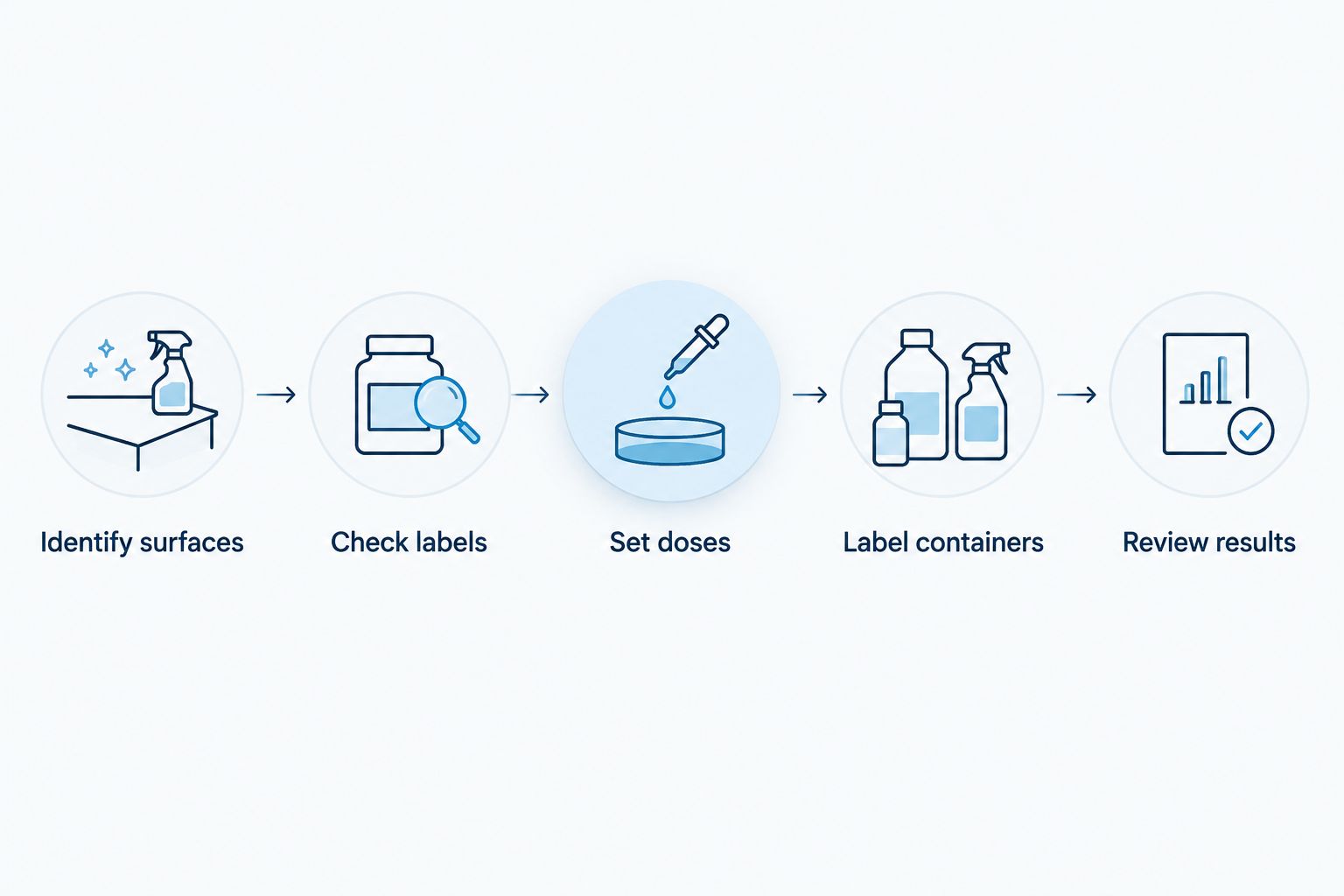
Build your 2026 product routine in this order:
- Identify surfaces: Record flooring, countertops, glass coatings, and washable textiles.
- Check labels: Confirm permitted uses, certification, fragrance, and safety directions.
- Set doses: Write down label-based dilution or dosing without improvising.
- Label containers: Keep working solutions identifiable and follow storage instructions.
- Review results: Check for remaining soil or residue before changing products.
Tampatopshelf provides residential and vacation-rental cleaning in St. Petersburg and Pinellas County. If you want professional cleaning rather than managing the kit yourself, explain your surfaces and fragrance preferences when requesting a quote; do not assume a particular product is included.
Request a free cleaning quote
Discuss your property, cleaning needs, and fragrance preferences with a local team.
FAQ
What's the best starting point for eco-friendly cleaning products in St. Petersburg?
An EPA Safer Choice-certified all-purpose cleaner is the best starting point for routine cleaning of compatible washable surfaces. Check the specific surface instructions and choose fragrance-free labeling if you want to avoid added fragrance.
Does EPA Safer Choice mean a cleaner is completely harmless?
No. EPA Safer Choice evaluates ingredients against safer-chemical criteria, but certification does not remove the need to follow handling, storage, and application directions. Keep cleaning products away from children and pets.
Is vinegar a good cleaner for every surface?
No. Vinegar is acidic and can etch acid-sensitive natural stone, including marble and limestone. Follow the surface manufacturer's care instructions instead of treating vinegar as a universal cleaner.
Are fragrance-free and unscented cleaners the same?
No. Unscented products can contain ingredients that mask odors, while fragrance-free labeling addresses added fragrance. Check the exact label and ingredient information rather than judging the product by smell.
Can an eco-friendly cleaner disinfect a vacation rental?
An ordinary cleaner should not be treated as a disinfectant. When disinfection is needed, choose an EPA-registered disinfectant with the appropriate label claims and follow its directions, including contact time.
Are concentrated floor cleaners always the better choice?
No. A concentrate is useful only when it suits the flooring and you can measure the dilution correctly. Ready-to-use formats remove the dilution step, while concentrates require more careful preparation.
What should I tell a cleaning service about product preferences in 2026?
Tell the cleaning service about fragrance preferences, known ingredient concerns, surface materials, and manufacturer care restrictions. Ask which products will be used and how special instructions will be recorded before agreeing on the cleaning scope.
One last thing
Cleaning and disinfection are different jobs. An eco-friendly claim does not establish that a product disinfects, and adding a second chemical does not make the first one work better. Never mix cleaning products, particularly bleach with ammonia or acids.
For your 2026 routine, put clear surface instructions ahead of a longer shopping list. Tampatopshelf is local, licensed, and insured, and reachable by phone or text. Request a free quote by phone or text and describe your property, cleaning needs, and product preferences.