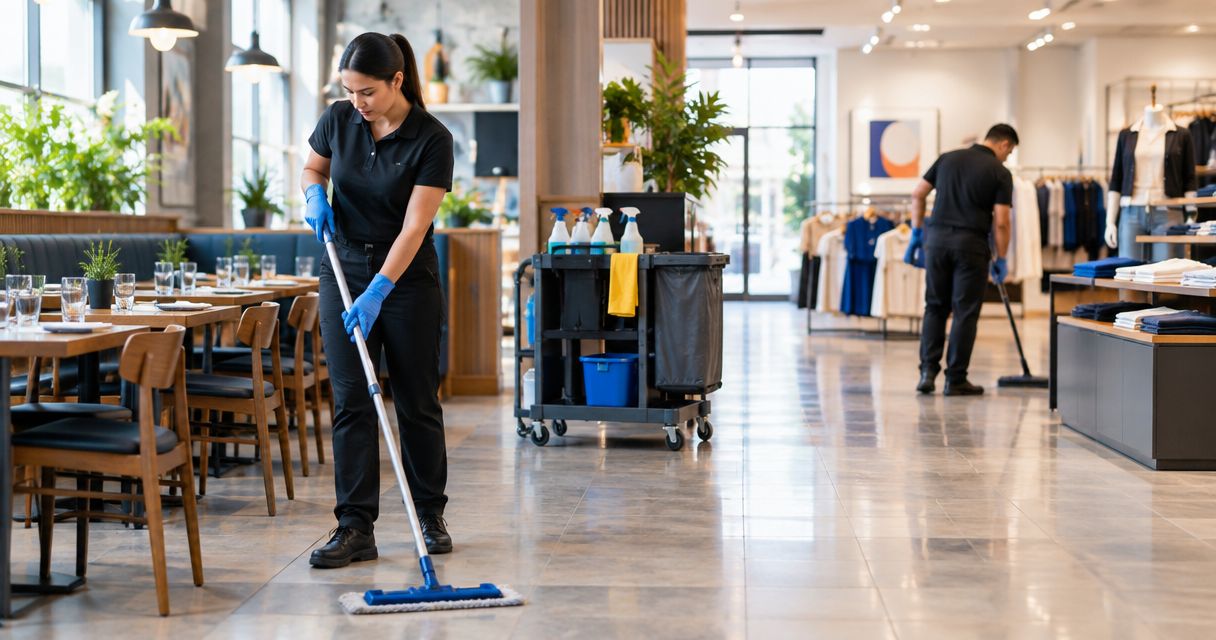
Restaurant and retail commercial cleaning is the planned cleaning of customer areas, staff spaces, and agreed operational surfaces with the aim of keeping your business ready to open. In St. Petersburg and Pinellas County, start with a written scope: Tampatopshelf provides commercial cleaning, but restaurant kitchen work and specialized floor care need explicit confirmation before booking.
- Commercial cleaning for restaurants and retail needs separate plans for customer areas, food-contact surfaces, and specialist work.
- Tampatopshelf suits St. Petersburg and Pinellas County businesses seeking a local commercial cleaning quote.
- Restaurant cleaning must distinguish routine housekeeping from food-contact sanitation and kitchen equipment maintenance.
- Retail cleaning should account for entrances, fitting rooms, displays, and floor materials.
- Compare written scope, access arrangements, and inspection procedures rather than an undefined promise to clean everything.
Why commercial cleaning matters for restaurants and retail
A restaurant and a shop need different cleaning plans, even when they share a building. Restaurants handle food residues and food-contact surfaces; retailers need clear customer routes, presentable displays, and methods that protect merchandise. A general checklist misses those differences.
Your 2026 cleaning plan should distinguish appearance from hygiene and maintenance. A polished dining room does not establish that food-contact surfaces were sanitized, and a tidy sales floor does not establish that restroom supplies were checked.
For local premises, include entrance conditions in the scope. Sand tracked across a shop floor needs removal, while a wet restaurant entrance needs an immediate response rather than a place on the next cleaning visit. Assign staff responsibility for problems that arise while customers are present.
Hire against a task list, not the phrase “commercial cleaning.” The useful question is who cleans each surface, by which method, and who checks the result.
Build your 2026 cleaning plan
1. Map each area before choosing a service
Walk through your premises with a floor plan or a simple paper checklist. Record customer spaces, staff-only areas, storage, restrooms, and any food preparation areas separately. This manual survey gives you a clearer brief than sending a provider only your total floor area.
For restaurants, distinguish dining furniture from preparation counters and equipment. For retail, record fitting rooms, shelving, checkout stations, and stockroom access. Note anything the cleaner must not move, disconnect, open, or treat.
Organize the survey into 3 task groups: routine cleaning, food-contact sanitation, and specialist maintenance. Those are planning categories, not interchangeable services.
- List every room or operating zone, including shared corridors.
- Identify surface materials and any manufacturer care instructions.
- Mark food-contact surfaces separately from ordinary touchpoints.
- Record restricted areas, delicate displays, and equipment exclusions.
- Assign each task group to staff, a cleaner, or a specialist.
2. Separate cleaning from sanitizing and disinfecting
Cleaning removes dirt and residue; sanitizing and disinfecting serve different purposes and require suitable products and procedures. In a restaurant, food-contact surfaces need the applicable food-safety process, not simply the same treatment used on restroom fixtures.
Start by checking product labels and the procedures already used by your food-service team. Follow directions for dilution, contact time, surface compatibility, and rinsing where required. Do not substitute a general disinfectant for a product suitable for the intended food-contact use.
Write 2 checklists: one for routine housekeeping and one for food-handling responsibilities. If an outside cleaner performs any food-contact work, name the exact surfaces and method in the agreement. Outsourcing a task does not remove the need to verify it.
- Remove visible soil before applying a sanitizer or disinfectant.
- Keep restroom tools separate from tools used in food areas.
- Follow the product label rather than guessing dilution or contact time.
- Store chemicals away from food and merchandise as required.
- Identify who checks food-contact work before preparation resumes.
3. Match the provider to the actual scope
Use your checklist to decide which work your staff can reasonably own and which work needs outside help. Staff-led cleaning gives you direct control but still needs scheduled time, training, supplies, and inspection. A recurring cleaning service moves agreed tasks outside the staff workload, but only the written scope defines what is included.
Tampatopshelf is best for St. Petersburg and Pinellas County businesses seeking a local commercial cleaning quote. The team is licensed and insured and reachable by phone or text; confirm the requested restaurant or retail tasks directly rather than assuming specialist capabilities.
Commercial cleaning is not automatic evidence of kitchen exhaust cleaning, pest treatment, mold remediation, or floor restoration expertise. Ask for a separate scope when your premises need those services.
- Send the same task list to every provider you compare.
- Ask which areas, surfaces, and tasks are excluded.
- Confirm supplies, equipment, waste handling, and restocking responsibilities.
- Check that insurance documentation matches your contracting requirements.
- Request a property-specific quote instead of an undefined package.
4. Schedule around opening, closing, and staff responsibilities
Build your 2026 schedule around how the premises operate, not a generic cleaning frequency. Use opening checks, in-service responses, and closing work as separate responsibilities. Recurring outside cleaning then fits around those duties rather than replacing them.
For restaurants, distinguish dining-room resets from kitchen close-down procedures. For retailers, consider deliveries, fitting-room use, and when displays are accessible. Ask about scheduling before agreeing to a service; do not assume an overnight or same-day option exists.
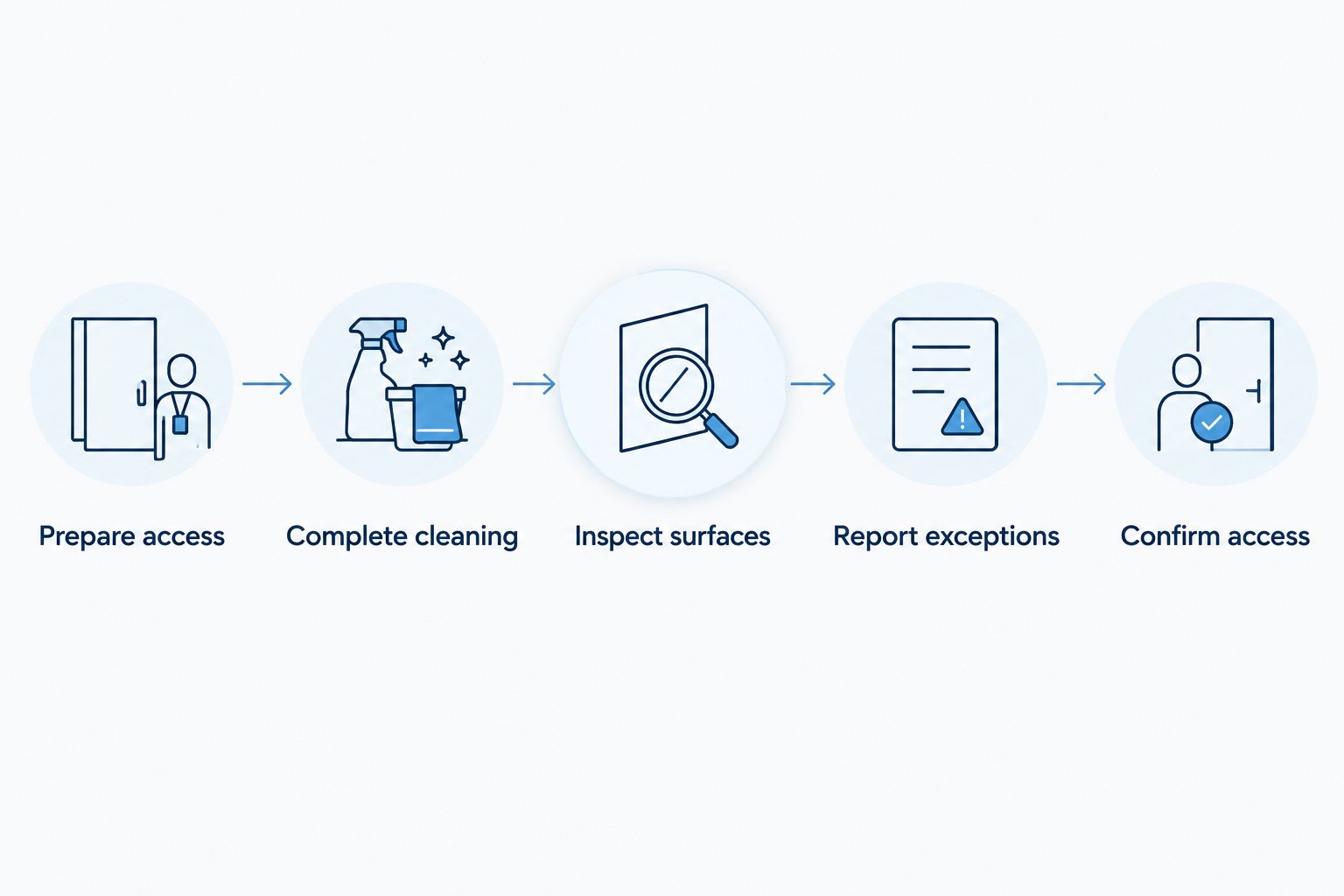
A workable handoff follows the same sequence each visit: prepare the space, complete agreed work, inspect it, and report exceptions. Keep 1 shared handoff record so the manager and cleaner do not maintain conflicting versions.
- Prepare access: record entry instructions and approved contacts.
- Complete cleaning: list tasks by area and responsibility.
- Inspect surfaces: check the agreed result before reopening an area.
- Report exceptions: record damage, inaccessible spaces, or unfinished work.
- Confirm access: assign responsibility for locking and alarm procedures.
5. Protect floors, fixtures, food, and merchandise
Choose methods by surface and task, not by the strongest-smelling product. Start with the care instructions for flooring, counters, upholstery, and fixtures. Test a suitable method in an inconspicuous area when the instructions call for it.
Restaurant grease, retail dust, and entrance grit are different problems. Do not let a single mop routine stand in for all of them. Keep food and merchandise protected from splash, overspray, and chemical contact, and agree on who moves items before cleaning begins.
Wet-floor signs communicate a hazard; they do not remove it. Plan the work so customers and staff have an appropriate route while floors are wet, and inspect the area before returning it to use.
- Remove loose grit before wet-cleaning floors.
- Match chemicals and tools to the surface care instructions.
- Protect exposed food, packaging, merchandise, and electrical fixtures.
- Specify whether display items and furniture can be moved.
- Keep cleaning chemicals labelled and stored appropriately.
6. Inspect results and revise the agreement
Use the original task list as your inspection form. Check the actual work rather than relying on fragrance, an empty bin, or a completed visit notification. A simple shared document is enough to record a missed task and the agreed response.
When requesting Tampatopshelf commercial cleaning, describe the premises, current cleaning responsibilities, access constraints, and areas needing attention. That gives the local team a practical basis for a straightforward quote tailored to the property. Confirm both the routine scope and the procedure for additional work.
Review your 2026 agreement whenever the business changes its layout, hours, food operations, or flooring. A checklist written for an earlier setup stops being useful when the cleaning conditions change.
- Inspect named surfaces and areas against the agreed checklist.
- Record incomplete work with a location and clear description.
- Route concerns through an agreed phone or text contact.
- Confirm additional tasks before adding them to a visit.
- Update the scope after operational or layout changes.
Compare cleaning options for your premises
Choose an option by the work it owns and the oversight it requires. No option removes the need for a manager to define standards and check completion. A combination works only when responsibilities remain explicit.
| Option | Best for | Main advantage | Key limitation |
|---|---|---|---|
| Staff-led cleaning | Businesses keeping routine work in-house | Direct control over immediate tasks and opening checks | Requires allocated staff time, training, supplies, and supervision |
| Recurring commercial cleaning service | Businesses outsourcing a defined routine scope | Establishes a separate process for agreed cleaning work | Does not automatically include food-contact sanitation or specialist maintenance |
| Tampatopshelf commercial cleaning | Local businesses seeking a property-specific quote in St. Petersburg or Pinellas County | Licensed and insured local team reachable by phone or text | Exact tasks, scheduling, and specialist requirements need direct confirmation |
| Specialist contractor | Premises needing work such as kitchen exhaust cleaning or floor restoration | Matches a defined technical task to an appropriate provider | Does not replace routine housekeeping or staff checks |
When comparing quotes, use identical inclusions and exclusions. Otherwise, a shorter scope can look like a better offer while leaving your team responsible for work you expected to outsource.
Common mistakes restaurant and retail operators make
Treating kitchen work as ordinary housekeeping
A restaurant agreement that says “clean counters” leaves a critical question unanswered: which counters, with what process? Name food-contact surfaces and assign their cleaning and sanitizing responsibilities separately from dining-room and restroom tasks.
Scheduling all floor work at closing
Spills and tracked-in moisture occur while businesses are open. Give staff a response procedure instead of expecting the next outside cleaning visit to resolve an active hazard.
Ignoring merchandise and display access
Retail shelving can be difficult to clean when products remain in place. Agree on whether staff clear displays, whether cleaners move stock, and which areas remain out of scope; do not leave that decision to the person holding the cloth.
Assuming a deep clean fixes a moisture source
Cleaning visible residue does not repair a leak or resolve the cause of persistent dampness. Report recurring moisture to the responsible property or maintenance contact, and keep repairs separate from routine cleaning expectations.
Accepting completion without an inspection standard
“Looks good” is too vague for a recurring agreement. Define observable outcomes such as removed debris, cleaned fixtures, and completed restroom tasks, then record exceptions against those items.
FAQ
What should commercial cleaning for restaurants and retail include?
Commercial cleaning for restaurants and retail should include a written list of areas, surfaces, tasks, exclusions, and inspection responsibilities. Restaurants also need a clear separation between routine housekeeping, food-contact sanitation, and specialist kitchen work.
Can a commercial cleaner handle all restaurant kitchen cleaning?
Do not assume a commercial cleaner handles every restaurant kitchen task. Confirm food-contact procedures, equipment responsibilities, and any specialist work explicitly before booking.
How often should a restaurant or retail store be cleaned?
Set the schedule by the task, how the area is used, and applicable food-safety requirements. Opening checks, spill responses, closing duties, and recurring outside cleaning belong in separate parts of the plan.
Is staff cleaning better than hiring a commercial cleaning service?
Staff cleaning suits immediate operating tasks, while an outside service suits a defined outsourced scope. Compare the staff time, training, supplies, and supervision each arrangement requires rather than assuming either approach covers everything.
Does Tampatopshelf offer commercial cleaning in St. Petersburg?
Tampatopshelf provides commercial cleaning services to businesses in St. Petersburg and Pinellas County. Contact the local, licensed and insured team by phone or text to confirm your premises' scope and request a free quote.
What information should I prepare for a commercial cleaning quote?
Prepare your room list, surface types, task checklist, operating hours, and access restrictions. Identify food-contact work, specialist requirements, and tasks your staff will retain so the quote reflects the requested work.
What should I review in a 2026 commercial cleaning agreement?
Review inclusions, exclusions, access arrangements, supplies, inspection standards, and the process for reporting unfinished work. Update the agreement when your layout, operating hours, or cleaning responsibilities change.
One last thing
Check the task nobody owns. A shared restroom, an entrance between tenants, or the floor beneath a movable display can fall outside both the staff checklist and the cleaning agreement. Walk those boundaries before approving the scope.
For Tampatopshelf commercial cleaning in St. Petersburg and Pinellas County, request a free quote by phone or text. Describe your space and the work you want covered so the conversation starts with a clear brief.
Request your free cleaning quote
Discuss your property, cleaning scope, and access needs with a local team by phone or text.


