Best overall for routine hard-surface cleaning: mild detergent. Best for shower buildup: soap-scum remover. Best for labeled mildew control: an EPA-registered product approved for the surface. For mold prevention cleaning products Florida homeowners can use in 2026, choose by surface and task—not by the strongest smell. Tampatopshelf provides residential and vacation-rental cleaning in St. Petersburg and Pinellas County; this guide explains what cleaning can address and where moisture control must take over.
- For mold prevention cleaning products Florida homes need, mild detergent is the default for washable hard surfaces.
- Choose soap-scum remover for shower buildup, not as a substitute for ventilation or drying.
- Use an EPA-registered mildew-control product only on surfaces and applications listed on its label.
- Tampatopshelf provides routine home and vacation-rental cleaning; moisture problems need a separate response.
Why this matters in Florida homes
A cleaner cannot prevent mold while the moisture source remains. Cleaning removes dirt and surface residue. Fixing leaks, managing indoor humidity, and drying wet materials address the conditions that allow mold to grow.
The U.S. Environmental Protection Agency recommends keeping indoor relative humidity below 60%, ideally 30–50%. EPA guidance also recommends drying wet materials within 24–48 hours to help prevent mold growth. Those are moisture-control targets, not promises about a cleaning product.
For a St. Petersburg homeowner, that means checking a damp bathroom rather than repeatedly spraying it. For a vacation-rental host, it means making moisture reporting part of the turnover checklist. A clean-looking shower does not establish that the room is dry between stays.
What makes the best mold-prevention cleaning products?
Use these criteria to choose your cleaning supplies in 2026:
- Surface compatibility: The label must permit use on the material you are cleaning, including its finish or sealant.
- Task fit: Ordinary soil, soap scum, mineral deposits, and visible mold are different problems. Choose accordingly.
- Clear directions: Dilution, application, rinsing, ventilation, and any contact time must be practical to follow.
- Claim accuracy: A general cleaner is not automatically a disinfectant or a mildew-control product.
- Residue removal: Follow instructions so treated surfaces are not left with unwanted cleaner residue.
- Safe storage: Keep products in their original containers and separate incompatible chemicals.
Do not rank a cleaner by fragrance, foam, or how aggressively it removes color. None of those observations establishes mold prevention. A straightforward product with instructions you follow is a better choice than a specialized formula used incorrectly.
Best options at a glance
These are ranked product categories, not endorsements of unverified formulas. Check the current label on the exact container before use.
| Rank and option | Best for | Standout function | Key limitation |
|---|---|---|---|
| 1. Mild detergent | Routine washable hard surfaces | Removes ordinary soil with physical cleaning | Does not fix dampness or establish mildew control |
| 2. Soap-scum remover | Compatible shower surfaces | Targets soap residue and bathroom buildup | Acidic formulas can damage acid-sensitive materials |
| 3. EPA-registered mildew-control product | Label-approved mildew treatment | Provides specific directions for a stated mildew claim | Registration does not make it suitable for every surface |
| 4. Neutral-pH floor cleaner | Compatible sealed floors | Supports finish-conscious routine floor cleaning | Does not address moisture underneath flooring |
Tampatopshelf is best for homeowners and hosts seeking routine cleaning support, not a substitute for mold remediation. Match the cleaning scope to the property, and treat recurring dampness as a separate maintenance issue.
1. Mild detergent: best for routine hard-surface cleaning
Mild detergent is the default for ordinary dirt on washable hard surfaces. Used with physical wiping or scrubbing, it removes soil without requiring a mildew-treatment claim. For small areas of mold on hard surfaces, EPA guidance describes cleaning with detergent and water and drying completely.
That does not make every detergent suitable for every countertop, cabinet, or painted finish. Read both the product label and the surface-care instructions. Do not assume a product described as gentle is approved for natural stone or unfinished wood.
For recurring residential cleaning, start here rather than applying a specialty treatment throughout the home. Remove the residue, rinse when required, and leave the surface dry.
Mild detergent pros:
- Fits routine cleaning of compatible washable hard surfaces.
- Supports physical removal of ordinary dirt and residue.
- Avoids treating every cleaning task as a disinfection task.
Mild detergent cons:
- Does not correct leaks, condensation, or high humidity.
- Does not establish a disinfecting or mildew-control claim unless the label specifically provides one.
Best for: Homeowners and hosts maintaining ordinary washable hard surfaces between deeper cleans.
Verdict: Buy as your routine cleaning default; do not treat it as a moisture-control solution.
2. Soap-scum remover: best for compatible shower surfaces
Soap-scum remover addresses buildup on shower surfaces that its label permits. Removing that residue is a bathroom-cleaning task; it is not proof that the product prevents mold. The bathroom still needs ventilation and drying.
Check the formula before using it around stone. Acidic bathroom cleaners can etch acid-sensitive materials such as marble and limestone. Tile, grout, metal fittings, and protective coatings also need their own compatibility check rather than a blanket assumption that everything in a shower tolerates the same treatment.
For a vacation rental, make the distinction visible in the cleaning checklist: remove buildup, then report staining or dampness that persists. Repeatedly applying more cleaner is not a diagnosis.
Soap-scum remover pros:
- Targets a specific bathroom-cleaning problem.
- Offers task-specific instructions for compatible shower surfaces.
- Helps separate residue removal from a mildew-treatment decision.
Soap-scum remover cons:
- Some formulas are unsuitable for natural stone and sensitive finishes.
- Removing soap residue does not repair failed caulk or stop water intrusion.
Best for: Hosts and homeowners cleaning soap buildup on label-approved shower materials.
Verdict: Buy for compatible shower buildup; skip any formula your surface-care instructions prohibit.
3. EPA-registered product: best for labeled mildew control
Choose an EPA-registered product when you need a specific mildew-control use that the label actually states. Confirm the EPA registration number, the permitted surface, and the directions for that claim. A disinfectant claim alone does not establish a mold-prevention claim.
The exact instructions matter. Precleaning, dilution, contact time, rinsing, and ventilation requirements differ by product and use. Follow the mildew-related directions rather than borrowing instructions from another bottle or another task.
Do not use the product to cover up a recurring moisture problem. A stain becoming lighter does not demonstrate that damp building materials are dry, and surface treatment does not make damaged porous materials sound again.
EPA-registered mildew-control product pros:
- Provides a defined use rather than an assumed mildew claim.
- Identifies permitted surfaces and application directions.
- Lets you check the registration and label before choosing a treatment.
EPA-registered mildew-control product cons:
- Requires exact compliance with the directions for the intended use.
- Does not replace moisture correction or assessment of affected building materials.
Best for: A specific, label-approved mildew-control task on an appropriate surface.
Verdict: Buy only when the label matches the problem; skip broad claims unsupported by that label.
4. Neutral-pH floor cleaner: best for compatible sealed floors
A neutral-pH floor cleaner is a sensible category to consider for routine cleaning of compatible sealed floors. The floor manufacturer's care instructions take priority. Neutral pH does not establish compatibility with every finish, nor does it establish mold prevention.
Use the prescribed dilution and cleaning method. Avoid leaving standing water, especially around joints, edges, and damaged finishes. A recurring damp patch needs investigation rather than another pass with a mop.
This category has a distinct role in recurring home cleaning and move-out preparation: cleaning the walking surface without confusing it with treatment of hidden moisture. If water has entered underneath flooring, cleaning the top is not a complete response.
Neutral-pH floor cleaner pros:
- Provides a floor-specific option for routine maintenance.
- Can fit a finish-conscious cleaning plan when manufacturer-approved.
- Keeps ordinary floor care separate from specialized mildew treatment.
Neutral-pH floor cleaner cons:
- Requires confirmation against the flooring manufacturer's instructions.
- Cannot address wet underlayment, hidden leaks, or moisture beneath flooring.
Best for: Routine cleaning of sealed floors whose care instructions permit the product.
Verdict: Buy when the flooring instructions approve it; skip excess water and unsupported mold-prevention claims.
Make moisture checks part of the cleaning routine
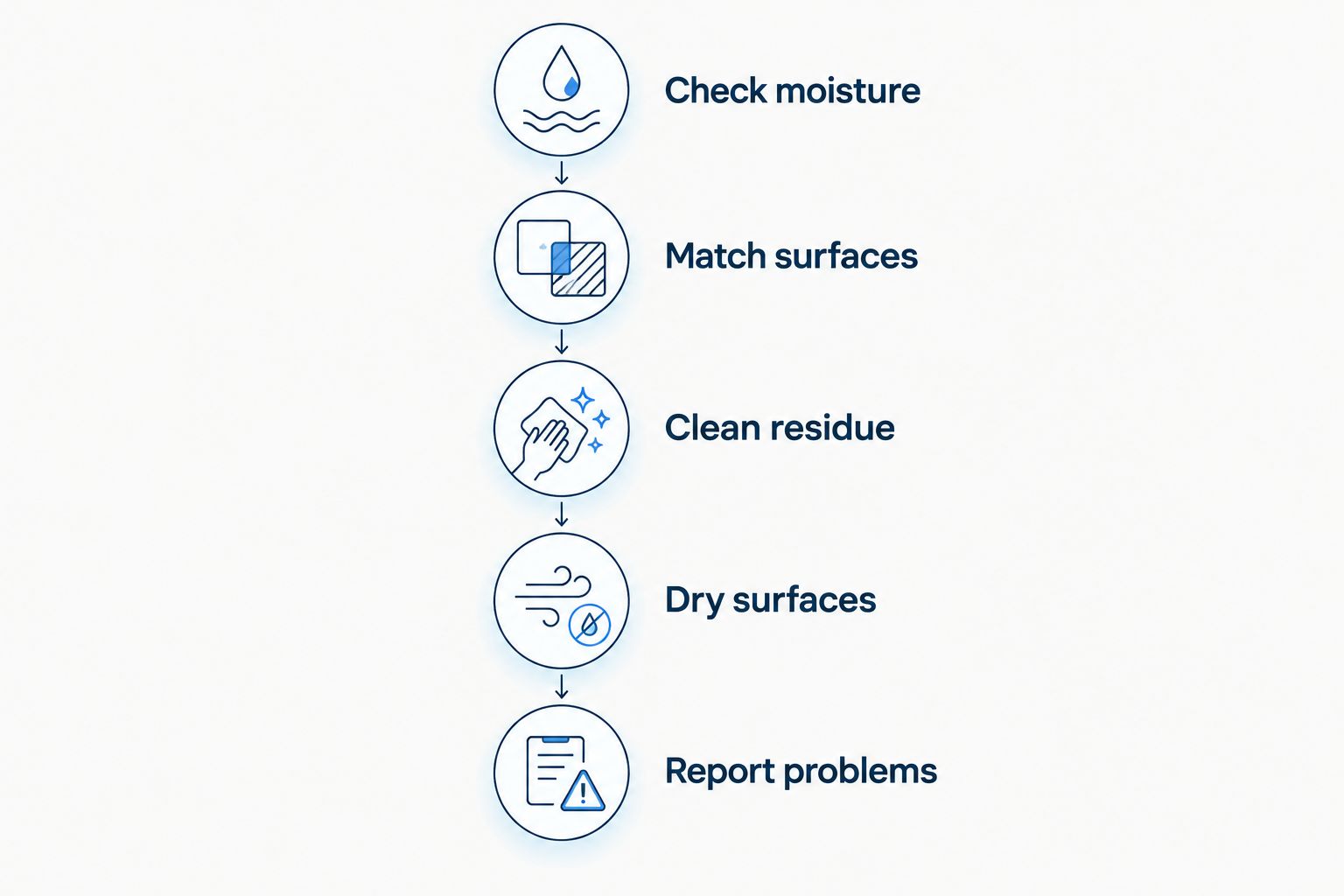
A practical prevention routine connects cleaning with maintenance. For your 2026 household or turnover checklist, use this sequence:
- Check moisture: Look for leaks, wet corners, condensation, and persistent dampness before cleaning.
- Match surfaces: Identify the material and select a product its care instructions permit.
- Clean residue: Follow the label, including dilution, precleaning, and rinsing where required.
- Dry surfaces: Remove remaining moisture and use appropriate ventilation.
- Report problems: Record persistent dampness, damaged materials, or recurring visible growth for follow-up.
The reporting step matters for hosts and property managers. Specify who receives the message and who arranges repairs. A cleaner reporting a wet cabinet base is useful; a note that nobody acts on is not moisture control.
Keep indoor humidity monitoring separate from the cleaning-product decision. A hygrometer measures relative humidity; a scented cleaner does not. If readings remain above EPA's recommended range, address the moisture-control problem rather than changing fragrances or adding more chemicals.
What to avoid
Never mix bleach with other cleaners. Mixing bleach with ammonia or acids can release dangerous gases. Keep products in their original containers, follow ventilation instructions, and use the protective equipment specified on the label.
Do not assume bleach is the required answer to every mold concern. EPA guidance does not recommend routine use of biocides such as chlorine bleach during mold cleanup. Removing mold and correcting moisture remain central to the response.
Avoid these shortcuts:
- Spraying over visible growth without addressing the affected material.
- Applying an acidic cleaner to stone without checking compatibility.
- Using a fragrance to cover a persistent musty odor.
- Treating stained or deteriorating caulk as ordinary soap residue.
- Assuming a turnover clean includes assessment of hidden mold.
Cleaning scope should be explicit. Tampatopshelf provides recurring residential, vacation-rental, and deep or move-in/move-out cleaning; do not assume those services include mold remediation.
How these options are ranked
This 2026 ranking prioritizes task fit, surface compatibility, clear instructions, and honest limits. Mild detergent comes first because routine soil removal does not require a specialized mildew claim. The remaining categories serve narrower jobs rather than competing as interchangeable whole-home treatments.
No comparative laboratory results are used here. The ranking is a selection guide, not a claim that one formula outperforms another in preventing mold.
Which cleaning product should you choose?
Choose mild detergent for ordinary washable hard surfaces, then add a specialist product only for a defined task. Use soap-scum remover for compatible shower buildup, a labeled mildew-control product for its stated application, and a manufacturer-approved floor cleaner for sealed floors.
For routine cleaning support, Tampatopshelf offers a local St. Petersburg team, licensed and insured, reachable by phone or text. Request a straightforward quote tailored to your home or vacation rental, and identify any moisture concerns separately from the cleaning scope.
FAQ
What's the best mold-prevention cleaning product for a Florida home?
Mild detergent is the default for routine cleaning of compatible washable hard surfaces, but no cleaner replaces moisture control. Choose specialized products only when their labels match the surface and task.
Does bleach prevent mold from coming back?
Bleach does not correct the moisture conditions that allow mold to return. EPA guidance does not recommend routine biocide use during mold cleanup; address the moisture source and affected materials.
What indoor humidity should I aim for in Florida in 2026?
EPA guidance recommends indoor relative humidity below 60%, ideally 30–50%. Measure humidity rather than judging it by room temperature or how clean the room smells.
How quickly should I dry wet materials?
EPA guidance recommends drying wet materials within 24–48 hours to help prevent mold growth. A cleaning product is not a substitute for drying or repairing the source of water.
Can I use a soap-scum remover on a marble shower?
Use only a product explicitly compatible with marble and permitted by the surface-care instructions. Acidic cleaners can etch marble, so a general bathroom-cleaner label is not enough.
Is an EPA-registered disinfectant automatically a mold-prevention product?
No, a disinfectant claim does not automatically establish a mildew-control or mold-prevention claim. Read the exact product label for the permitted use, surface, and application instructions.
Should I book routine cleaning when mold keeps returning?
Recurring mold needs moisture investigation rather than routine cleaning alone. Keep ordinary cleaning, maintenance repairs, and any needed mold assessment as separate tasks with clear responsibilities.
One last thing
For your 2026 cleaning checklist, add dryness alongside cleanliness. A bathroom can look ready for the next guest while still needing ventilation, a leak repair, or attention to a persistently wet corner.
Request a free quote from Tampatopshelf by phone or text for residential cleaning or vacation-rental turnovers. Describe the property, the cleaning scope, and any recurring dampness so the cleaning request and maintenance concern stay distinct.