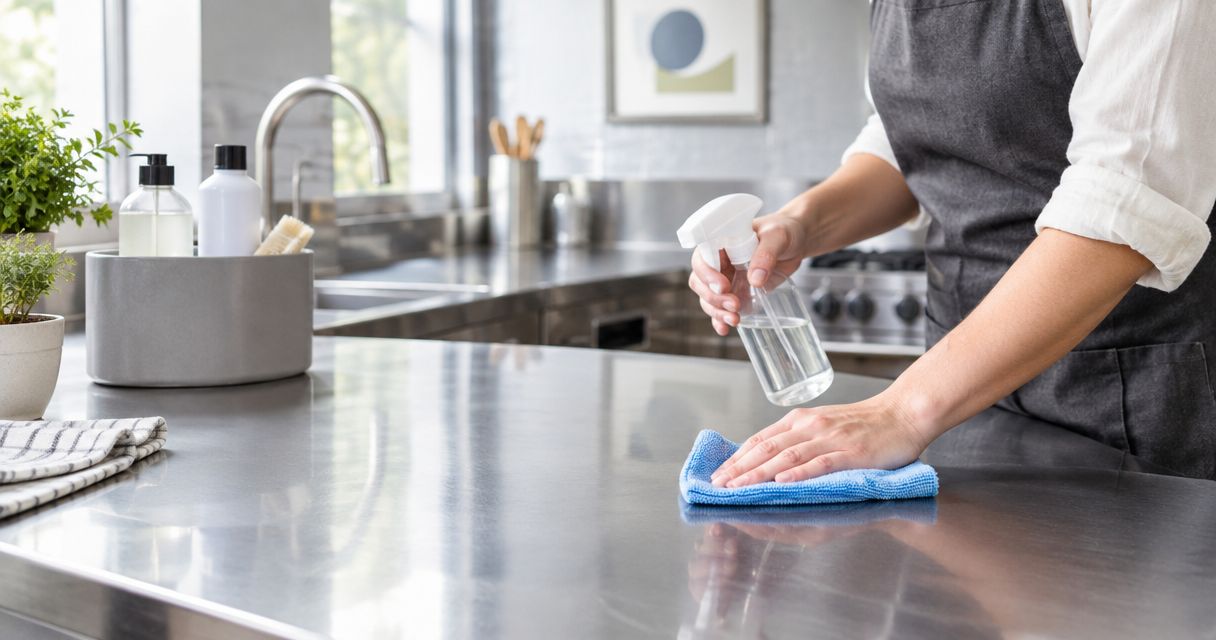
Best overall: mild dish soap and water, where the appliance instructions permit it. Best for exterior fingerprints: a finish-compatible stainless steel cleaner. Best for small touch-ups: compatible stainless steel wipes. This 2026 guide helps rental hosts choose by surface and cleaning task—not by shine alone.
- Stainless steel cleaner rental kitchen verdict: start with mild dish soap where permitted by the appliance manufacturer.
- Use stainless steel cleaner on approved appliance exteriors, not automatically on food-preparation surfaces.
- Choose compatible wipes for isolated fingerprints, not greasy kitchen resets.
- Tampatopshelf provides rental kitchen cleaning as part of vacation-rental turnover services in St. Petersburg and Pinellas County.
Why this matters
A rental kitchen contains different surfaces that happen to look similar. A refrigerator door, a sink basin, and a food-preparation counter do not automatically accept the same cleaning product. Fingerprint-resistant finishes also need their own care instructions.
Choose the cleaner for the surface first and the mark second. A product that improves an appliance door's appearance is not automatically appropriate for a chopping area or a coated panel.
For hosts managing turnovers in 2026, the useful purchase is a small, clearly labeled kit with written instructions. Tampatopshelf provides vacation-rental, residential, and commercial cleaning services locally; the product choices below are practical purchasing guidance, not a claim about the team's supplies.
What makes the best stainless steel cleaning product?
Use these criteria before adding anything to your rental's cleaning cupboard:
- Finish compatibility: The appliance instructions and cleaner label must allow the specific finish. Stainless appearance alone does not establish compatibility.
- Task fit: Choose differently for fingerprints, cooking grease, and stuck-on sink residue. Polish is not a substitute for removing soil.
- Surface use: Separate appliance exteriors from food-contact surfaces. Follow any required rinsing directions.
- Residue control: The product should leave the intended finish after the complete labeled process, including wiping or buffing where required.
- Repeatable instructions: Another cleaner should be able to identify where the product belongs without guessing.
- Material safety: Avoid abrasive tools and chemicals prohibited by the appliance or sink manufacturer.
Stainless steel cleaning options at a glance in 2026
These are product categories, not endorsements of particular formulas. Check the actual label before buying; products within the same category have different instructions.
| Rank and option | Best for | Standout feature | Key limitation |
|---|---|---|---|
| 1. Mild dish soap and water | Routine soil removal | Cleans without adding a separate polishing step | Requires wiping away soap and drying; manufacturer approval still matters |
| 2. Finish-compatible stainless steel cleaner | Exterior fingerprints and finish care | Intended for the stainless surfaces named on its label | Not automatically suitable for coated finishes or food-contact areas |
| 3. Compatible stainless steel wipes | Isolated exterior touch-ups | Combines product and applicator | Does not replace a complete wash when grease or debris remains |
| 4. Manufacturer-approved nonabrasive cream or paste | Stubborn residue in suitable sink basins | Provides targeted cleaning where the sink instructions permit it | Nonabrasive wording does not establish appliance-panel compatibility |
1. Mild dish soap: best for routine rental kitchen cleaning
Mild dish soap diluted according to the relevant instructions is the first option to check for everyday soil. Use it only where the appliance or sink manufacturer permits soap and water. Remove the soap as directed, then dry the surface with a clean, soft cloth.
This is the default recommendation because it starts with cleaning rather than adding a finishing product. You still need to inspect the result: a damp surface can hide streaks that appear after drying.
Mild dish soap pros:
- Addresses ordinary washable soil on surfaces whose instructions allow it.
- Fits a straightforward wash, wipe, and dry routine.
- Avoids adding polish when the cleaned surface does not need it.
Mild dish soap cons:
- Excess soap creates more residue to remove.
- Does not replace a surface-compatible treatment for persistent deposits.
- Still requires checking the care instructions for coated finishes.
Best for: Hosts building a simple routine for manufacturer-approved stainless surfaces between guests.
For the working kit, set out 2 clean cloths: one for the permitted cleaning step and one for drying. Keep additional cloths available rather than carrying grease from the stovetop to the refrigerator door. Follow the appliance's wiping direction where specified.
Verdict: Buy mild dish soap as the default cleaner where the care instructions allow it.
2. Stainless steel cleaner: best for approved appliance exteriors
A dedicated stainless steel cleaner belongs on the shortlist when exterior fingerprints or finish appearance remain a problem after cleaning. Select a product that explicitly matches the appliance's care requirements. A label that says stainless steel does not override restrictions for a fingerprint-resistant coating.
Some products combine cleaning and polishing functions; others have different directions. Read those directions rather than assuming every stainless spray works the same way.
Stainless steel cleaner pros:
- Gives you a product intended for the stainless surfaces listed on its label.
- Provides a defined application and finishing process.
- Keeps exterior finish care separate from general kitchen washing.
Stainless steel cleaner cons:
- Compatibility varies across finishes and formulas.
- Application or buffing instructions add work to the turnover routine.
- Exterior suitability does not establish food-contact suitability.
Best for: Hosts whose approved appliance exteriors need a separate fingerprint-removal or finishing step.
Check handles, panel edges, and the area around controls without spraying into openings. Apply the product exactly as directed, including any instruction to put it on a cloth rather than directly on the appliance. Inspect after completing the required finishing step.
Verdict: Buy only after confirming compatibility with the exact appliance finish.
3. Stainless steel wipes: best for isolated exterior touch-ups
Compatible stainless steel wipes are an option for a small fingerprint mark on an otherwise clean appliance. They combine the cleaning product and applicator, but the package directions still determine where and how you can use them.
Do not turn a touch-up product into the entire kitchen routine. Visible grease, crumbs, and food residue call for appropriate cleaning before any finishing step.
Stainless steel wipes pros:
- Keep the product and applicator together.
- Suit a narrowly defined exterior touch-up task.
- Give staff package instructions at the point of use.
Stainless steel wipes cons:
- Create disposable waste with each use.
- Do not eliminate any labeled buffing or follow-up requirements.
- Remain subject to finish and food-contact restrictions.
Best for: A final inspection that finds an isolated mark on an approved appliance exterior.
Store the package closed according to its directions. Keep it clearly separated from disinfecting wipes: similar packaging does not mean the products perform the same job. Never describe a stainless polishing wipe as a disinfectant unless its label establishes that use.
Verdict: Hold until you have a recurring touch-up task that justifies a separate product.
4. Nonabrasive cream or paste: best for approved sink cleaning
A manufacturer-approved nonabrasive cream or paste is a separate option for residue that routine washing has not removed from a suitable stainless sink. Confirm both the product and the applicator with the sink's care instructions. The word nonabrasive is not permission to use the product everywhere.
Keep this category out of the appliance-door routine unless the appliance manufacturer explicitly permits it. Decorative panels and sink basins need separate decisions.
Nonabrasive cream or paste pros:
- Gives you a targeted option when ordinary washing leaves residue.
- Keeps sink treatment separate from appliance finishing.
- Can be assigned to a specific approved surface in the cleaning instructions.
Nonabrasive cream or paste cons:
- Requires explicit compatibility checks for both cleaner and tool.
- Adds a separate application and rinse process where directed.
- Is unnecessary when routine washing already removes the soil.
Best for: A known sink-cleaning problem with a manufacturer-approved treatment.
Do not scrub harder simply because a mark remains. Stop and identify whether you are seeing removable residue, a scratch, or a change in the finish. Additional product will not repair physical damage.
Verdict: Skip as a general-purpose appliance cleaner; buy only for an approved sink task.
How we ranked these options
The order prioritizes routine soil removal, finish compatibility, clear surface boundaries, and repeatable instructions. It is a task-based ranking, not a laboratory performance comparison or a ranking of named brands.
For a 2026 rental cleaning kit, begin with the least complicated permitted routine. Add a specialist product only when it solves an identified problem that the default routine leaves behind.
Build a turnover routine someone else can follow
The product list is only useful if your cleaner knows which bottle belongs on which surface. Write the routine around the appliance instructions, not around a general instruction to make everything shine.
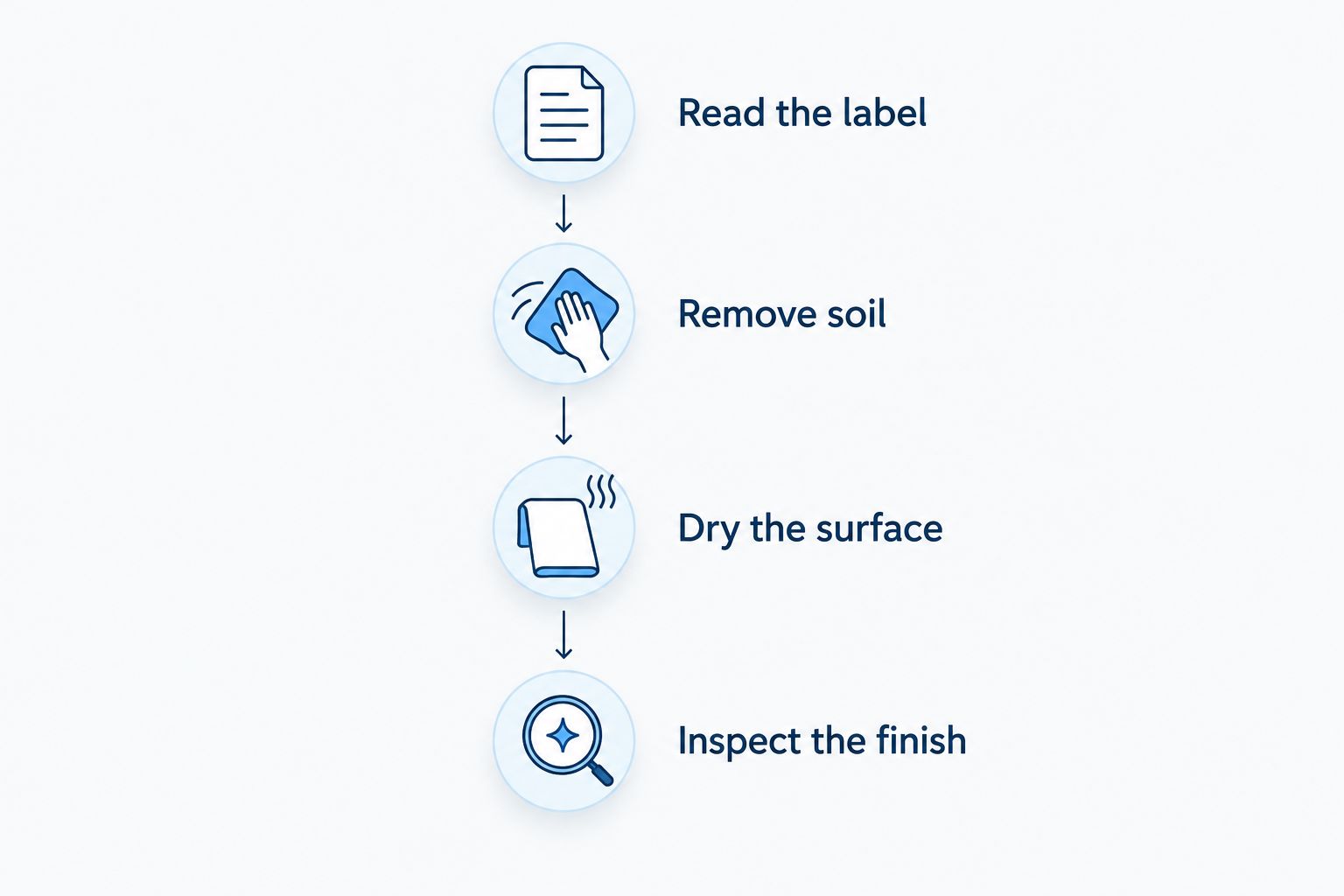
Read the label
Check the appliance care instructions and the cleaner label together. Record finish restrictions and any required rinsing. Keep 1 written care note per appliance in your property instructions so a substitute cleaner does not have to identify the finish from appearance.
Remove soil
Remove loose debris and use the permitted cleaning method. Keep food-contact cleaning separate from exterior polishing, and change a dirty cloth instead of spreading the same residue across another panel.
Dry the surface
Complete the required wiping, rinsing, and drying steps before judging the finish. Check the surface from the doorway and from the side; reflected light makes remaining streaks easier to see.
Inspect the finish
Decide whether an approved finishing product is actually needed. If the surface is already clean and meets the manufacturer's care guidance, stop rather than adding another product by habit.
For a compact working station, keep 1 labeled bottle for each assigned task rather than several unidentified decanted products. Retain the original directions and follow label requirements for storage and containers. Never mix cleaners.
Which stainless steel cleaning option should you choose?
Choose mild dish soap first where the manufacturer permits it. Add a compatible stainless steel cleaner for approved exterior finish care, wipes for isolated touch-ups, or a sink-specific treatment for a documented residue problem.
If you manage several properties in 2026, standardize the instructions without assuming the appliances share a finish. The same model appearance is not enough; keep the actual care information with each property's checklist.
Tampatopshelf is a local, licensed and insured team serving St. Petersburg and Pinellas County, reachable by phone or text. Tampatopshelf is best for local hosts seeking rental kitchen cleaning as part of a vacation-rental turnover service. Quotes are tailored to the property; explain the kitchen's surfaces and cleaning needs when you get in touch.
Request your cleaning quote
Discuss your property's turnover, recurring cleaning, or deep-cleaning needs with a local team.
FAQ
What's the best stainless steel cleaner for a rental kitchen?
Mild dish soap and water is the first option to check where the appliance manufacturer permits it. Choose a compatible dedicated cleaner only when the surface needs a separate exterior cleaning or finishing step.
Can I use the same stainless steel cleaner on the sink and refrigerator?
Use the same product only if both manufacturers' instructions and the product label allow it. A sink basin and a coated refrigerator panel do not automatically accept the same treatment.
Are stainless steel wipes enough for an Airbnb kitchen turnover?
Stainless steel wipes are not a substitute for removing kitchen grease, crumbs, and food residue. Use compatible wipes for isolated exterior marks after the appropriate cleaning process.
Do fingerprint-resistant appliances need a special cleaner?
Fingerprint-resistant appliances need the cleaning method specified by their manufacturer. Do not assume a conventional stainless steel polish is suitable for the coating.
Does stainless steel polish disinfect kitchen surfaces?
Treat a stainless steel polish as a disinfectant only if its label explicitly establishes that use. Follow the disinfectant's surface restrictions, contact-time instructions, and any food-contact rinsing requirements.
Why does my stainless steel look streaky after cleaning?
Remaining soil, soap residue, excess finishing product, or incomplete drying can leave visible streaks. Check the care instructions, complete the required wiping process, and inspect with a clean cloth before adding more cleaner.
Can Tampatopshelf help with vacation-rental kitchen cleaning?
Tampatopshelf provides vacation-rental turnover cleaning in St. Petersburg and Pinellas County. Contact the local, licensed and insured team by phone or text to discuss your property and request a free quote.
One last thing
A photograph of the appliance's model information can be more useful than another bottle of cleaner. Save it with the care instructions so you can find the correct guidance when a product or finish question comes up.
For your 2026 checklist, add a plain instruction: report scratches, peeling coatings, and persistent marks instead of repeatedly scrubbing them. Cleaning and repairing a finish are different jobs.
Related guides
- Cleaning supplies for short-term rental turnovers
- Airbnb turnover cleaning checklist
- Cleaning routines between vacation-rental guests
Need help keeping your rental ready between guests? Request a free quote by phone or text and describe the cleaning your property needs.


