
Yes—move-in cleaning is necessary for a brand-new home when the builder’s final cleanup leaves dust, debris, or residue on surfaces you will use, but a separate professional appointment is not automatically necessary. Before your 2026 move, inspect the finished home and confirm what the builder will address; cleaning does not replace unfinished construction work or repairs.
- Is move in cleaning necessary new construction? Yes, if the builder’s cleanup leaves dust, debris, or residue.
- Inspect cabinet interiors, bathroom fixtures, and floor edges before deciding whether another cleaning is needed.
- Finish dust-producing repairs before scheduling the final move-in cleaning.
- Tampatopshelf provides residential cleaning in St. Petersburg and Pinellas County; confirm the scope for your new home.
Why this matters
A home can be newly built without being ready for dishes, bedding, and bare feet. The useful question is not whether anyone has lived there—it is whether the surfaces you will touch and fill are clean.
For a St. Petersburg or Pinellas County move, separate the builder’s unfinished work from your household cleaning needs. The post-construction cleaning guide for home builders explains the construction-cleanup side; this page focuses on deciding what your home still needs before you unpack.
Inspect first, then book the work that remains. That prevents you from requesting a general house cleaning when the property still needs construction cleanup—or paying for a second cleaning after another dusty repair.
Is move-in cleaning necessary for a brand-new home?
Move-in cleaning is necessary when the completed home still has removable dirt or residue in areas you will use. If the builder has already delivered a thoroughly cleaned home and your inspection confirms that condition, another full professional cleaning is not automatically needed.
Use these 3 checks during your walkthrough. They give you a practical basis for a 2026 move-in decision without relying on how clean the home looks from the doorway.
- Check storage interiors. Open kitchen cabinets, bathroom drawers, closets, and pantry shelving. Look for loose particles, dusty corners, packaging, and residue before putting belongings inside.
- Check usable surfaces. Inspect counters, sinks, tubs, toilets, handles, and switches. Note dirt separately from scratches, damaged finishes, or incomplete installation.
- Check edges and floors. Look along baseboards, door tracks, corners, and floor transitions. Visible debris or dust transfer onto a clean cloth identifies an area that still needs attention; it does not identify the material or establish that it is safe to disturb.
Ask the builder to explain any unfamiliar powder, coating, or residue. Do not turn an uncertain construction material into a do-it-yourself cleaning experiment.
What if the builder says the home was professionally cleaned?
Ask what that cleaning included and whether any tradespeople returned afterward. A completed cleaning appointment tells you that work occurred, not that every surface is currently ready for your belongings.
Walk through the home after the last repair visit. If the agreed cleaning is incomplete, document the affected areas and ask the builder to address them before arranging duplicate work yourself.
Which cleaning approach fits the condition of your home?
Choose by the remaining work, not by the service name. “Final clean,” “deep clean,” and “move-in clean” do not tell you whether cabinet interiors, windows, or construction residue are included.
| Approach | Best for | Main benefit | Main limitation |
|---|---|---|---|
| Your own final wipe-down | A home already cleaned thoroughly by the builder | You can check and clean surfaces as you unpack | You supply the time, equipment, and surface knowledge |
| Professional move-in cleaning | A finished home with ordinary dust and household cleaning needs | You can agree on a room-by-room scope before moving belongings in | Construction residue and specialty work require separate confirmation |
| Post-construction cleanup | A home with remaining building debris or construction-related residue | The request identifies construction conditions rather than routine housekeeping | You must verify that the provider accepts the actual materials and tasks |
A clean-looking room is not proof that its cupboards and drawers are ready to fill. Conversely, an isolated dusty shelf does not automatically justify an extensive whole-home appointment.
For your 2026 booking, send photographs and describe the condition plainly. “Dust inside empty kitchen cabinets” gives a cleaner more useful information than “new house needs a deep clean.”
What should a new-home move-in cleaning cover?
Build the scope around the rooms you will use immediately. Treat the following as a discussion checklist, not a promise that every cleaning company includes each task.
Kitchen and food-storage areas
Check counters, the sink, cabinet shelves, drawers, and pantry surfaces before unloading groceries or dishes. Ask specifically whether empty cabinet and drawer interiors are included.
Inspect appliances separately. New appliances still need a condition check, but protective materials, installation components, and manufacturer instructions should guide what gets removed or cleaned. Do not assume appliance interiors are part of a general appointment.
Bathrooms and personal-use surfaces
Look at sinks, toilets, tubs, showers, counters, mirrors, and storage interiors. Identify ordinary dust separately from grout haze, adhesive, sealant, or damaged surfaces.
New finishes need appropriate products and methods. Ask the builder for care instructions, and pass those instructions to the cleaning provider rather than choosing an aggressive product because a mark looks stubborn.
Bedrooms, closets, and living spaces
Inspect closet shelves, accessible trim, door frames, switches, and floor edges. Empty rooms make these areas easier to see and reach before furniture and storage boxes occupy them.
Include the spaces where bedding and clothing will go. Cleaning the middle of a bedroom floor while leaving dusty closet shelving misses part of the move-in task.
Floors, glass, and unfinished issues
Confirm which floor materials are installed and follow their care instructions. Glass, window tracks, and doors also need an explicit scope discussion rather than an assumption that “whole-home cleaning” includes everything.
Cleaning is not repair work. Report scratches, loose fixtures, leaks, cracked materials, and incomplete installation to the builder instead of asking a cleaner to correct them.
Why new-construction cleaning needs vary
These 5 factors determine the work you should discuss. They explain why two newly completed homes can need different cleaning scopes without relying on a standard package.
- Builder handoff condition. A home with clean storage interiors and finished floors needs a different response from one with visible debris.
- Remaining trade visits. Sanding, drilling, cutting, and installation work can undo cleaning already completed.
- Requested interiors. Empty cabinets, drawers, closets, and appliances add specific tasks that need agreement.
- Surface requirements. Flooring, stone, cabinetry, glass, and freshly finished surfaces need suitable cleaning methods.
- Access and belongings. An empty, accessible home presents a different job from one already filled with furniture, boxes, or active work areas.
Describe these conditions when requesting a quote. The number of bedrooms alone does not tell a provider what is inside the cupboards or whether construction work is finished.
When should you schedule cleaning before moving in?
Schedule the final household cleaning after dust-producing work is complete and before furniture delivery when practical. For a 2026 move, coordinate the order of events rather than assuming a fixed waiting period suits every home.
Use these 4 steps to organize the handoff:
- Builder walkthrough. Record unfinished work, visible debris, and surfaces that need clarification. Confirm who is responsible for each item.
- Repairs complete. Finish the work that would create more dust or require access to newly cleaned areas.
- Final cleaning. Arrange the agreed cleaning once the home is accessible and ready for that scope.
- Move-in check. Inspect the cleaned rooms before unloading belongings, and address any remaining agreed tasks.
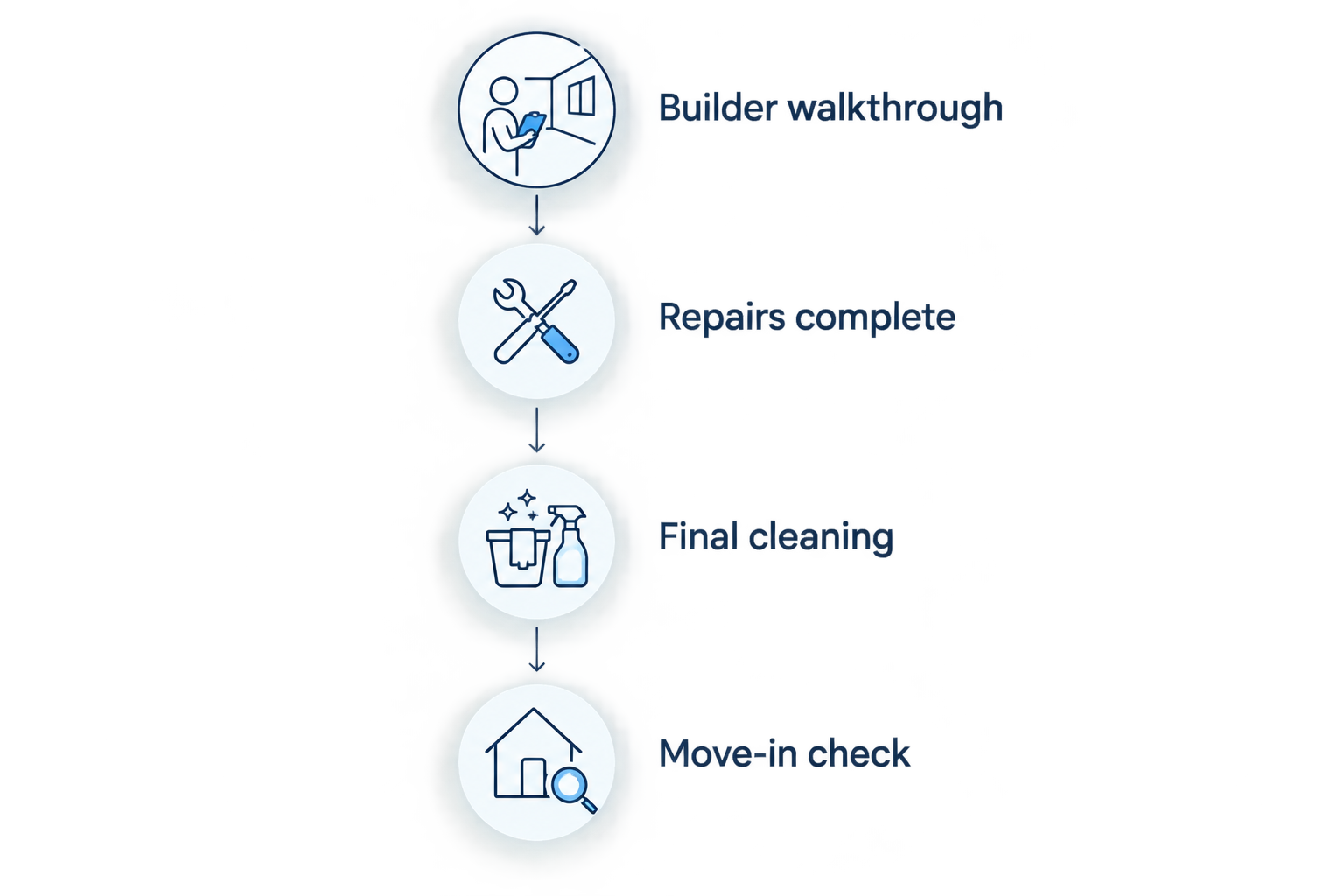
If a repair visit must happen afterward, identify which rooms will be affected and discuss a targeted follow-up. Do not assume the entire home needs cleaning again, and do not assume the repaired area will remain clean.
Can you clean a newly built home yourself?
You can handle a final wipe-down yourself when the home is finished, the remaining dirt is ordinary household dust, and you know the correct care method for each surface. The benefit is direct control over the work; the drawback is fitting it around packing, deliveries, and unpacking.
Stop when the task involves unidentified residue, specialized removal, unsafe access, or unfinished building work. Ask the builder to identify the issue and the appropriate person to address it before proceeding.
Does a new home need disinfecting before you move in?
A new home does not automatically need whole-home disinfection simply because construction workers entered it. Cleaning and disinfecting serve different purposes; choose disinfecting tasks for a specific need and follow the product label and surface instructions.
Do not treat strong odors or an unfamiliar film as proof that a surface needs disinfectant. Identify the source first, particularly when new materials or unfinished work are involved.
How do you arrange local move-in cleaning?
Tampatopshelf residential cleaning is best suited to St. Petersburg and Pinellas County homeowners seeking a local team reachable by phone or text. The team is licensed and insured and provides straightforward quotes tailored to each property.
That local service is useful when you want to discuss the home’s actual condition with a real person. The limitation is scope: a residential cleaning request does not establish that construction debris, adhesive removal, high-access work, or other specialty tasks are included.
When requesting Tampatopshelf move-in cleaning, share the address, room details, photographs, remaining construction work, and surfaces needing special care. For your 2026 move, include the planned handoff and furniture-delivery dates so the scheduling conversation reflects the order of work.
Use the quote request page to start the conversation. Confirm the tasks and exclusions before booking rather than relying on the phrase “move-in ready.”
FAQ
Is move-in cleaning necessary if nobody has lived in the house?
Move-in cleaning is necessary if dust, debris, or residue remains, even when nobody has lived in the house. Inspect storage interiors, usable surfaces, and floor edges before deciding what work is needed.
Can I skip professional cleaning if the builder already cleaned?
You can skip another full professional cleaning if the builder’s completed cleanup meets your needs and your inspection confirms it. Check after the last repair visit, not only after the original cleaning appointment.
Should I clean before or after the builder finishes repairs?
Schedule the final cleaning after dust-producing repairs are complete. If work must happen afterward, identify the affected rooms and discuss whether a targeted follow-up is needed.
Does move-in cleaning include inside cabinets and drawers?
Cabinet and drawer interiors are included only when they are part of the agreed scope. Request empty storage interiors explicitly before booking.
Can a house cleaner remove paint splatters or adhesive from new finishes?
Do not assume paint or adhesive removal is included in house cleaning. Ask the builder to identify the material and confirm an appropriate removal method before anyone treats the surface.
Does move-in cleaning replace a new-home inspection?
Move-in cleaning does not replace an inspection or builder walkthrough. Report damaged finishes, leaks, loose fixtures, and incomplete work separately.
Who can I contact about move-in cleaning in St. Petersburg?
Tampatopshelf provides residential cleaning in St. Petersburg and Pinellas County. Request a free quote by phone or text and explain that the property is newly built so the cleaning scope can be discussed.
One last thing
Check the inside of a kitchen drawer before judging the whole home by its floors. It is a useful reminder that the surfaces hidden behind doors matter as much as the ones visible during a walkthrough.
Before filling storage areas, photograph anything you want the builder to address. Once your belongings are inside, both cleaning access and the original condition become harder to establish.
Related guides
- Move-in cleaning checklist for new St. Petersburg homeowners
- Post-construction cleaning checklist for new builds
- How to prepare your home before the cleaners arrive
For your 2026 move in St. Petersburg or Pinellas County, request a free quote by phone or text. Describe what the builder has finished and what still needs cleaning so you can agree on a straightforward scope.


