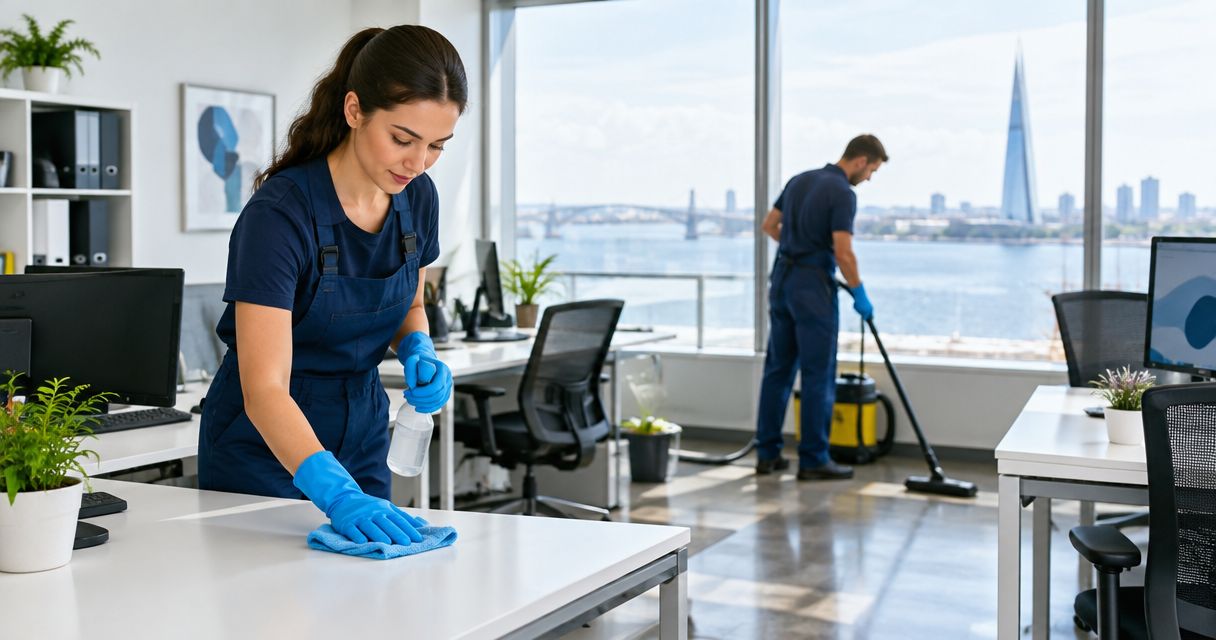
Small-office commercial cleaning is the scheduled cleaning of shared workplaces with the aim of keeping your business ready for staff and visitors. In St. Petersburg, start with a written room-by-room scope: a compact office still needs clear restroom, breakroom, floor-care, and access instructions.
- Commercial cleaning for small offices St Petersburg: choose a written scope before choosing a schedule.
- Tampatopshelf offers commercial cleaning for local businesses, with phone or text contact and property-specific quotes.
- Keep employee tidying separate from restroom cleaning, floor care, and other assigned cleaning work.
- Compare providers using the same office checklist, access instructions, and exclusions.
Why commercial cleaning matters for small offices
A small office puts several functions close together: desks, food preparation, client seating, and shared restrooms. A vague instruction to clean the office leaves too much open to interpretation. Your cleaner needs to know which surfaces are included, what must stay untouched, and who handles supplies.
For your 2026 office cleaning plan, distinguish between keeping the workplace orderly and cleaning it. Employees can clear their desks without becoming responsible for restroom sanitation or choosing chemicals for unfamiliar flooring.
Tampatopshelf commercial cleaning is best for St. Petersburg small offices seeking a local team reachable by phone or text. The company is licensed and insured and provides straightforward quotes tailored to each property. You can start through Tampatopshelf, then discuss your office’s scope directly.
The advantage is a direct conversation about your space. The boundary is equally important: a general commercial-cleaning offering does not establish which specialist tasks, access arrangements, or supplies your quote includes. Confirm those details before service begins.
Build a cleaning plan your office can actually follow
Define the spaces you control
Start with a walkthrough and a simple document; you do not need scheduling software. Create a 1-page scope listing the rooms your business occupies and the shared areas managed by someone else.
In a multi-tenant building, responsibility matters as much as room size. Your landlord’s cleaner might handle the corridor while your business remains responsible for an internal restroom. Check the lease or ask the property manager rather than assuming either task is covered.
Keep private offices, storage rooms, and client areas distinct. A room with confidential paperwork needs different access instructions from an open reception area.
- List every room included in your office cleaning scope.
- Mark building-managed corridors and shared facilities separately.
- Identify locked rooms and restricted storage areas.
- Record floor materials and any manufacturer care instructions you have.
- Assign an office contact who can resolve scope questions.
Separate everyday tidying from scheduled cleaning
Use 2 task categories: work employees handle during the day and work assigned to the cleaning provider. This prevents a cleaning visit from becoming an unplanned sorting session.
Your staff should decide what can be discarded and where personal belongings belong. A cleaner should not have to judge whether a stack of papers is recycling or an active client file. Keep the instructions specific enough that a substitute office contact can follow them.
For your 2026 checklist, describe visible outcomes rather than writing only “clean kitchen” or “clean desks.” For example, distinguish wiping an accessible counter from moving appliances or cleaning inside them.
- Ask employees to clear food and personal items from shared surfaces.
- Specify which accessible desk surfaces the cleaner can wipe.
- Separate trash removal from confidential-document disposal.
- State whether appliance interiors are included or excluded.
- Identify restroom tasks and who replenishes consumables.
Write the visit sequence and access instructions
Once your manual checklist is clear, a cleaning service becomes the practical way to assign the agreed work rather than coordinate it internally. Tampatopshelf commercial cleaning offers a local option to discuss that scope; confirm the actual tasks and access arrangements in your quote.
Build the visit around four stages: Access, Cleaning, Inspection, and Lockup. Each stage needs an instruction, not an assumption. An evening visit is not useful if nobody has explained how the cleaner enters or which alarm procedure applies.
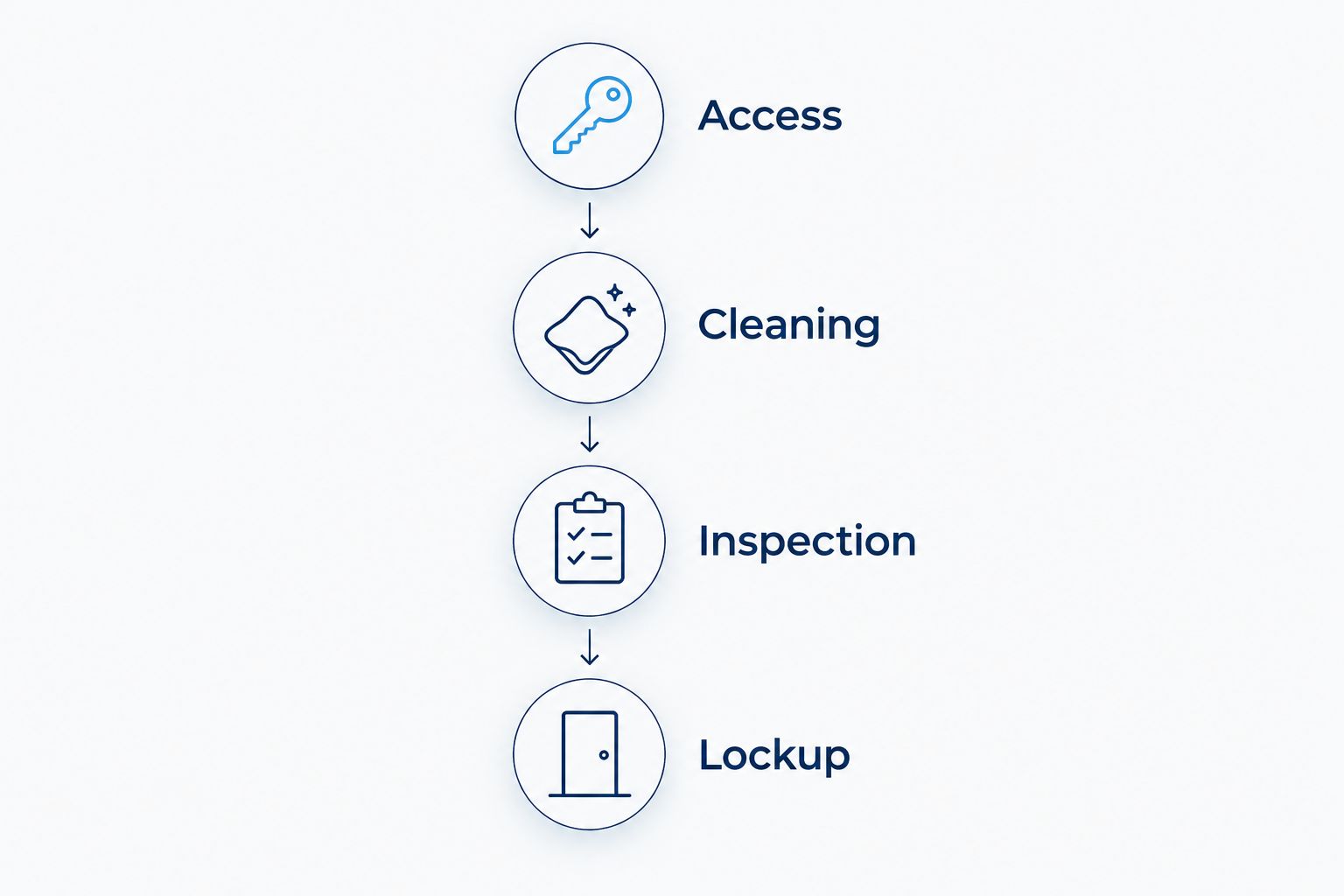
Give access details through a private channel, separate from any checklist displayed in a shared workspace. Agree who receives questions when the usual contact is unavailable.
- Document the approved entry method and arrival instructions.
- Identify rooms that remain locked or off-limits.
- Explain where equipment and permitted supplies belong.
- Define how unfinished work or damage concerns are reported.
- Confirm the closing procedure for doors, lights, and alarms.
Match the schedule to actual office use
Choose frequency from how your office operates, not from its description as small. Restroom use, shared meals, client visits, and floor conditions give you more useful scheduling information than the number of desks alone.
Start by noting where cleaning is needed between planned visits. If the breakroom counter needs attention during the working day, a scheduled service does not replace an employee spill-cleanup rule. If a meeting room remains unused, it does not automatically need the same attention as a busy entrance.
Keep your 2026 schedule editable. A staffing change or a different visitor pattern is a reason to review the scope, not simply repeat the original arrangement.
- Record when staff and visitors actually use the office.
- Note which rooms need attention between cleaning visits.
- Choose service windows that avoid calls and client meetings.
- Separate routine tasks from occasional detailed work.
- Review the schedule when occupancy or room use changes.
Confirm surface care and service boundaries
Tell the cleaner what materials are present and share any care instructions you already have. Stone counters, coated floors, screens, and upholstered furniture should not all receive the same treatment.
Cleaning removes dirt and impurities; disinfecting uses a suitable product to address germs on a surface. If disinfection is part of your scope, the product label governs its approved surfaces, application, and contact time. Do not substitute a made-up universal waiting period.
Be equally clear about exclusions. Routine office cleaning should not be treated as an agreement to handle mold, pest contamination, hazardous waste, or specialist equipment. Ask what the provider accepts and who handles work outside that scope.
- Identify delicate finishes and surfaces with care restrictions.
- Confirm whether the provider or your office supplies cleaning products.
- Specify any disinfection tasks separately from general wiping.
- Keep restroom cleaning materials separate from food-area materials.
- Ask about interior glass, upholstery, and detailed floor work explicitly.
- Establish how leaks, persistent dampness, or suspicious growth are reported.
Inspect outcomes and update the checklist
Use the same short checklist for each review instead of judging the office by fragrance or a quick glance from the doorway. Start with 3 inspection points: the restroom, breakroom, and entrance floor. Add room-specific checks where your scope requires them.
A useful report identifies the room, the missed task, and the correction requested. “The office was not clean” gives the provider little direction; “the breakroom sink still contains food debris” describes a specific outcome.
Keep your 2026 service record focused on work completed, recurring issues, and agreed changes. Do not add new tasks informally and assume they are now included in the original quote.
- Check agreed surfaces and floors after a visit.
- Record missed tasks with a location and clear description.
- Keep photographs free of confidential documents and screens.
- Send concerns through the agreed contact channel.
- Confirm scope changes before treating them as recurring duties.
Compare small-office cleaning options
Choose the option that assigns responsibility clearly, not the one with the longest generic checklist. These approaches solve different problems. Employee tidying helps maintain order, while a recurring service assigns a defined cleaning scope outside employees’ ordinary work.
For a 2026 comparison, give each provider the same room list and task requirements. Differences in exclusions, materials, and access arrangements matter more when the underlying scope is consistent.
| Option | Best for | Main advantage | Key limitation |
|---|---|---|---|
| Employee-led tidying | Offices managing personal belongings and immediate spills | Staff can address their own mess during the day | Does not establish a trained cleaning process or dedicated service coverage |
| Recurring commercial cleaning | Small offices needing an assigned routine | Creates a repeatable scope and service arrangement | Occasional detailed tasks still need explicit inclusion |
| Occasional detailed cleaning | Offices with a defined buildup or reset project | Concentrates work on an agreed problem or area | Does not maintain the office between visits |
| Landlord-managed cleaning | Tenants whose building agreement includes relevant spaces | Uses an existing building arrangement | Coverage follows the agreement, not necessarily your office’s full needs |
| Tampatopshelf | Local small offices wanting phone or text contact | Local, licensed and insured team with property-specific quotes | Specialized tasks and office-specific arrangements require confirmation |
You can combine approaches without duplicating work. For example, employees can clear shared counters while a contracted cleaner handles the agreed breakroom surfaces. The important step is assigning each task once and making the boundary visible to everyone involved.
Request an office cleaning quote
Discuss your St. Petersburg office, cleaning scope, and access needs with a local team.
Common mistakes small offices make
Assuming the building cleaner covers your suite
Common-area cleaning does not establish responsibility for your private office. Check which restrooms, entrances, bins, and interior floors fall under your lease or building arrangement. Give your office cleaner only the tasks your business actually needs to assign.
Treating every desk as an available cleaning surface
Paperwork, charging cables, and personal items create unclear boundaries. Ask employees to clear surfaces and specify whether occupied desks are excluded. Never expect a cleaner to organize files or decide which documents can be moved.
Asking for a deep clean without defining it
The phrase does not identify the work. Write down whether you mean cabinet fronts, appliance interiors, baseboards, interior glass, or another specific task. Confirm each item rather than assuming the phrase includes every neglected surface.
Scheduling work during sensitive office activity
Cleaning around confidential calls or client appointments creates avoidable coordination problems. Agree on rooms, access, and timing before service. If your business handles sensitive records, keep those records secured rather than relying on a general instruction to be careful.
Using fragrance as the quality test
A strong scent does not show whether a restroom fixture, shared handle, or floor was cleaned correctly. Inspect the outcomes listed in your scope. Report visible residue, debris, or missed work rather than requesting stronger-smelling products.
FAQ
What is the best commercial cleaning option for a small office in St. Petersburg?
A recurring commercial cleaning service is best for a small office that needs assigned, repeatable cleaning work. Choose it using a written room list, task scope, access plan, and clear exclusions rather than a generic service description.
How often should a small office be cleaned?
Set the cleaning frequency according to restroom use, shared food areas, visitors, and visible soil. Review the schedule when occupancy changes, and assign immediate spill cleanup separately from scheduled service.
Does commercial office cleaning include disinfecting?
Disinfecting is included only when it is part of the agreed scope. Confirm the surfaces and products involved; disinfectants must be used according to their labels, including the required contact time.
Can an office cleaner work after business hours?
After-hours cleaning requires an agreed schedule and access arrangement with the provider. Confirm entry, alarm procedures, restricted rooms, and lockup instructions before arranging an unattended visit.
Should employees clear their desks before office cleaning?
Employees should clear any desk surfaces included in the cleaning scope. Keep confidential records and personal belongings secured, and identify surfaces the cleaner must not touch.
Is landlord-provided cleaning enough for a small office?
Landlord-provided cleaning is enough only if its documented scope covers your office’s needs. Check private rooms, internal restrooms, breakrooms, and trash responsibilities before arranging additional work.
What should I send when requesting an office cleaning quote?
Send a room list, desired tasks, floor information, service-window preferences, and access restrictions. Include occasional detailed tasks separately so the provider can distinguish them from recurring work.
One last thing
Give your cleaner permission to leave a surface untouched when its contents or care requirements are unclear. An explicit stop-and-ask instruction is better than asking someone to guess around confidential papers or an unfamiliar finish.
Request a free quote from Tampatopshelf by phone or text. Describe your St. Petersburg or Pinellas County office, the rooms you need cleaned, and the access arrangements you want to discuss.


