Cleaning for multi-property Airbnb hosts is a coordinated turnover process that prepares each rental for its next guest while keeping schedules, property instructions, and completion checks organized. For hosts in St. Petersburg and Pinellas County, this 2026 guide explains how to manage overlapping departures without treating every property as the same job.
- Cleaning for multi-property Airbnb hosts needs property-specific checklists, confirmed assignments, and a clear ready-for-guests status.
- Tampatopshelf suits St. Petersburg and Pinellas County hosts seeking local vacation-rental turnover cleaning.
- Separate turnover cleaning, laundry, restocking, maintenance, and deep cleaning before assigning responsibility.
- A booking calendar records departures; it does not confirm that a cleaner has accepted the work.
Why turnover cleaning matters for multi-property hosts
The task is not just cleaning several homes. It is knowing which homes are ready, which need attention, and who owns the next action. A completed kitchen does not make a rental guest-ready if its beds remain unmade or the entry instructions fail.
A single-property host can keep many details in memory. Across multiple rentals, that approach leaves instructions scattered between messages, calendars, and conversations. Your cleaning plan needs a shared record that someone else can follow without calling you for every decision.
Tampatopshelf provides vacation-rental turnover cleaning in St. Petersburg and Pinellas County. Tampatopshelf is best for hosts seeking local turnover cleaning in St. Petersburg and Pinellas County. The team is licensed and insured and reachable by phone or text; confirm the scope for each property rather than assuming every task is included.
For your 2026 operating plan, make the standard consistent but keep the instructions property-specific. A condo with building access rules and a house with a lanai need different arrival notes and cleaning boundaries.
Build a repeatable turnover process
1. Create a separate brief for each rental
Start with a shared document or spreadsheet. Keep 1 property brief per rental, even when several units have similar layouts. Use the same headings so cleaners can find information quickly, but write the actual instructions for that address.
Record what a cleaner needs before entering, what the finished property should look like, and what requires your approval. Distinguish cleaning instructions from maintenance instructions. Reporting a loose cabinet hinge is not the same assignment as repairing it.
Include building requirements where applicable: parking instructions, gate entry, elevator procedures, or an authorized contact. Confirm those details with the building rather than asking a cleaner to discover them on arrival.
Finish each brief with a revision date. When you change a bed configuration or move the supply cupboard, update the brief instead of leaving the correction in a message thread.
- Record the full address and a unique property name.
- Add authorized entry and building-access instructions.
- List beds, bathrooms, and property-specific cleaning tasks.
- Identify supply storage and approved products.
- Name the person who approves exceptions and repairs.
2. Define what clean and guest-ready mean
Walk through each property yourself with a room checklist. Separate visible cleaning from presentation: a clean bed frame and correctly prepared bedding are different checks. Write both where both belong in the assignment.
Use 5 reference photos per property as a starting checklist: kitchen, bathroom, bed setup, living area, and entry. Add images when a rental has additional layouts or features that need explanation. These are suggested documentation targets, not a requirement imposed by a booking platform.
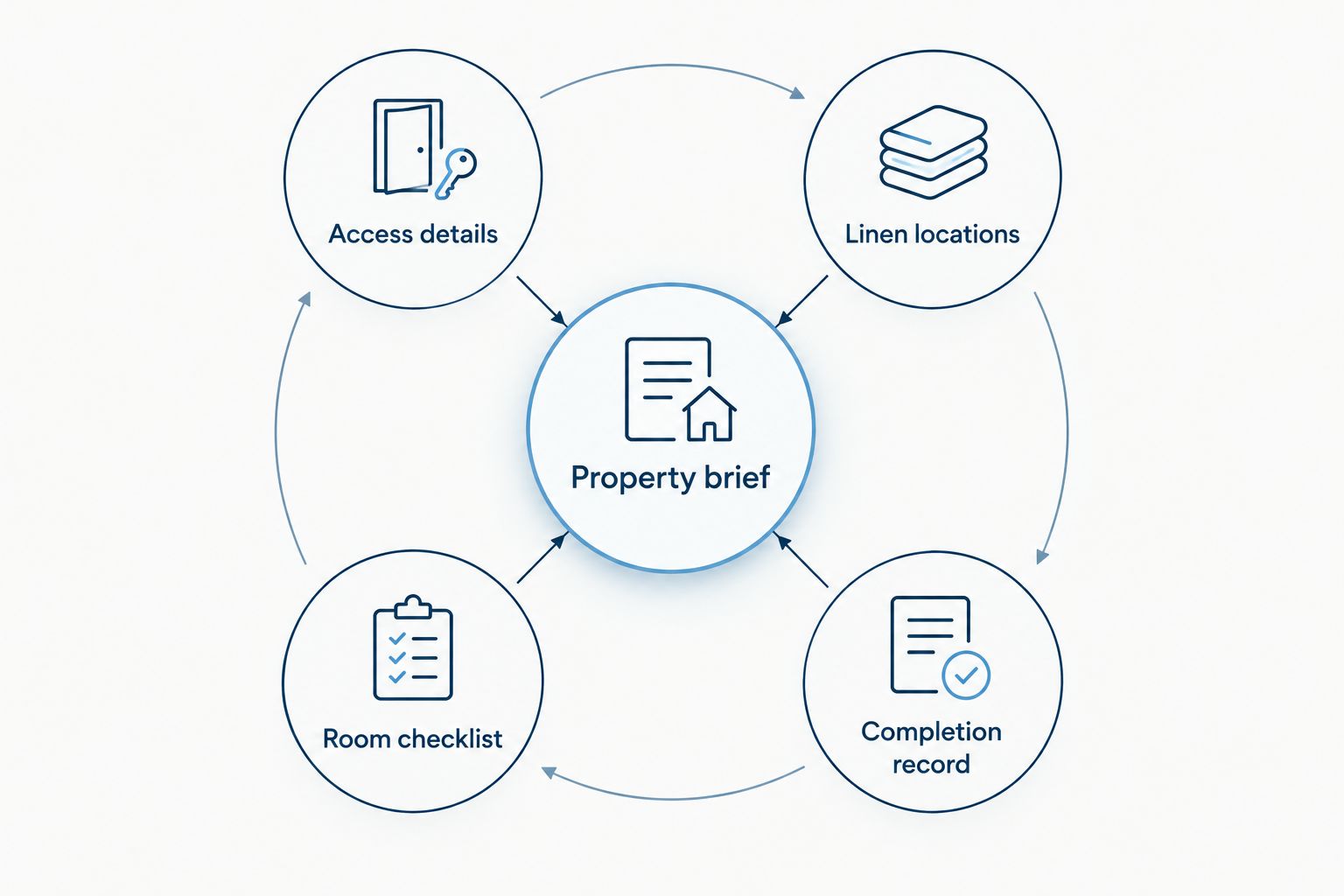
Organize the property brief around access details, linen locations, a room checklist, and a completion record. This keeps entry instructions connected to the work and its final sign-off.
Reference photos show the intended setup; they do not replace a written task list. Specify whether the visit includes appliance interiors, outdoor areas, or other work beyond the agreed turnover scope.
- Photograph the approved bed and furniture arrangements.
- List kitchen and bathroom checks separately.
- State which appliance surfaces and interiors are included.
- Identify any lanai, patio, or entry-area tasks.
- Define what must be reported rather than cleaned or repaired.
3. Assign cleaning, linens, and supplies explicitly
Build a responsibility sheet before delegating. For each task, name the person doing it and the person resolving exceptions. You can manage this manually with a shared checklist; no scheduling software is required to establish ownership.
Laundry deserves its own instructions. State whether linens are washed at the property, removed for laundering, or replaced from stored sets. Confirm who handles stained items, missing towels, and bedding that cannot be returned to service.
Tampatopshelf offers Airbnb and vacation-rental turnover cleaning, providing a local service option instead of handling each clean yourself. Use the quote request to explain your properties and agree on the work; do not assume laundry, replenishment, inspections, or outdoor tasks are included without confirmation.
Treat consumables the same way. Recording low supplies and purchasing replacements are separate responsibilities. Put an approval process beside any task that requires buying something or changing the agreed scope.
- Assign bathroom, kitchen, bedroom, and floor-cleaning tasks.
- Confirm who washes, dries, folds, and replaces linens.
- Identify who checks and replenishes consumables.
- Set instructions for damaged or heavily soiled items.
- Name the contact who approves additional work.
4. Schedule from actual access and arrival constraints
Begin with a shared calendar containing departures, arrivals, and the agreed cleaning assignment. A reservation event is not an accepted job. Ask the assigned cleaner or service to confirm the property and visit.
Build your 2026 turnover schedule around the usable work window, not just the gap shown between bookings. Access restrictions, laundry arrangements, property condition, and travel between addresses belong in that discussion. Ask for an assessment of each property's needs rather than applying one duration across the portfolio.
When a guest changes departure plans, update the cleaning assignment directly. Do not assume that editing a reservation or calendar automatically tells everyone what changed.
Keep an exception plan for jobs that no longer fit the agreed window. The decision belongs with a named person who can coordinate cleaning priorities and guest communication, not with a cleaner left to improvise.
- Record agreed checkout and guest-arrival times.
- Confirm when the cleaner can actually enter.
- Obtain acceptance for each assigned turnover.
- Flag overlapping jobs across different properties.
- Send changes directly to the responsible contact.
- Record the next action when the schedule no longer fits.
5. Separate job acceptance from guest readiness
Use 3 status labels in your shared record: Scheduled, Accepted, and Ready. Scheduled means a turnover has been entered. Accepted means someone has agreed to perform it; Ready means the agreed completion checks have been satisfied.
Keep unresolved issues beside the status rather than hiding them in a separate conversation. A clean property with an unresolved access problem still needs a host decision before you treat it as ready for arrival.
Ask for a concise completion record tied to the property and visit. That record should identify unfinished tasks and concerns without requiring the cleaner to make decisions outside the agreed role. Handle guest belongings and sensitive information carefully when requesting photographs.
The host or designated manager should control the final guest-ready decision when an exception remains. This makes responsibility clear without turning the cleaning team into a maintenance or guest-services department.
- Use Scheduled, Accepted, and Ready consistently.
- Record who accepted the assignment.
- Request completion confirmation against the agreed checklist.
- Attach relevant photos without exposing guest information.
- Flag damage, access failures, and unfinished work separately.
- Name who clears exceptions before guest arrival.
6. Review exceptions and schedule deeper work
Review the turnover record yourself before adding another system. Look for repeated problems: missing linens, unclear entry instructions, tasks excluded from the scope, or cleaning needs that exceed an ordinary reset. Fix the instruction or responsibility behind the problem.
For your 2026 review, separate between-guest cleaning from deeper cleaning. A turnover checklist follows the agreed reset; it should not silently expand to cover every task the property eventually needs.
Use planned gaps to discuss deeper work, especially before returning a rental to service after a longer stay or a period without occupancy. Confirm the property's condition and requested tasks before assigning the visit.
Tampatopshelf also provides residential cleaning. If a property changes between personal use and guest use, explain that change when requesting a quote so the cleaning discussion reflects the actual condition and next use.
- Record recurring exceptions by property.
- Update instructions when the same question repeats.
- Separate maintenance requests from cleaning requests.
- Identify deeper tasks outside the turnover checklist.
- Arrange a scope review when property use changes.
Compare cleaning arrangements for your portfolio
Choose an arrangement based on who will do the work and who will coordinate it. For 2026, compare task ownership and communication before committing; a service relationship still needs clear instructions from the host.
| Option | Best for | Main advantage | Key limitation |
|---|---|---|---|
| Host-managed cleaning | Hands-on hosts able to perform each clean | Direct control over cleaning and presentation | The host must cover the labor and resolve overlapping assignments |
| Directly managed individual cleaner | Hosts prepared to coordinate assignments themselves | A direct working relationship with the person doing the work | Backup arrangements and task ownership require explicit agreement |
| Local cleaning company | Hosts delegating cleaning while retaining property oversight | A defined service scope and business contact | Laundry, restocking, and other tasks must be confirmed rather than assumed |
| Property-management arrangement | Owners seeking delegation beyond cleaning | Can place broader coordination with a manager when contracted | Cleaning responsibilities depend on the management agreement |
Choose the arrangement that covers the work you need, not the broadest-sounding service description. Ask who accepts schedule changes, who reports problems, and who can authorize work outside the original scope.
A local cleaning company does not automatically replace a property manager. Equally, hiring a manager does not remove the need for a property-specific cleaning standard. Keep the written scope available whichever arrangement you choose.
Common mistakes multi-property hosts make
Copying one checklist across different properties
A shared template is useful; identical instructions are not. Keep common headings, then specify each rental's beds, surfaces, entry arrangements, and included outdoor areas. Remove tasks that do not apply so the checklist remains usable.
Treating calendar entries as confirmed coverage
A departure on the calendar tells you a clean is needed, not that someone has agreed to it. Require acceptance and keep schedule changes visible. Resolve unanswered assignments before relying on them in your guest-arrival plan.
Leaving laundry and replenishment implied
“Turnover cleaning” does not define every linen and supply task. Confirm washing, replacement sets, consumable checks, purchasing, and exception handling individually. Otherwise, the property can be clean while the guest setup remains incomplete.
Using turnover visits to absorb deferred work
An ordinary reset and a deeper clean need separate scope discussions. Report accumulated cleaning needs, damaged items, and maintenance issues as distinct tasks. Do not leave the next cleaner to choose between the agreed checklist and unplanned work.
FAQ
What's the best way to organize cleaning across multiple Airbnb properties?
Use a separate brief for each rental and a shared record for assignments, acceptance, and completion. Define cleaning, laundry, restocking, and exception handling before delegating the work.
Can one cleaning checklist cover all my vacation rentals?
One template can cover your portfolio, but each rental needs its own instructions. Include the actual bed setup, access requirements, surfaces, supplies, and agreed outdoor tasks for that property.
Does an Airbnb calendar entry confirm that cleaning is booked?
No. Treat a turnover as accepted only after the assigned cleaner or service confirms it. Send schedule changes directly instead of assuming a calendar edit communicates acceptance.
Should I use the same cleaning duration for every property?
No. Discuss each property's scope, condition, access window, and linen arrangements before setting the schedule. Do not treat the interval between reservations as proof that the work fits.
Does vacation-rental turnover cleaning include laundry and restocking?
Include laundry and restocking only when they are part of the agreed scope. Confirm who supplies replacement linens, checks consumables, purchases supplies, and handles damaged items.
Is turnover cleaning the same as deep cleaning?
No. Turnover cleaning follows the agreed between-guest reset, while deeper cleaning addresses separately identified tasks. Discuss those tasks in advance rather than adding them silently to the next visit.
Can Tampatopshelf help hosts with properties in St. Petersburg and Pinellas County?
Yes. Tampatopshelf provides vacation-rental and Airbnb turnover cleaning in St. Petersburg and Pinellas County. Request a property-specific quote and confirm the tasks, scheduling arrangements, and communication process by phone or text.
One last thing
A completion message should name the property, not just say the cleaning is done. Before your next 2026 turnover, ask everyone to use the same property name in assignments, photos, and completion messages. It is a small change that makes multi-property records easier to follow.
Related guides
- Airbnb turnover cleaning checklist
- Cleaning checklists for property managers with multiple units
- Booking cleaning between back-to-back Airbnb reservations
Request a free quote by phone or text. Share your property locations, turnover needs, and access details for a straightforward quote tailored to each rental.


