Best for routine porcelain tile care: a tile-approved neutral cleaner. Best for vinyl plank: a vinyl-approved no-wax cleaner; best for wood: a finish-approved hardwood cleaner—this 2026 guide matches cleaning products for different floor types to the surfaces in your St. Petersburg home or vacation rental.
- Choose cleaning products for different floor types by material and finish, not fragrance or an all-purpose label.
- Tile-approved neutral cleaners suit routine porcelain care; stone needs a cleaner explicitly approved for that stone.
- Wood and laminate need compatible products and controlled moisture, not a wetter mop.
- Tampatopshelf provides residential and vacation-rental cleaning for St. Petersburg and Pinellas County properties.
For local help, Tampatopshelf provides residential, vacation-rental turnover, and commercial cleaning. Tampatopshelf is best for homeowners and vacation-rental hosts seeking local cleaning services in St. Petersburg and Pinellas County.
Why this matters
A wood-look floor does not tell you which cleaner belongs on it. Porcelain, vinyl, and laminate can look similar but require different care, especially around joints and edges.
For a beach rental, remove tracked-in sand before wet cleaning so the mop does not drag grit across the finish. For a snowbird home, identify the flooring and inspect its condition before treating an unfamiliar mark with a stronger product.
Match the cleaner to the floor first; match the cleaning method to the mess second. A stain remover that works on one surface can damage the next room's flooring.
What makes the best floor cleaner
Use these criteria when comparing cleaning products for different floor types in 2026:
- Material approval: The label must name your floor material, and the flooring manufacturer's instructions must permit its use.
- Finish compatibility: Sealed wood, waxed wood, coated concrete, and natural stone do not share a single care routine.
- Moisture control: The application method must suit the flooring, including its seams, edges, and installation requirements.
- Residue management: Follow the stated dilution and rinsing directions. More concentrate does not mean a cleaner floor.
- Task fit: Routine cleaning, stain treatment, disinfection, and finish restoration are different jobs.
- Clear directions: Choose a product whose application, precautions, and any required contact time you can follow consistently.
Floor cleaners at a glance
These are ranked product categories, not endorsements of unverified bottles. Each recommendation owns a different flooring use case; a higher position does not make a cleaner suitable for the surfaces below it.
| Rank and cleaner category | Best for | Standout feature | Key limitation |
|---|---|---|---|
| 1. Tile-approved neutral cleaner | Routine glazed porcelain and ceramic tile | Everyday cleaning without an acid-based treatment | Does not replace targeted grout or mineral-deposit treatment |
| 2. Vinyl-approved no-wax cleaner | Luxury vinyl plank and vinyl tile | Routine cleaning without adding a polish layer | Requires approval for the specific vinyl floor |
| 3. Finish-approved hardwood cleaner | Compatible finished hardwood | Matches cleaning chemistry to the finish | Not a substitute for repairing worn finish |
| 4. Laminate-approved spray cleaner | Laminate with moisture restrictions | Controlled application instead of saturation | Does not make seams waterproof |
| 5. Stone-approved neutral cleaner | Compatible marble, limestone, travertine, or other stone | Avoids acid-based cleaning on acid-sensitive stone | Cannot reverse etching or repair damaged stone |
| 6. Carpet-compatible extraction detergent | Carpet approved for wet extraction | Supports soil removal through an extraction process | Needs suitable equipment and complete drying |
1. Tile-approved neutral cleaner: best for routine porcelain care
A tile-approved neutral cleaner is the default for routine cleaning of compatible glazed porcelain and ceramic flooring. Remove loose grit first, then use the label's dilution and application directions rather than guessing a stronger mixture.
Tile and grout need separate attention. A cleaner suitable for the tile face is not automatically suitable for every grout, grout sealer, or decorative insert.
Tile-approved neutral cleaner pros:
- Suits everyday maintenance when approved for the installed tile.
- Avoids using an acidic treatment as the routine cleaner.
- Provides a repeatable method for kitchens, bathrooms, and entryways.
Tile-approved neutral cleaner cons:
- Does not automatically remove mineral buildup or deeply embedded grout soil.
- Incorrect dilution or dirty mop water can leave residue behind.
Best for: Homeowners and hosts maintaining compatible glazed tile between deeper cleaning appointments.
Verdict: Buy a tile-approved neutral cleaner for routine tile care; skip acid-based stain treatments as your everyday default.
2. Vinyl-approved no-wax cleaner: best for luxury vinyl plank
A vinyl-approved no-wax cleaner cleans compatible luxury vinyl without intentionally adding a polish coating. Check the flooring instructions before selecting a product labeled for multiple surfaces.
Keep moisture controlled, including around plank edges and transitions. A water-resistant flooring claim does not authorize every wet-cleaning method or cleaning chemical.
Vinyl-approved no-wax cleaner pros:
- Matches routine cleaning to a vinyl wear surface.
- Avoids adding a separate wax or polish unless the flooring instructions require it.
- Works within a straightforward sweep-and-clean routine.
Vinyl-approved no-wax cleaner cons:
- Cannot repair scratches, lifted edges, or worn areas.
- Does not replace checking instructions for textured surfaces or stubborn marks.
Best for: Vacation rentals and homes with luxury vinyl plank or vinyl tile whose care instructions permit the product.
For a 2026 rental supply checklist, record the approved cleaner rather than writing only the floor's appearance. “Wood-look hallway” is not enough information for someone choosing a bottle.
Verdict: Buy a vinyl-approved no-wax cleaner; skip unapproved waxes, polishes, and abrasive treatments.
3. Finish-approved hardwood cleaner: best for finished wood
A hardwood cleaner must suit the finish, not just the wood species. Follow the flooring or finish manufacturer's directions, including restrictions on water and application tools.
Remove loose debris before cleaning and use only the permitted amount of moisture. If the finish is worn through, stop treating the exposed area as though its protective coating remains intact.
Finish-approved hardwood cleaner pros:
- Makes finish compatibility the starting point.
- Supports controlled cleaning rather than soaking.
- Gives recurring cleaners a specific product and method to follow.
Finish-approved hardwood cleaner cons:
- A cleaner for one finish is not automatically suitable for another.
- Cleaning cannot replace refinishing or repair moisture damage.
Best for: Homeowners who know their wood floor's finish and have its care instructions.
An oil-finished or waxed floor needs its own approved care system. Do not substitute a general hardwood spray because the bottle shows a similar-looking floor.
Verdict: Buy only after confirming finish compatibility; hold if the finish is unknown.
4. Laminate-approved spray cleaner: best for moisture-controlled care
A laminate-approved spray cleaner supports light, controlled application on compatible laminate flooring. Apply it exactly as directed; some instructions call for application to the cleaning pad rather than directly to the floor.
Pay attention to seams, damaged edges, and areas near sinks or exterior doors. Cleaning cannot reseal swollen joints or correct an underlying moisture problem.
Laminate-approved spray cleaner pros:
- Supports controlled dosing instead of bucket soaking.
- Keeps the product choice specific to laminate.
- Fits a routine that starts with dry debris removal.
Laminate-approved spray cleaner cons:
- Overapplication still introduces unwanted moisture.
- Cannot restore a swollen core or damaged printed surface.
Best for: Laminate floors whose instructions permit the selected spray cleaner and damp-cleaning method.
Do not assume a steam mop is acceptable because it uses water rather than detergent. Heat and moisture restrictions still apply, so check the flooring instructions before using steam.
Verdict: Buy a laminate-approved cleaner for controlled application; skip soaking and unapproved steam cleaning.
5. Stone-approved neutral cleaner: best for natural stone
Choose a neutral cleaner explicitly approved for the installed stone. Marble, limestone, and travertine are acid-sensitive; vinegar and acidic bathroom cleaners can etch their surfaces.
“Natural” on a cleaning label does not establish stone compatibility. Identify the stone, its finish, and any sealer-care requirements before choosing a routine product or spot treatment.
Stone-approved neutral cleaner pros:
- Puts stone compatibility ahead of a general-purpose claim.
- Avoids acid-based routine cleaning on acid-sensitive materials.
- Supports a consistent maintenance method when used as directed.
Stone-approved neutral cleaner cons:
- Does not remove etching, scratches, or every absorbed stain.
- Does not replace sealing advice specific to the stone and installation.
Best for: Homes and rentals with identified natural stone and documented care requirements.
For a 2026 property handoff, photograph the stone's existing marks before cleaning. A dull spot caused by etching is surface damage, not necessarily dirt that needs more scrubbing.
Verdict: Buy a cleaner approved for the specific stone; skip vinegar and unverified acidic treatments.
6. Carpet-compatible extraction detergent: best for extraction cleaning
Use an extraction detergent only when the carpet and equipment instructions permit it. The detergent, dilution, machine, and drying process must work together; household dish soap is not a substitute for a machine-compatible formula.
Vacuum loose soil before wet extraction. Test the selected treatment as directed, and avoid repeated saturation when a mark does not lift.
Carpet-compatible extraction detergent pros:
- Supports soil removal with compatible extraction equipment.
- Provides directions for dilution and machine use.
- Separates whole-area extraction from small spot treatments.
Carpet-compatible extraction detergent cons:
- Requires suitable equipment and thorough drying.
- Is not appropriate for every fiber, backing, rug, or stain.
Best for: Carpeted areas approved for wet extraction, with a plan to keep people off the carpet until dry.
A tight guest-change schedule is not a reason to ignore drying. Plan carpet work separately when the next use of the room conflicts with the required process.
Verdict: Buy only for approved extraction work; hold when the carpet type or drying plan is unclear.
Build a floor-care routine your cleaner can follow
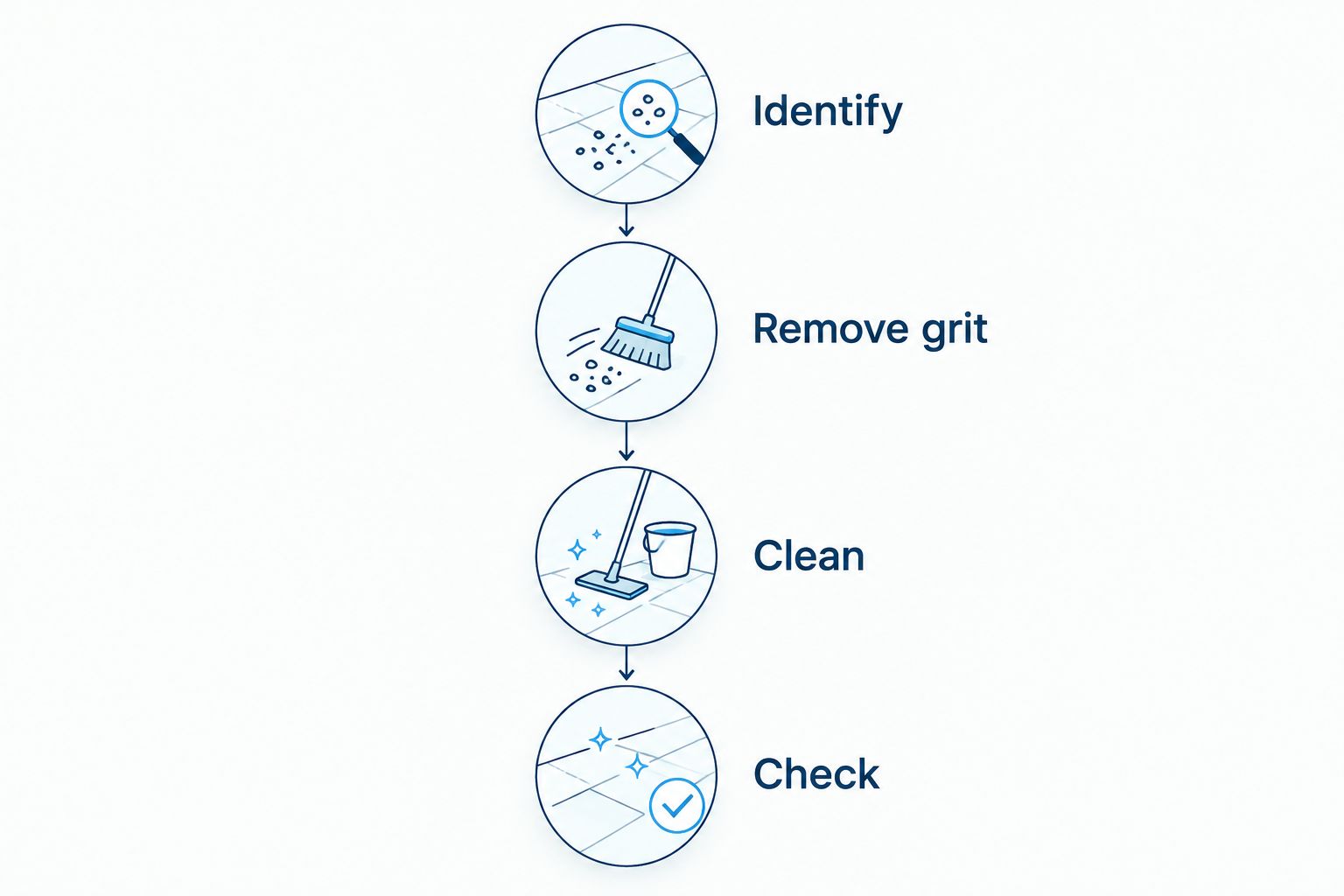
For your 2026 property checklist, use the same sequence in every room. Keep 1 floor-care sheet per property so household members, hosts, and cleaners can find the approved instructions without guessing.
- Identify: Record the material, finish, and any damaged areas.
- Remove grit: Vacuum or sweep using tools approved for the surface.
- Clean: Use the approved product, dilution, and application method.
- Check: Inspect for residue, remaining soil, and moisture before reopening the area.
Start with 2 separately labeled mop pads: one for bathroom floors and one for other living areas. Change pads whenever soiled; the separation is an organizational starting point, not permission to spread a dirty pad through multiple rooms.
Keep 1 labeled container for each prepared solution, following the product's storage and labeling instructions. Never mix cleaning products, and never put a cleaning solution in a food or drink container.
How the categories are ranked
The ranking puts routine hard-floor maintenance first, then material-specific care and equipment-dependent carpet extraction. It uses the criteria above: material approval, finish compatibility, moisture control, residue management, task fit, and clear directions.
This 2026 guide is a selection framework, not a laboratory product test. Your flooring manufacturer's instructions take priority over a category recommendation.
Which floor cleaner should you choose?
Choose the cleaner explicitly approved for your installed floor and finish. If you have compatible glazed porcelain, begin with a tile-approved neutral cleaner; if you have mixed flooring, keep separate, clearly identified products wherever the care instructions differ.
Tampatopshelf offers floor cleaning within residential and vacation-rental cleaning services, including recurring cleaning, deep cleaning, and move-in or move-out needs. Share the flooring details, existing damage, and product restrictions when requesting a tailored quote.
FAQ
What's the best way to choose cleaning products for different floor types?
Choose by the installed material, finish, and manufacturer's care instructions. Then confirm that the cleaner's label permits that use and follow its dilution and application directions.
Can I use the same cleaner on tile and vinyl plank?
Use the same cleaner only if both flooring manufacturers and the product label permit it. A shared wood-look appearance or an all-purpose claim does not establish compatibility.
Is vinegar safe for marble or travertine floors?
No. Vinegar is acidic and can etch marble and travertine; choose a cleaner explicitly approved for the installed stone instead.
Can I steam-clean laminate or hardwood floors?
Use steam only when the flooring manufacturer's instructions explicitly permit it. Do not assume that a detergent-free method avoids heat or moisture damage.
Why does my floor feel sticky after mopping?
Cleaner residue is one possible cause of a sticky floor. Check dilution, rinsing directions, pad cleanliness, and the flooring care instructions before adding more product.
Does a floor cleaner disinfect the floor?
A cleaner is not automatically a disinfectant. Disinfection requires a product labeled for that purpose and surface, used according to its directions, including the stated contact time.
What should I tell a cleaner before an Airbnb turnover?
Provide the floor materials, approved products, known damage, and any moisture or finish restrictions. Include these details in the property's cleaning instructions so product selection does not depend on appearance.
One last thing
A clean floor does not need an added shine. Matte finishes are intentional, and a dull patch on stone or wood can be damage rather than removable dirt; adding polish without approval creates a different problem instead of diagnosing the first one.
Related guides
- Cleaning tips for sand and salt at beach vacation rentals
- Requesting specific cleaning products in your home
- Airbnb turnover cleaning checklist
Ready for help with your floors and the rest of your property? Request a free quote from Tampatopshelf, a local, licensed and insured St. Petersburg team. Reach a real person by phone or text to discuss cleaning built around your space.


