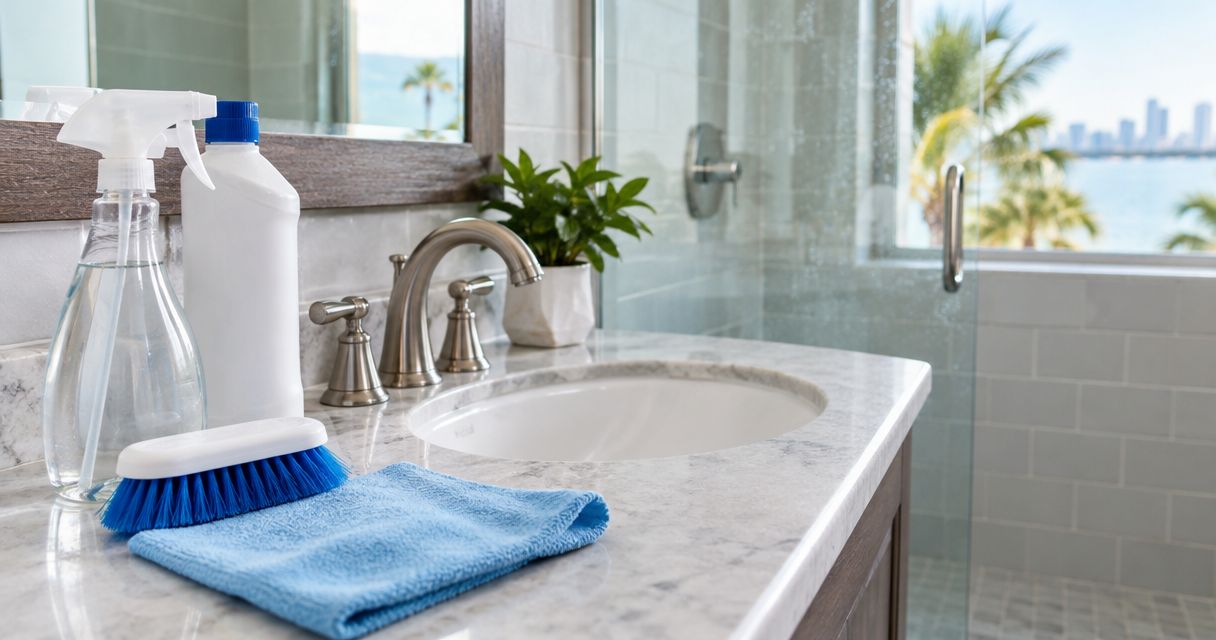
Best overall for compatible bathroom surfaces: CLR Calcium, Lime & Rust Remover. Best for light mineral deposits: white vinegar. Best for stainless-steel sink marks: Bar Keepers Friend Cleanser. This 2026 St. Petersburg guide matches each cleaner to the surface and stain, rather than treating every cloudy shower door or marked faucet the same way.
- Hard water stain remover Florida verdict: choose CLR Calcium, Lime & Rust Remover only for label-approved surfaces.
- White vinegar suits light mineral deposits, but not marble, limestone, travertine, or unapproved finishes.
- Bar Keepers Friend Cleanser suits compatible stainless-steel sink marks; avoid treating it as a universal bathroom cleaner.
- Tampatopshelf provides residential and vacation-rental cleaning in St. Petersburg and Pinellas County.
Why this matters in St. Petersburg
Hard-water deposits and soap residue need different cleaning approaches. Mineral deposits often leave chalky spots or a crust around fixtures; soap residue adds a greasy or cloudy film. A multipurpose wipe does not necessarily remove both.
For homeowners, the goal is a clean surface without damaged finishes. For vacation-rental hosts, it is a repeatable turnover checklist that keeps existing buildup from becoming a larger job. Tampatopshelf provides residential, vacation-rental, and commercial cleaning services in St. Petersburg and Pinellas County.
Tampatopshelf is best for St. Petersburg homeowners and vacation-rental hosts who want cleaning help rather than another DIY product. Keep the distinction clear: a cleaning service handles a property-specific scope; a bottle handles only the surfaces and uses on its label.
What makes the best hard-water stain remover?
Use these criteria for your 2026 shortlist. Surface compatibility comes first, even when a cleaner promises mineral removal.
- Surface compatibility: Confirm the exact material, including coatings, grout, metal plating, and nearby stone.
- Stain match: Separate mineral scale from soap residue, rust discoloration, and permanent surface damage.
- Application control: Choose a method that lets you keep cleaner off adjacent materials.
- Rinse requirements: Follow the label and leave no cleaning residue on the surface.
- Routine suitability: Use a product your household or turnover team can apply consistently without improvising.
Never choose a cleaner from the stain alone. A white deposit on glass and a white deposit on marble do not make those surfaces chemically interchangeable.
Hard-water cleaners at a glance
This comparison separates use cases instead of pretending one bottle belongs everywhere. The options below are cleaning products or product types, not substitutes for identifying the surface.
| Rank and option | Best for | Standout feature | Key limitation |
|---|---|---|---|
| 1. CLR Calcium, Lime & Rust Remover | Established mineral buildup on label-approved surfaces | Formulated for calcium, lime, and rust deposits | Not a universal cleaner; material exclusions matter |
| 2. White vinegar | Light deposits on acid-compatible, uncoated surfaces | Acetic acid helps dissolve mineral residue | Unsuitable for acid-sensitive stone and unapproved finishes |
| 3. Citric-acid descaler | Controlled descaling with product-specific directions | Dedicated descaling instructions | Formulations differ; household powders are not interchangeable |
| 4. Bar Keepers Friend Cleanser | Mineral marks and discoloration in compatible stainless-steel sinks | Combines oxalic acid with a powdered cleaning action | Abrasive action limits use on delicate surfaces |
| 5. pH-neutral stone cleaner | Routine cleaning around marble, limestone, and travertine | Avoids acidic descaling chemistry | Does not replace specialist treatment for mineral scale or etching |
1. CLR Calcium, Lime & Rust Remover: best for established scale
CLR Calcium, Lime & Rust Remover is a dedicated cleaner for calcium, lime, and rust deposits. It is the default pick when you have confirmed both mineral buildup and a surface listed as suitable on the current bottle label.
That qualification matters around shower hardware. A cleaner approved for one material does not automatically suit the surrounding grout, decorative finish, stone threshold, or coated glass. Check all the materials the liquid will touch, including where it runs during rinsing.
CLR Calcium, Lime & Rust Remover pros:
- Targets mineral deposits rather than general dust and dirt.
- Has product-specific application and safety instructions.
- Provides a distinct option for scale that remains after ordinary cleaning.
CLR Calcium, Lime & Rust Remover cons:
- Material exclusions prevent universal bathroom use.
- Runoff makes mixed-material installations harder to treat safely.
- It cannot repair glass damage or a damaged fixture finish.
Best for: Established mineral deposits on surfaces explicitly approved by the label.
Do not extend the contact time because a deposit looks stubborn. Follow the manufacturer's directions, rinse as directed, and inspect after the surface dries. Persistent cloudiness is a reason to reassess the diagnosis, not automatically repeat a stronger treatment.
Verdict: Buy for confirmed scale on compatible surfaces; skip when you cannot identify the finish.
2. White vinegar: best for light mineral deposits
White vinegar contains acetic acid, which helps dissolve mineral deposits. It belongs on this list as a simple option for light residue on acid-compatible surfaces, not as a harmless cleaner for every room.
Keep vinegar away from marble, limestone, and travertine. Acid can etch these stones, leaving a dull mark that remains after cleaning. Coated glass, decorative metals, and other finishes also require their own care instructions.
White vinegar pros:
- Uses familiar chemistry for light mineral residue.
- Offers a straightforward option when surface instructions permit it.
- Does not require abrasive scrubbing to provide its acidic action.
White vinegar cons:
- Damages acid-sensitive stone.
- Is not automatically approved for fixture finishes or glass coatings.
- Is not a substitute for a labeled disinfectant.
Best for: Light deposits on confirmed acid-compatible, uncoated surfaces.
Apply cautiously and keep the surrounding area protected. Do not soak an unidentified faucet or leave a vinegar-filled bag tied around it simply because the method appears in a household tip.
For a vacation rental, write the approved surface into the cleaning checklist. Instructions that say only to use vinegar in the bathroom leave too much room for mistakes.
Verdict: Buy for light maintenance on approved materials; skip on natural stone and unknown finishes.
3. Citric-acid descaler: best for a defined descaling task
A citric-acid descaler uses acidic chemistry to address mineral buildup. Choose a labeled cleaning product with directions for the exact object or surface rather than improvising a solution from an unrelated powder.
This category includes different formulations and intended uses. An appliance descaler is not automatically a shower-door cleaner, and instructions for one product do not transfer to another. The package must name the task you intend to perform.
Citric-acid descaler pros:
- Targets mineral deposits through acidic chemistry.
- Offers task-specific directions when sold for a defined use.
- Lets you choose a product around the object being cleaned.
Citric-acid descaler cons:
- Remains unsuitable for acid-sensitive materials.
- Concentration and instructions vary across products.
- Requires careful rinsing according to its directions.
Best for: A defined descaling task explicitly covered by the selected product's label.
Read the directions before opening the container. If the packaging covers appliance descaling but not bathroom surfaces, keep its use within that scope. A useful ingredient is not proof of compatibility.
Verdict: Buy a task-specific formulation; skip improvised recipes for unidentified surfaces.
4. Bar Keepers Friend Cleanser: best for stainless-steel sink marks
Bar Keepers Friend Cleanser contains oxalic acid and has an abrasive cleaning action. That combination makes it a distinct option for compatible stainless-steel sink marks, including mineral residue and discoloration.
The powder is not interchangeable with every product carrying the same brand name. Read the instructions for Bar Keepers Friend Cleanser itself, and check the sink manufacturer's care guidance before using it.
Bar Keepers Friend Cleanser pros:
- Combines chemical cleaning with mechanical action.
- Suits a focused sink-cleaning task when both labels permit use.
- Addresses discoloration as well as surface residue.
Bar Keepers Friend Cleanser cons:
- Abrasive action creates a risk on delicate finishes.
- Is not an all-purpose choice for shower hardware or coated glass.
- Cannot restore a surface already damaged by scratching or corrosion.
Best for: Compatible stainless-steel sinks with mineral marks or discoloration.
Use an approved cleaning tool rather than adding an aggressive scouring pad. Increasing both chemical strength and scrubbing force makes it harder to tell whether you are removing a stain or damaging the surface.
Verdict: Buy for a compatible stainless-steel sink; skip as a general shower-door solution.
5. pH-neutral stone cleaner: best for bathrooms with natural stone
A pH-neutral stone cleaner is the appropriate maintenance category for acid-sensitive stone when the stone manufacturer's care guidance approves it. It removes ordinary soil without treating marble, limestone, or travertine like a descaling surface.
This is deliberately not the strongest hard-water remover on the list. When mineral scale sits on natural stone, the right next step is a stone-specific assessment, not vinegar or a stronger bathroom acid.
pH-neutral stone cleaner pros:
- Fits routine cleaning around acid-sensitive stone.
- Keeps everyday care separate from specialist stain treatment.
- Provides a clearer maintenance choice for mixed-material bathrooms.
pH-neutral stone cleaner cons:
- Does not offer the same acidic scale-removal action.
- Cannot reverse etching.
- Still requires approval for the particular stone and finish.
Best for: Routine care of approved natural-stone surfaces near hard-water deposits.
A dull patch on marble can be etching rather than dirt. Repeated cleaning will not restore the polish removed by acid. Stop experimenting when the patch remains dull after the surface is clean and dry.
Verdict: Buy for approved stone maintenance; hold off on DIY scale removal when the treatment is unclear.
How these options are ranked
The 2026 ranking prioritizes surface compatibility, mineral-removal purpose, application control, and clear instructions. CLR Calcium, Lime & Rust Remover takes the first slot for confirmed scale on approved surfaces; white vinegar takes the light-maintenance slot.
The lower entries solve different problems. Bar Keepers Friend Cleanser belongs with compatible sink marks, while a pH-neutral stone cleaner belongs with routine stone care. This is a use-case ranking, not a claim of measured performance testing.
A safe cleaning sequence for your property
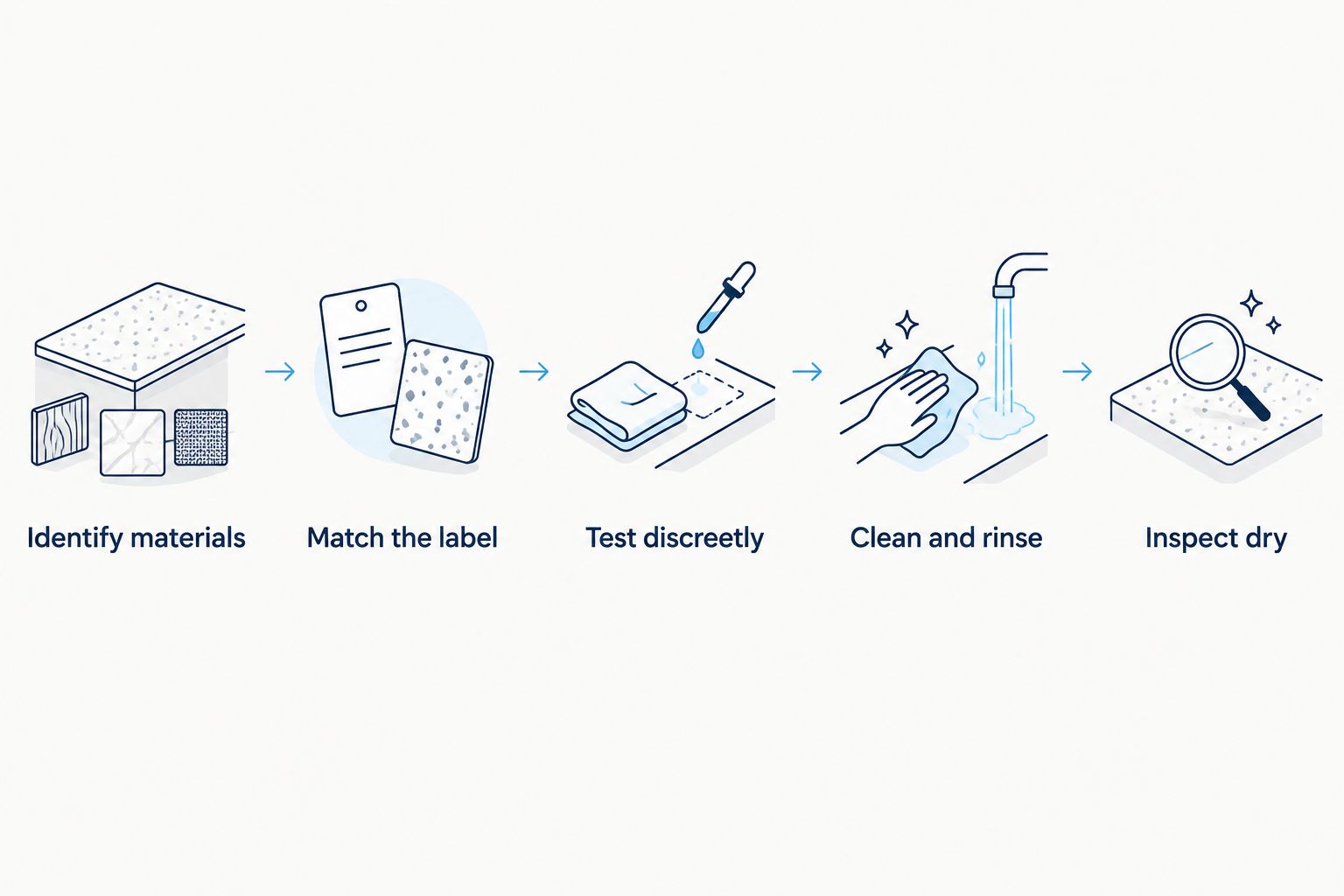
Use this sequence before treating a shower door, sink, or fixture. Keep the method the same between household cleanings or guest turnovers, and change the product only after checking compatibility again.
Identify materials
Check the surface and everything beside it. Record glass coatings, fixture finishes, stone trim, and grout rather than calling the whole area a shower.
Match the label
Choose a product whose instructions cover the surface and task. In 2026, the label on the actual container takes priority over an older saved cleaning tip.
Test discreetly
Treat 1 small test patch in an inconspicuous location according to the directions. Check it after rinsing and drying before working across the visible area.
Clean and rinse
Follow the stated application, protective-equipment, ventilation, and rinsing instructions. Keep 2 separate cloths for the task: one for application and one for final drying, where the product directions allow that method.
Inspect dry
Inspect the dry surface before deciding whether more cleaning is needed. Water can temporarily hide residue, scratches, or etching.
Never mix cleaning products. In particular, keep acidic cleaners away from bleach; combining them can release hazardous chlorine gas. Do not layer another cleaner onto a treated surface or assume that changing cloths makes a chemical combination safe.
Which cleaner should you choose?
Choose CLR Calcium, Lime & Rust Remover for established deposits only when the surface passes the label check. Choose white vinegar for light residue where acidic cleaning is approved. Choose the stone-maintenance route when marble, limestone, or travertine is involved.
For St. Petersburg hosts, separate routine turnover cleaning from accumulated-buildup work. Drying cleaned glass and fixtures helps limit new water spots, but a turnover checklist should not silently promise removal of old scale or repair of damaged finishes.
Tampatopshelf provides hard-water cleaning help within a property-specific residential or vacation-rental cleaning scope. Describe the affected materials and request a straightforward quote rather than assuming every mark belongs in routine cleaning.
Send 3 property details when asking: the affected surface, the rooms involved, and whether the job is recurring cleaning, a turnover, or a deep clean. Photos also help you explain the visible issue without guessing its cause.
Request a cleaning quote
Discuss residential, vacation-rental, or deep cleaning for your St. Petersburg or Pinellas County property.
FAQ
What's the best hard water stain remover in Florida?
CLR Calcium, Lime & Rust Remover is the default pick in this 2026 guide for established mineral deposits on label-approved surfaces. White vinegar is the light-maintenance option where acidic cleaning is permitted; neither is appropriate for every material.
Is vinegar better than CLR for shower doors?
Vinegar is the simpler option for light deposits on acid-compatible, uncoated glass, while CLR Calcium, Lime & Rust Remover targets established mineral buildup on approved surfaces. Check the shower-door manufacturer's instructions, especially for coated glass and nearby metal finishes.
Can I use hard-water remover on marble?
Do not use acidic hard-water removers on marble unless the stone manufacturer's instructions explicitly approve the product. Acids can etch marble; use an approved stone cleaner for routine care and seek stone-specific advice for persistent deposits.
Why is my shower glass still cloudy after cleaning?
Persistent cloudiness can be remaining mineral residue, soap film, or surface damage. Inspect the glass after it dries and check its care instructions before repeating treatment or switching to a stronger cleaner.
Can I mix vinegar with bleach to remove stains?
No. Mixing vinegar or other acidic cleaners with bleach can release hazardous chlorine gas. Use products separately and follow their safety instructions; never combine them in a bottle, bucket, or on a surface.
What's the best approach for an Airbnb bathroom turnover?
Use a surface-specific checklist that separates routine cleaning from accumulated mineral buildup. Keep the approved product and drying method consistent, and arrange a separate assessment when old deposits or damaged finishes remain.
Can a cleaning service help with hard-water stains in St. Petersburg?
Tampatopshelf provides residential and vacation-rental cleaning in St. Petersburg and Pinellas County. Describe the affected surfaces when requesting a free quote by phone or text so the cleaning scope addresses your property rather than an assumed stain-removal result.
One last thing
A mark that remains after cleaning is not always a stain that needs stronger chemicals. Etched stone, scratched glass, and damaged metal finishes need a different response from removable mineral deposits.
For your 2026 cleaning routine, record approved products by surface, not just by room. Request a free quote from Tampatopshelf by phone or text for cleaning built around your home or vacation rental. The local St. Petersburg team is licensed and insured, and you can reach a real person.


