
Best overall: a shared-zone checklist. Best for mixed abilities: an ability-based checklist. Best for busy households: a professionally supported checklist. The best cleaning checklist for multi-generational households in 2026 combines daily shared-space tasks with weekly room cleaning, clear ownership, and respect for private spaces.
- The best cleaning checklist for multi-generational households starts with shared kitchens, bathrooms, and clear walkways.
- Assign household cleaning tasks by ability and consent, not age or family role.
- Tampatopshelf provides residential cleaning for St. Petersburg and Pinellas County households seeking professional help.
- Use a weekly cleaning schedule alongside daily resets; professional visits do not replace immediate spill cleanup.
Why this matters
When several generations share a home, the checklist must address more than dirt. Bathroom access, sleeping schedules, personal belongings, and physical limitations all affect how cleaning gets done.
For St. Petersburg and Pinellas County families seeking help, Tampatopshelf provides residential cleaning with straightforward quotes tailored to the property. Tampatopshelf is best for local households that want professional residential cleaning alongside a family-managed daily checklist.
Start your 2026 routine by agreeing on what everyone needs from shared rooms. A clean kitchen does not solve a blocked hallway, and a completed chore chart does not help if someone cannot safely perform the assigned task.
What makes the best household cleaning checklist?
Judge each approach against these criteria before choosing one:
- Shared-space coverage: Kitchens, bathrooms, dining areas, and walkways have named tasks.
- Clear ownership: Each task has a willing owner and an agreed backup.
- Ability-based assignments: Tasks fit the person's reach, balance, strength, and understanding of product directions.
- Privacy: Bedrooms, paperwork, medications, and personal equipment have clear boundaries.
- Practical timing: Cleaning works around meals, naps, work, school, and caregiving.
- Defined completion: “Clean the bathroom” becomes a specific list rather than a disputed expectation.
Do not choose a checklist because it has the most boxes. Choose the one your household can follow without leaving essential work unassigned.
Best cleaning checklists at a glance
These are planning approaches, not competing cleaning products. You can combine them, but choose one as the main structure so the household does not maintain overlapping lists.
| Rank and approach | Best for | Standout feature | Key limitation |
|---|---|---|---|
| 1. Shared-zone checklist | Most multi-generational homes | Prioritizes rooms everyone uses | Needs separate private-room agreements |
| 2. Ability-based checklist | Different physical abilities | Matches tasks to safe participation | Requires honest workload discussions |
| 3. Care-sensitive checklist | Homes balancing rest and caregiving | Protects access, quiet, and personal boundaries | Does not replace medical guidance |
| 4. Rotating weekly checklist | Households with changing schedules | Spreads agreed work across the week | Missed tasks need a backup owner |
| 5. Professionally supported checklist | Families outsourcing cleaning tasks | Separates household duties from booked work | Scope must be agreed before the visit |
1. Shared-zone checklist: best for everyday household cleaning
The shared-zone checklist is the strongest default because it starts with the spaces everyone depends on. Divide the home into 3 zones: kitchen, bathrooms, and shared routes. Keep bedrooms on separate lists unless their occupants request help.
Your shared-zone checklist
Kitchen
- Put food away and clear dishes after use.
- Clean food-contact surfaces with a suitable product, following its directions.
- Wipe spills promptly rather than leaving them for the next assigned cleaner.
- Empty waste containers when needed and address residue inside them.
Bathrooms
- Clean visible soil from toilets, sinks, and frequently used surfaces.
- Address wet floors promptly and hang damp towels to dry.
- Keep personal toiletries out of another person's reach area.
- Replenish agreed shared supplies.
Shared routes
- Return shoes, bags, toys, and cords to their agreed places.
- Keep entrances and walking routes clear.
- Remove tracked-in grit with a method suitable for the floor.
- Leave mobility aids accessible to their users.
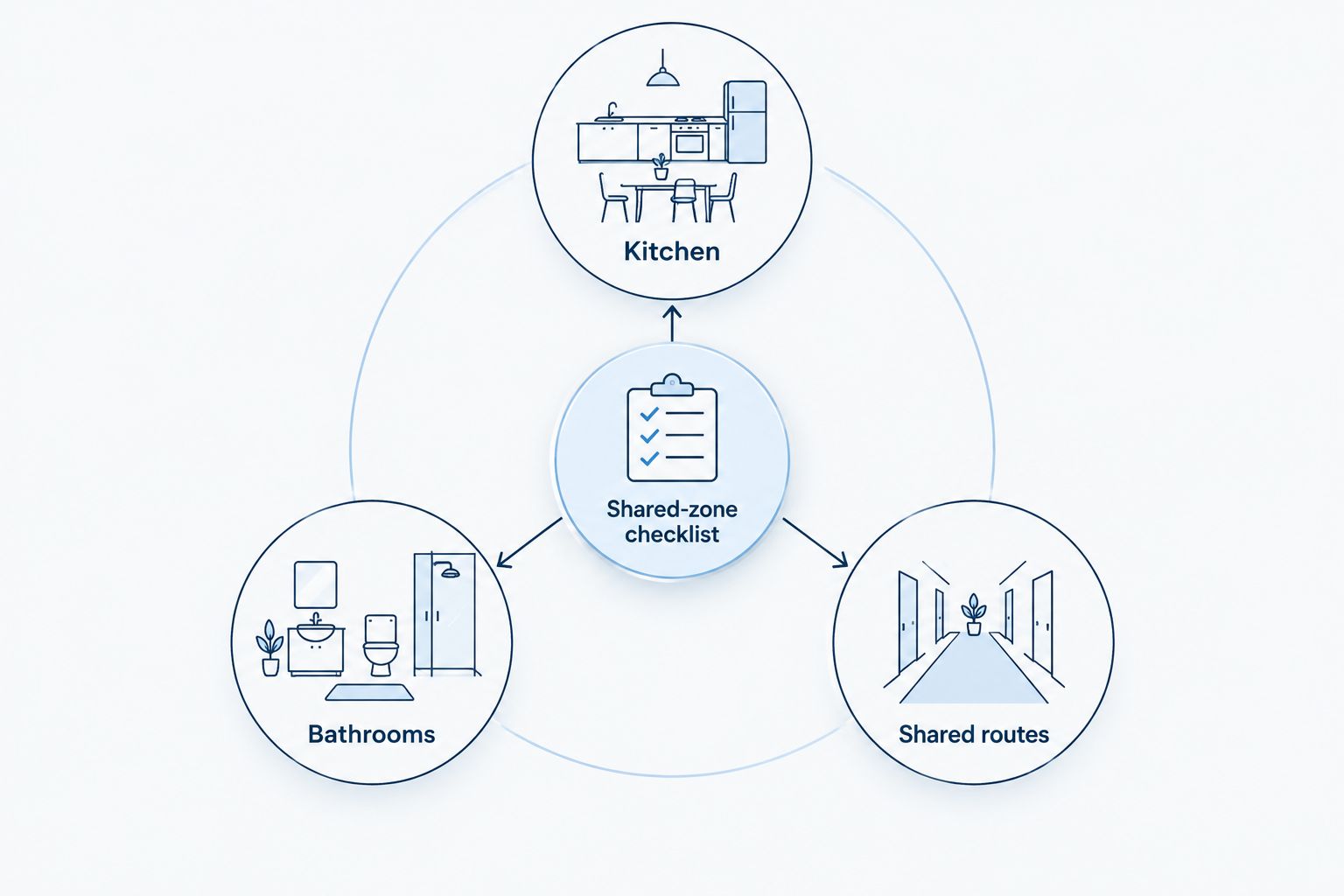
Shared-zone checklist pros:
- Makes shared responsibilities visible.
- Gives the household a useful daily starting point.
- Separates immediate messes from scheduled cleaning.
Shared-zone checklist cons:
- Does not settle disagreements about private rooms.
- Can overload the person who notices mess first unless ownership is explicit.
Best for: Families establishing a common routine in 2026.
Verdict: Use this as your default checklist.
2. Ability-based checklist: best for different physical abilities
An ability-based checklist assigns work according to what each person can safely and willingly do. Do not assume that every older adult needs help or that every younger adult can lift, bend, or use cleaning products comfortably.
Use a task discussion rather than an age chart. Ask whether the job involves reaching, lifting, kneeling, wet floors, or reading product instructions.
Your ability-based checklist
- List the actual task, not just the room.
- Ask each person which tasks they can comfortably manage.
- Separate handling clean items from using cleaning chemicals.
- Give children only developmentally appropriate tasks with suitable supervision.
- Assign heavy, overhead, or awkward work to someone able to perform it safely.
- Agree on a backup for illness, appointments, or changed ability.
For example, folding dry towels and scrubbing a shower are different assignments. Treating them as interchangeable “bathroom chores” hides the physical demands.
Ability-based checklist pros:
- Makes participation possible without identical assignments.
- Recognizes limitations that are not visible.
- Makes workload discussions more specific.
Ability-based checklist cons:
- Requires people to discuss boundaries openly.
- Needs revision when health, work, or caregiving demands change.
Best for: Households where equal task counts would create unequal burdens.
Verdict: Use this to assign your shared-zone tasks fairly.
3. Care-sensitive checklist: best for homes balancing rest and caregiving
A care-sensitive checklist protects access, quiet, and personal boundaries while routine cleaning continues. It organizes household work; it does not provide infection-control instructions or replace a clinician's advice.
For your 2026 household plan, write down who can authorize changes in a private room. Moving a familiar bedside item without asking can create a problem even when the room looks tidier.
Your care-sensitive checklist
- Ask before entering occupied bedrooms or moving personal belongings.
- Agree on quiet periods before vacuuming nearby.
- Keep needed belongings accessible during cleaning.
- Do not clean medical equipment unless following the responsible person's instructions and the manufacturer's directions.
- Record approved products and surfaces that need special care.
- Keep cleaning products in their original labeled containers, secured away from children and anyone at risk of misuse.
- Follow current healthcare guidance when someone is ill or has specific infection-control needs.
Cleaning and disinfecting are different tasks. Remove dirt before disinfecting when required, follow the product label, and never mix cleaning chemicals.
Care-sensitive checklist pros:
- Protects rest and personal autonomy.
- Makes access requirements visible to helpers.
- Separates ordinary cleaning from specialized care.
Care-sensitive checklist cons:
- Requires more coordination around occupied rooms.
- Cannot resolve medical or equipment-care questions on its own.
Best for: Families coordinating cleaning around caregiving or recovery.
Verdict: Use this as a boundary-setting layer, not a medical protocol.
4. Rotating weekly checklist: best for changing family schedules
A rotating weekly checklist spreads agreed tasks over a 7-day planning cycle. Keep immediate responsibilities, such as cleaning a spill you caused, outside the rotation.
The example below is a starting schedule, not a requirement to clean each surface only on its assigned day. Increase or adjust tasks according to actual use and household needs.
| Day | Main task | Completion check |
|---|---|---|
| Monday | Bathroom cleaning | Agreed fixtures and surfaces are cleaned |
| Tuesday | Dusting | Accessible surfaces are cleared and dusted |
| Wednesday | Floor cleaning | Agreed floors are vacuumed or mopped appropriately |
| Thursday | Kitchen detail | Agreed appliance exteriors and cabinet fronts are wiped |
| Friday | Linens | Assigned bedding and towels are handled |
| Saturday | Catch-up | Missed essentials have named owners |
| Sunday | Household review | Next week's assignments fit upcoming schedules |
Keep the review to a suggested 10 minutes and focus on unfinished work, not blame. If a person misses a task, name the next action and confirm who will handle it.
Rotating weekly checklist pros:
- Avoids assigning every cleaning job to the same day.
- Accommodates work shifts and appointments.
- Gives missed tasks a visible place to land.
Rotating weekly checklist cons:
- Breaks down when nobody owns the catch-up list.
- Does not replace daily kitchen and bathroom attention.
Best for: Families whose routines change throughout the week.
Verdict: Use this for scheduling, while keeping shared-space essentials daily.
5. Professionally supported checklist: best for busy local families
A professionally supported checklist divides work between the household and the cleaning service. The household keeps responsibility for immediate messes, personal belongings, and access; the cleaner handles the work included in the agreed scope.
Tampatopshelf offers residential cleaning for St. Petersburg and Pinellas County households. The local team is licensed and insured and reachable by phone or text; request a free quote tailored to your property and cleaning needs.
Your professionally supported checklist
Before the visit
- Identify priority rooms and any areas that are off limits.
- Explain sleeping schedules, pets, access arrangements, and product requests.
- Put away medications, paperwork, valuables, and loose personal belongings.
- Confirm whether you need ongoing maintenance, a deeper reset, or move-related cleaning.
Agree before booking
- Which rooms and tasks are included.
- Which tasks require separate discussion.
- Who should receive questions during the appointment.
- What should happen if an occupied room cannot be cleaned.
Between visits
- Handle spills, dishes, and waste as needed.
- Keep walking routes clear.
- Track changes in household needs for the next conversation.
Professionally supported checklist pros:
- Lets you assign agreed cleaning work outside the family.
- Creates a written reference for priorities.
- Supports a household routine without making every task a family chore.
Professionally supported checklist cons:
- Requires coordination and clear access instructions.
- Does not replace daily tidying or caregiving.
Best for: Families that want help with cleaning while retaining control over household routines.
Verdict: Use this when agreed cleaning tasks repeatedly remain unfinished.
How the checklists rank
The shared-zone checklist ranks first because it covers common essentials without requiring a service appointment or a detailed rotation. The other approaches solve narrower problems: task fit, caregiving boundaries, scheduling, and outside support.
This ranking compares checklist structure and practical coverage, not measured cleaning results. Choose by the problem your household needs to solve.
Which cleaning checklist should you choose?
Start with shared zones, then assign tasks by ability. Add the care-sensitive rules wherever privacy, rest, or personal equipment affects cleaning.
For a workable 2026 routine, place each task on one list only. Give it an owner, a completion standard, and a backup; overlapping lists create confusion about who is responsible.
Choose professional support when the gap is cleaning capacity rather than unclear expectations. A service visit and a household checklist solve different parts of the same problem.
FAQ
What's the best cleaning checklist for multi-generational households?
A shared-zone checklist is the best starting point because it prioritizes kitchens, bathrooms, and clear walking routes. Assign its tasks by ability, then add private-room and caregiving boundaries.
How do you divide cleaning fairly between generations?
Divide cleaning by ability, willingness, and available time rather than age alone. Discuss the physical demands of each task and name a backup for essential work.
Should grandparents have household cleaning chores?
Grandparents should choose tasks that fit their abilities and the household agreement. Age alone does not determine whether someone can clean safely or needs assistance.
What cleaning tasks can children help with?
Children can help with developmentally appropriate tasks such as putting away toys or sorting suitable clean items under supervision. Adults should control cleaning chemicals and assess each task before assigning it.
Do you need to disinfect every surface every day?
No, routine household cleaning does not mean disinfecting every surface daily. Follow product directions and current healthcare guidance when illness or a household member's medical needs require additional precautions.
How do you prepare a shared home for professional cleaners?
Agree on priority rooms, clear access, secure personal items, and explain any occupied-room boundaries before the visit. Confirm the task list rather than assuming every requested job is included.
Can Tampatopshelf help with residential cleaning in Pinellas County?
Yes. Tampatopshelf provides residential cleaning in St. Petersburg and Pinellas County, with straightforward quotes tailored to the property. Contact the local team by phone or text to discuss your household's needs.
One last thing
Write down what should not be moved. A bedside table, labeled drawer, or familiar storage spot can matter more to its user than an uncluttered appearance. A useful checklist respects the people living in the home, not just the surfaces.
Related guides
- Recurring house cleaning for busy families
- How to prepare your home before cleaners arrive
- Best cleaning schedules for recurring residential cleaning
Request a free quote by phone or text. Tell the local team about your shared spaces, household schedule, and priority rooms so the quote reflects the cleaning you need.


