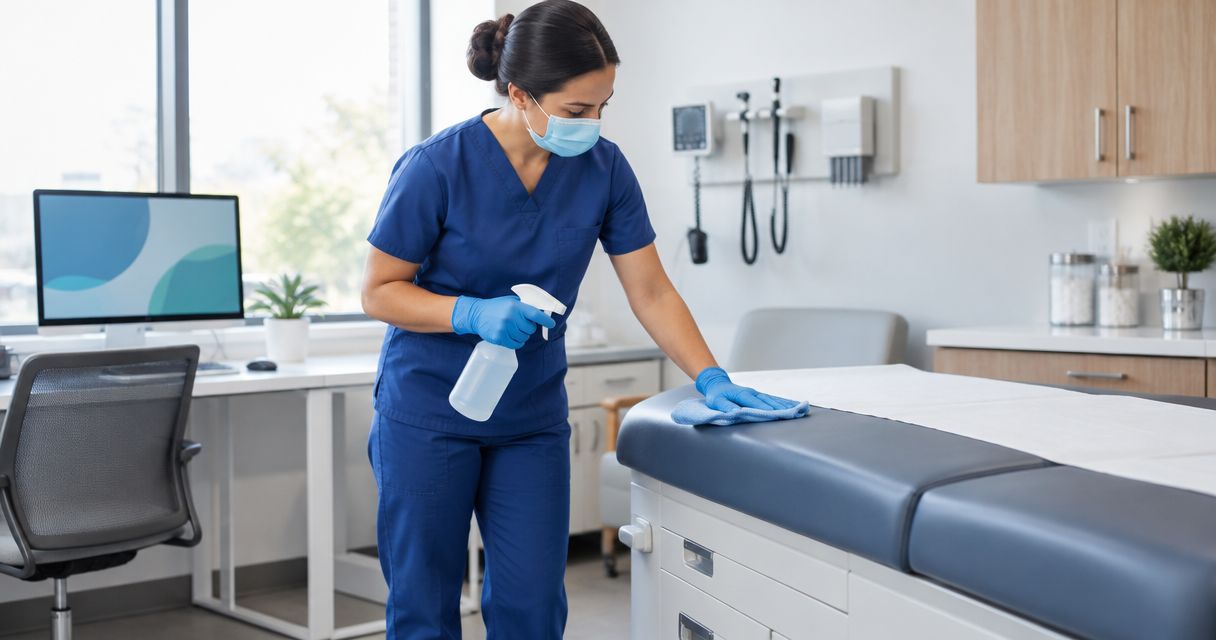
Medical-office commercial cleaning is the planned cleaning of a healthcare workspace with the aim of maintaining clean premises while supporting the practice’s infection-prevention procedures. This 2026 guide explains how to separate routine janitorial work from clinical responsibilities, define a written scope, and compare cleaning arrangements for your St. Petersburg or Pinellas County practice.
- Commercial cleaning for medical offices needs a written boundary between routine cleaning, clinical disinfection, and regulated waste handling.
- Tampatopshelf provides local commercial cleaning; confirm medical-office requirements before agreeing to a scope.
- Choose cleaning products by their EPA label, surface compatibility, and required contact time—not fragrance.
- Assign between-patient cleaning separately from scheduled janitorial visits so responsibilities remain clear.
Why commercial cleaning matters for medical offices
A medical office contains different kinds of spaces: reception areas, administrative rooms, restrooms, and patient-care rooms. Treating them as interchangeable leaves important questions unanswered: who cleans examination surfaces, who handles a blood spill, and who checks that work is complete?
A clean-looking office is not proof that clinical cleaning requirements have been met. Your practice needs a written division of responsibilities, not simply a promise to clean thoroughly.
Tampatopshelf provides commercial cleaning in St. Petersburg and Pinellas County and is a local, licensed and insured team reachable by phone or text. Those business credentials do not establish healthcare-specific training, clinical disinfection capabilities, or regulated-waste services; confirm each requirement directly.
For your 2026 cleaning plan, start with the work your practice requires. Then determine which tasks belong to trained practice staff, a general commercial cleaner, or a healthcare-focused contractor.
How to build a medical-office cleaning plan
Map your rooms and separate their responsibilities
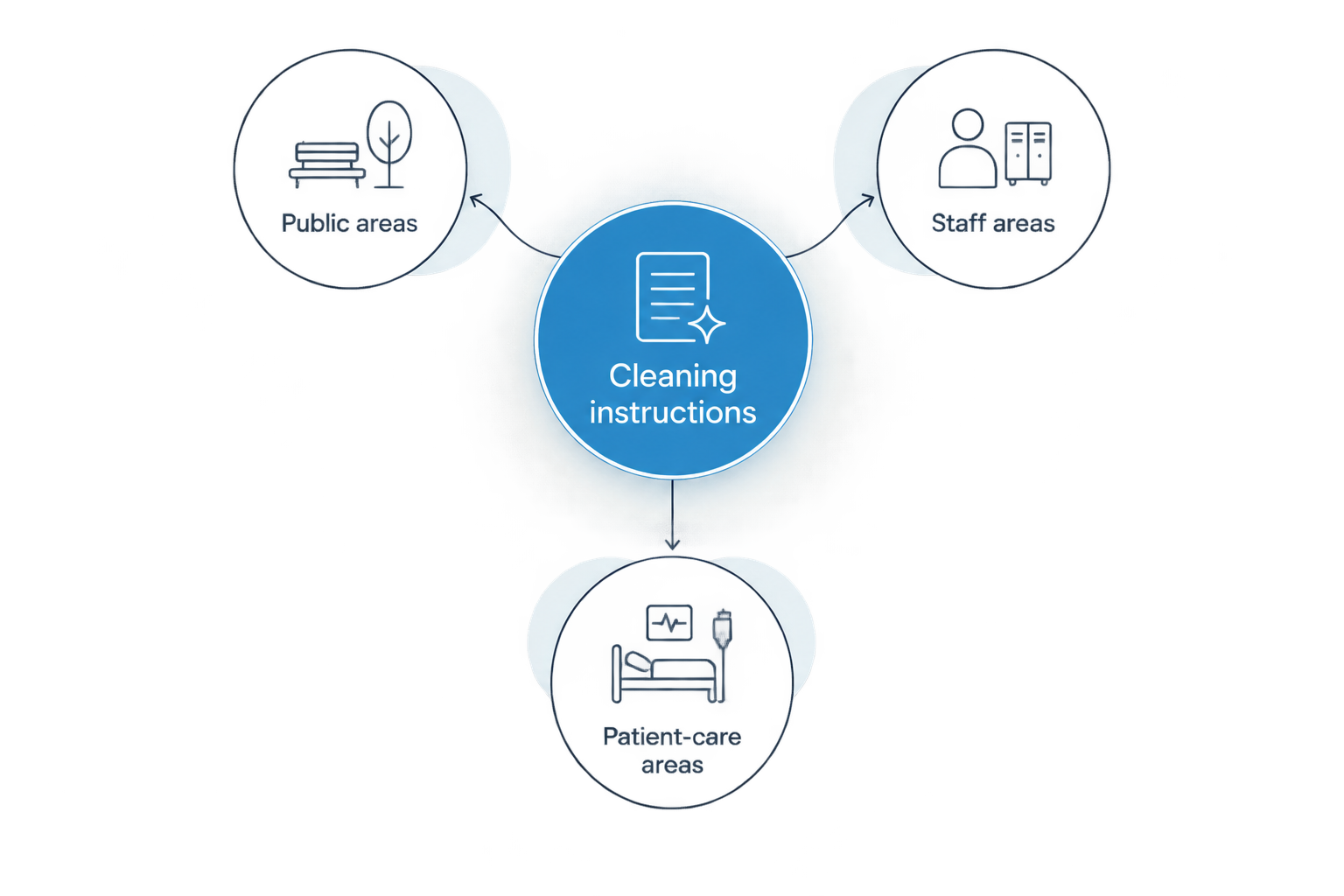
Start with a floor plan or a handwritten room list. Divide the office into 3 planning zones: public areas, staff areas, and patient-care areas. These are organizing labels, not regulatory classifications.
For each room, record its surfaces, activities, cleaning needs, and responsible person. A reception desk and an examination table should not inherit the same checklist simply because they occupy the same suite.
Identify restricted rooms before giving anyone access. Include storage areas, medication spaces, records, and equipment that cleaners must not touch or move.
- Public areas: list reception seating, entrance glass, door handles, and public restrooms.
- Staff areas: list desks, breakroom surfaces, staff restrooms, and shared touchpoints.
- Patient-care areas: list examination rooms and procedure spaces for clinical review.
- Mark equipment and storage that require separate authorization.
- Assign an owner to each room’s cleaning instructions.
Write separate routine and clinical task lists
Use a spreadsheet or printed checklist before considering scheduling software. Create 2 schedules: one for scheduled janitorial work and another for clinical tasks that follow patient care, contamination events, or your practice’s infection-prevention procedures.
Routine work includes the agreed tasks for floors, ordinary trash, reception areas, and restrooms. Clinical responsibilities require their own instructions, suitable products, and trained personnel. Do not assume an evening cleaner replaces the practice’s between-patient process.
Define what staff must remove or secure before a cleaning visit. Used instruments, exposed sharps, and patient paperwork should never become items a cleaner has to interpret.
- Specify routine tasks by room and surface.
- Assign between-patient cleaning to an identified role.
- Separate ordinary trash from sharps and regulated waste.
- State who handles blood or other potentially infectious material.
- Identify tasks excluded from the cleaning agreement.
Request a quote against the same written scope
Prepare a short brief yourself: location, room use, flooring, access arrangements, requested visit pattern, and exclusions. Give every prospective provider the same information so you compare the same work.
A provider’s property-specific quote is the faster next step once that brief exists. Tampatopshelf commercial cleaning is best for St. Petersburg and Pinellas County businesses seeking a local team and a property-specific quote. Medical-office requirements still need explicit confirmation; do not treat a general commercial service description as acceptance of clinical work.
Use the quote request to describe your premises and ask which parts of the scope the team can undertake. Include your clinical exclusions rather than leaving them for the first visit.
- Describe room functions, not just total floor space.
- Separate requested routine work from healthcare-specific tasks.
- Ask about relevant training and written procedures.
- Confirm who provides products, equipment, and consumables.
- Request written acceptance of inclusions and exclusions.
Verify disinfectants and surface instructions
Build a product list using container labels and the equipment manufacturers’ cleaning instructions. You do not need a paid system to record the product name, intended surface, dilution instructions, protective equipment, and contact time.
EPA disinfectant labels specify approved uses and directions, including contact time. Use the label’s actual instructions rather than a universal dwell-time rule. Some surfaces require cleaning before disinfection; follow the relevant label and your practice’s procedure.
For a 2026 product review, check the products actually supplied to your office. A familiar brand name alone does not identify the formulation or its permitted uses.
- Verify the EPA registration and intended use for disinfectants.
- Record the label’s required wet contact time.
- Check compatibility with upholstery, flooring, and equipment.
- Keep safety data sheets accessible to relevant workers.
- Prohibit mixing cleaning chemicals.
- Obtain approval before changing an agreed product.
Control tools, waste, and restricted tasks
Write down how tools move through the office. Separate restroom tools from those used in other spaces, and specify how reusable cloths and mop heads are handled after use. Do not rely on an informal color system nobody has documented.
Sharps and contaminated materials require a separate boundary. OSHA’s Bloodborne Pathogens standard addresses occupational exposure to blood and other potentially infectious materials; an ordinary cleaning agreement does not replace applicable employer duties.
Tell cleaners how to stop work and report an unexpected hazard. A clear escalation route is more useful than expecting someone to improvise around an exposed needle or unidentified spill.
- Separate tools by assigned area and task.
- Define reusable-tool handling and storage.
- Identify approved waste containers and collection responsibilities.
- Prohibit reaching into trash or handling exposed sharps.
- Name the contact for spills and unexpected hazards.
- Keep instrument reprocessing outside routine janitorial work unless separately authorized and qualified.
Set access and communication rules
Use a written opening and closing checklist before adding an access-management platform. Specify the permitted entrance, alarm procedure, authorized rooms, and how the cleaner confirms departure.
Designate 1 named contact at the practice for routine questions, plus a backup for urgent access or safety issues. Keep patient information out of cleaning messages; report the room and operational problem without unnecessary clinical details.
Your 2026 access plan should also cover exceptions. Late appointments, an occupied treatment room, or a locked supply cupboard need a defined response—not an assumption that the cleaner can work around them.
- Record approved access windows and entrances.
- Limit access to agreed rooms and storage.
- Secure records and screens before cleaning begins.
- Define which photographs, if any, are permitted.
- Provide a contact and backup escalation route.
- State how to report unfinished or inaccessible areas.
Inspect the agreed work and revise the checklist
Begin with a simple completion log and a walk-through against the written scope. Check whether specified tasks were completed, whether access problems occurred, and whether the team reported hazards correctly.
Visual inspection identifies visible soil and missed tasks; it does not establish that a surface is free of pathogens. If your practice uses additional verification methods, have the clinical lead define their purpose, method, and interpretation.
Review the agreement whenever room use, equipment, or operating hours change. A former consultation room converted into a procedure room needs a fresh assessment rather than a copied checklist.
- Check completed work against the room-specific scope.
- Record missed tasks without including patient information.
- Note product substitutions or damaged surfaces.
- Assign corrective actions to a named person.
- Update instructions after operational changes.
Compare cleaning arrangements for your practice
Choose the arrangement that matches your actual responsibilities, not the broadest service label. The options below are operating models, not guarantees that a particular provider accepts medical-office work.
| Option | Best for | Main advantage | Key limitation |
|---|---|---|---|
| Practice staff handling all cleaning | Practices that can assign, train, equip, and supervise the work internally | Direct control over task ownership and timing | The practice carries the full staffing and supervision burden |
| General commercial cleaning contractor | Clearly defined routine work in agreed areas | A separate team handles the accepted janitorial scope | Clinical tasks, hazardous spills, and regulated waste require explicit confirmation |
| Healthcare-focused cleaning contractor | Practices seeking a contractor with relevant clinical-environment experience | A focused starting point for discussing healthcare requirements | Experience and service labels still require verification against your exact tasks |
| Split staff-and-contractor arrangement | Practices keeping patient-care tasks internal while outsourcing routine work | Separates clinical responsibility from scheduled janitorial work | Handoffs fail unless both parties follow the same written boundaries |
Compare written acceptance of tasks, training, and supervision before choosing an arrangement. An impressive proposal does not resolve an unassigned responsibility.
When considering Tampatopshelf, the advantage is a local commercial cleaning team offering straightforward, property-specific quotes and phone or text contact. The limit is equally important: medical-office specialization and clinical services are not established by the general commercial offering.
Common mistakes medical offices make
Treating every room like an administrative office
A generic office checklist leaves patient-care responsibilities undefined. Separate room functions first, then have your clinical lead approve instructions for treatment spaces and equipment.
Scheduling only around the last appointment
An after-hours visit does not assign cleaning needed during the working day. Document between-patient duties separately and identify who responds when an unexpected spill interrupts operations.
Approving disinfectants by scent or appearance
Fragrance is not evidence of disinfection, and a visibly wet surface has not necessarily received the required contact time. Verify the product label, application method, and compatibility instead.
Assuming “licensed and insured” means healthcare-qualified
Business credentials and healthcare-specific competence answer different questions. Request evidence relevant to the tasks you intend to assign, including training, procedures, and supervision.
Leaving exceptions out of the agreement
An inaccessible room, an exposed sharp, or a product shortage needs a defined response. Add a stop-work and reporting procedure so a missed task does not silently become a completed checklist item.
FAQ
What does commercial cleaning for medical offices include?
Commercial cleaning for medical offices includes the tasks explicitly accepted in the written agreement. Separate routine work such as floors, restrooms, and reception cleaning from clinical disinfection, instrument reprocessing, sharps, and regulated-waste responsibilities.
Can a regular commercial cleaner clean a medical office?
A general commercial cleaner can undertake an agreed routine scope when the provider confirms the required procedures, training, and boundaries. Do not assume that accepting office cleaning also means accepting patient-care cleaning or hazardous-spill response.
Is after-hours cleaning enough for a medical practice?
After-hours cleaning does not replace cleaning required between patients or after contamination events. Your practice must separately assign those duties according to its infection-prevention procedures.
How long should disinfectant stay wet on a surface?
Disinfectant must remain wet for the contact time specified on its applicable product label. Follow the label’s instructions for preparation, application, and any required cleaning before disinfection.
Can office cleaners empty sharps containers?
Do not include sharps-container handling in ordinary trash duties. Assign sharps and regulated-waste tasks through your practice’s approved procedures and confirm the responsible party’s training and authorization.
Does Tampatopshelf offer medical-office cleaning?
Tampatopshelf offers commercial cleaning in St. Petersburg and Pinellas County, but its stated services do not establish medical-office specialization. Describe your rooms and requirements by phone or text and confirm the accepted scope before booking.
What should I prepare before requesting a medical-office cleaning quote?
Prepare a room list, requested tasks, access arrangements, visit requirements, and exclusions. Identify patient-care areas and any healthcare-specific requirements so the provider can confirm what it accepts.
One last thing
The most useful line in your 2026 cleaning agreement is often the one explaining what happens when a task cannot be completed safely. Specify who gets notified, how the room is left, and who authorizes the next action; a completion checkbox alone cannot answer those questions.
Related guides
- Commercial cleaning for small offices in St. Petersburg
- Can cleaners bring their own supplies and equipment?
- Can I request specific cleaning products?
Request a free quote by phone or text. Describe your St. Petersburg or Pinellas County property and ask the local team to confirm the cleaning scope before you schedule.


