
Best overall: a daily reset plus weekly zones. Best for meeting-heavy schedules: recurring professional cleaning with light daily upkeep. Best for unpredictable workdays: a task queue. Best for shared homes: a shared-zone roster. These four options give St. Petersburg and Pinellas County remote workers a practical cleaning routine without turning breaks into another shift.
- The best cleaning routine for work from home professionals combines daily resets with weekly cleaning zones.
- Tampatopshelf provides residential cleaning for St. Petersburg and Pinellas County homeowners who want to delegate recurring chores.
- Choose a task queue when your work hours change; choose a shared-zone roster when household responsibilities overlap.
- Keep cleaning outside focused work blocks, and agree on office access before a professional cleaning appointment.
Why this matters
Working from home puts your workspace beside dishes, laundry, and floors that need attention. A useful routine tells you what to handle now, what to schedule, and what to leave alone until work ends.
For your 2026 schedule, start with the interruption you need to prevent: an untidy desk, unfinished household chores, or cleaning noise during calls. If you want to delegate household cleaning, Tampatopshelf serves homeowners in St. Petersburg and Pinellas County.
The best routine protects your workday rather than filling every spare minute with chores. Set a stopping point before you start cleaning, not after you notice another task.
What makes the best work-from-home cleaning routine?
Choose your routine against these five criteria:
- Work boundaries: Cleaning happens before work, after work, or during an intentional break—not whenever you notice dust.
- Clear scope: You know whether today's job is clearing the desk, cleaning the bathroom, or handling floors.
- Catch-up rules: A missed task moves to a planned slot instead of taking over the next workday.
- Household fit: The plan accounts for shared rooms, pets, meals, and anyone else working at home.
- Delegation: You can separate personal organizing from cleaning tasks you want a professional to handle.
Use the smallest routine that addresses your actual problem. A complicated checklist is not an improvement if you spend your lunch break managing it.
Work-from-home cleaning routines at a glance
| Routine | Best for | Standout feature | Key limitation |
|---|---|---|---|
| Daily reset plus weekly zones | A predictable workweek | Separates daily tidying from scheduled cleaning | Requires a protected weekly slot |
| Recurring professional cleaning plus upkeep | Meeting-heavy schedules | Delegates agreed household cleaning tasks | Requires access and scope planning |
| Task queue | Unpredictable workdays | Lets you choose a task around the day's workload | Bigger jobs can remain unfinished |
| Shared-zone roster | Multiple adults working at home | Assigns ownership of shared spaces | Depends on household agreement |
These are scheduling choices, not competing cleaning standards. All four still need a way to handle kitchen mess, bathroom cleaning, floors, and occasional deeper work.
1. Daily reset plus weekly zones: best for predictable workweeks
A daily reset handles the clutter you create while working and living at home. Weekly zones give bathrooms, floors, and other cleaning tasks a separate place on your calendar. This is the default recommendation for a 2026 workweek with reasonably consistent hours.
Best for: You work a regular schedule and want to handle cleaning yourself without repeatedly interrupting work.
Build the routine around stopping points
Use these suggested timeboxes as limits, not promises about how long your home takes to clean:
- Morning reset: Set a 5-minute timer to remove dishes, clear your work surface, and put loose papers in a tray.
- Kitchen close: After lunch, handle the dishes and food mess you just created. Leave unrelated kitchen projects for later.
- Weekly zone: Reserve a 30-minute block outside work for one defined area, such as the bathroom or main living space.
- Shutdown check: At the end of work, return office items to their places and write down any cleaning task that needs scheduling.
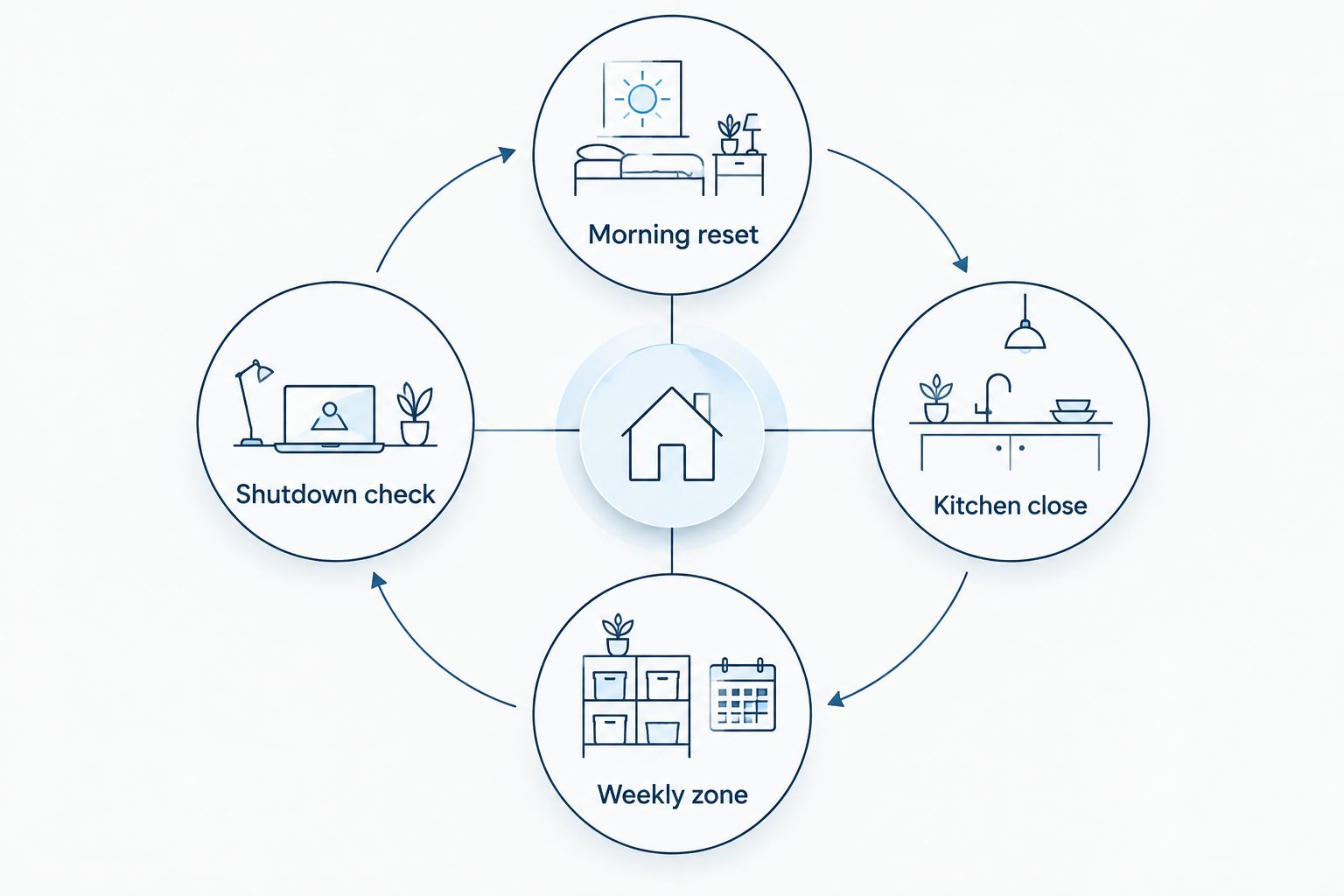
Keep the weekly zone narrow. Cleaning a bathroom is a defined job; reorganizing every bathroom cabinet while cleaning is a separate project. If the scheduled block ends before the job is complete, record the remaining work and give it another slot.
Daily reset plus weekly zones pros:
- Gives everyday clutter an assigned home in your schedule.
- Separates short resets from more involved cleaning.
- Makes unfinished work visible without demanding immediate action.
Daily reset plus weekly zones cons:
- Still leaves the household cleaning work with you.
- Needs adjustment when the home's condition exceeds the planned scope.
Verdict: Buy — adopt this routine first if your workweek is predictable.
2. Recurring professional cleaning: best for meeting-heavy schedules
Recurring professional cleaning separates household cleaning from your work responsibilities. You handle personal items and immediate messes while a cleaning team handles the tasks included in your agreed service.
Tampatopshelf residential cleaning is best for St. Petersburg and Pinellas County homeowners who want to delegate recurring household cleaning. The team is local, licensed and insured, and reachable by phone or text.
Best for: You want to stop assigning your own work breaks to household cleaning.
Before setting a recurring cleaning schedule in 2026, identify the rooms you need cleaned and the workspaces that need restricted access. Explain whether you take calls behind a closed office door, use a shared dining table, or need a clear route through the home during appointments.
Separate cleaning scope from workday access
Agree on these details before the appointment:
- Room access: Identify the office, shared rooms, and any areas that should remain untouched.
- Call boundaries: Discuss meetings and noise-sensitive work; confirm arrangements rather than assuming quiet service.
- Personal items: Put away confidential papers, medication, and objects that need special handling.
- Cleaning priorities: Describe the bathrooms, kitchen, floors, and other areas you want included in the quote.
Ask whether an initial deep clean fits the property's current condition before choosing recurring maintenance. Moving into a home also calls for a different scope discussion from maintaining an occupied home office.
Recurring professional cleaning pros:
- Delegates the cleaning tasks included in the service agreement.
- Gives you a defined opportunity to discuss room priorities.
- Keeps personal organizing separate from professional cleaning.
Recurring professional cleaning cons:
- Does not replace putting away your belongings or handling new spills.
- Requires coordination around access, calls, pets, and household routines.
Verdict: Buy — choose recurring cleaning when delegation is the priority, and confirm the scope before booking.
3. Task queue: best for unpredictable workdays
A task queue replaces a fixed daily cleaning calendar with a short, visible list. You select a task only when you have an intentional opening, then stop at the boundary you set.
Best for: Your appointments, deadlines, or working hours change throughout the week.
For a flexible 2026 routine, divide the list by attention required rather than by room alone. Clearing a desk before a call is different from starting a floor-cleaning task that blocks the room you need next.
Try these suggested planning limits:
- Quick reset: Allow 5 minutes for clearing dishes or putting away loose office items.
- Focused task: Reserve 15 minutes for a narrowly defined job, such as dusting accessible office surfaces.
- Scheduled project: Put involved cleaning on the calendar instead of treating it as something to squeeze between calls.
These are optional timeboxes, not cleaning-duration estimates. Adjust the scope to your space and stop when the planned break ends.
Give every larger task a date. Otherwise, the queue becomes a collection of easy jobs while the bathroom and floors remain on the list. Check it at the end of the week and schedule the task you have repeatedly avoided.
Task queue pros:
- Adapts to workdays that do not follow a consistent pattern.
- Lets you choose a task with a clear stopping point.
- Keeps cleaning reminders outside your working memory.
Task queue cons:
- Makes postponing larger jobs easy.
- Requires a regular review to prevent the list from growing indefinitely.
Verdict: Buy — use a task queue for variable hours, but give larger jobs calendar space.
4. Shared-zone roster: best for households with multiple remote workers
A shared-zone roster assigns responsibility for rooms and shared surfaces. Each person knows which cleaning tasks they own and when those tasks should be completed.
Best for: Multiple adults work at home, and shared spaces keep becoming somebody else's unfinished job.
Start your 2026 roster with areas that affect everyone: the kitchen, shared bathroom, entryway, and living space. Keep personal desks separate unless the household explicitly agrees otherwise.
Define the finished result. “Handle the kitchen” leaves room for disagreement; “wash the dishes, clear food debris, and wipe the counter using a surface-appropriate product” describes an observable task. Decide who replaces supplies as well as who uses them.
Work around both people's calls. One person's lunch break is not automatic permission to vacuum beside another person's meeting. If schedules conflict, move the cleaning task rather than expecting the person working to relocate without notice.
Shared-zone roster pros:
- Makes ownership of shared rooms explicit.
- Separates personal clutter from household responsibilities.
- Gives everyone a place to raise scheduling conflicts.
Shared-zone roster cons:
- Requires agreement on what “finished” means.
- Breaks down when one person repeatedly takes over uncompleted tasks.
Verdict: Buy — choose shared ownership when unclear responsibility is the main problem.
How these routines rank
The ranking follows work boundaries, scope clarity, catch-up rules, household fit, and delegation. It compares scheduling approaches—not measured cleaning performance or customer results.
Daily resets plus weekly zones rank first because the approach gives both immediate mess and scheduled cleaning a place. Professional cleaning ranks first for delegation, the task queue for variable hours, and the shared-zone roster for divided household responsibilities.
Which cleaning routine should you choose?
Start with daily resets plus weekly zones unless your main problem is delegation or shared responsibility. Keep the daily part limited to the mess you create, then put actual room cleaning outside focused work hours.
For a meeting-heavy 2026 calendar, discuss recurring residential cleaning with Tampatopshelf. Explain your property's condition, the rooms that matter most, and your office-access needs so the quote reflects your home rather than a generic checklist.
Whichever approach you choose, keep cleaning products away from work equipment and follow the product and equipment manufacturers' instructions. Do not spray cleaner directly onto electronics or mix cleaning products.
FAQ
What's the best cleaning routine for work from home professionals?
Daily resets plus weekly zones are the best default cleaning routine for work from home professionals with predictable hours. Handle immediate mess during planned breaks and schedule room cleaning outside focused work.
Should I clean my home during work breaks?
Use work breaks only for cleaning tasks with a clear stopping point. Save involved bathroom, floor, and deep-cleaning work for a scheduled block or an agreed professional service.
Can I work from home while cleaners are there?
Discuss working from home before the cleaning appointment. Confirm office access, meeting boundaries, and room priorities rather than assuming the service will be quiet or avoid your workspace.
Is recurring cleaning better than doing everything myself?
Recurring cleaning is the better fit when your goal is to delegate agreed household cleaning tasks. You still need to manage personal belongings and immediate messes between appointments.
How do I keep a shared home office clean?
Assign ownership of shared surfaces and agree on a finished standard. Keep personal desks separate unless everyone agrees to include them in the household routine.
Do I need a deep clean before starting a routine?
Discuss an initial deep clean if the property's current condition needs more work than routine maintenance covers. Describe the buildup and priority areas before agreeing on service scope.
How do I arrange residential cleaning in St. Petersburg?
Request a property-specific quote from Tampatopshelf by phone or text. Describe your home, cleaning priorities, and work-from-home schedule so you can discuss suitable service arrangements.
One last thing
Your desk is not automatically part of a whole-home cleaning plan. Papers, cables, monitors, and confidential material need explicit handling instructions, whether you clean yourself, share chores, or hire help.
Write down what should stay untouched before the next cleaning session. That small boundary matters more than adding another task to the checklist.
Related guides
- Best cleaning schedules for recurring residential cleaning
- Do I need to be home during a house cleaning appointment?
- How do I prepare my home before the cleaners arrive?
Ready to delegate household cleaning? Request a free quote by phone or text and explain your property, priorities, and work schedule.


